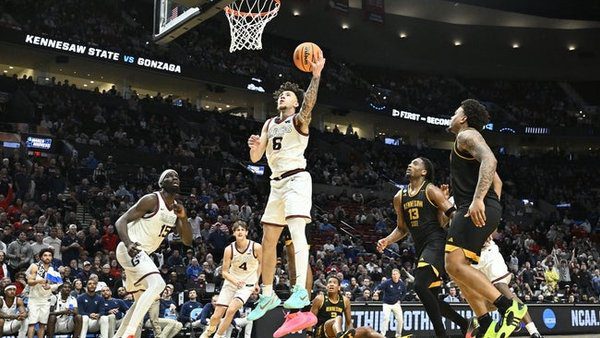
Bash is backing the Zags’ suffocating defense to exploit a Texas team that’s been bleeding points all season long, but he’s wary of the 11-seed’s free-throw rate advantage in a grind-it-out March setting.
The Line and the Thesis
No. 3 seed Gonzaga is laying 5.5 points against No. 11 seed Texas in the NCAA Tournament’s Round of 32 at the Moda Center, and the market is telling you exactly what it thinks about these two teams. The Bulldogs sit at #12 in KenPom’s adjusted efficiency rankings with a +30.4 net rating, while the Longhorns check in at #34 with a +17.1 mark. That’s a 13.3-point gap in adjusted efficiency—and yet we’re only getting 5.5 on a neutral floor. When you dig into the collegebasketballdata.com numbers, this is a classic March matchup where elite defense meets a team that can absolutely get to the free-throw line. This is a tournament situational spot where bubble motivation meets bracket reality: Texas already punched their ticket with upset wins over BYU and NC State, while Gonzaga is trying to validate their 31-3 season and avoid becoming another March casualty.
The Zags’ adjusted defensive efficiency ranks #5 nationally at 91.6, while Texas sits at a pedestrian #107 at 105.9. That’s not a small gap—that’s the difference between an elite shutdown unit and a team that’s allowed 76.3 points per game all season. But here’s the wrinkle: Texas ranks #3 nationally in free-throw rate at 45.659%, and in a tournament setting where possessions shrink and whistles tighten, that matters.
Why the Market Landed Here
Gonzaga’s resume is legitimately impressive: 31-3 overall, #10 in RPI, 8-2 in Quadrant 1 games. The Bulldogs’ strength of schedule sits at 90, and their non-conference RPI of 20 shows they didn’t just beat up on the WCC—they handled business in November and December. Texas, meanwhile, is #78 in RPI with a 7-9 Q1 record, and their strength of schedule at 59 is actually stronger than Gonzaga’s. That SEC grind matters, even if the results were ugly at times.
The pace here projects to 68.3 possessions—right in the middle of both teams’ season averages. Gonzaga runs at 69.4 (64th nationally), Texas at 67.3 (162nd). Neither team is forcing tempo extremes, which means this game will be won in the halfcourt. The Zags’ adjusted offensive efficiency sits at 122.0 (#30), while Texas checks in at 123.0 (#21). That’s essentially a wash, which is why this spread isn’t 9 or 10.
The total of 146.5 feels low given both teams’ offensive ratings, but the model projects 151.2—a 4.7-point overlay. Gonzaga’s defense is the story here. They’ve allowed just 65.9 points per game (#17 nationally) and hold opponents to 39.4% from the field (#11) and 30.5% from three (#24). Texas has been a sieve all season, allowing 76.3 per game and ranking #247 in defensive efficiency. When you’re giving up 44.7% from the field and 35.5% from three in conference play, you’re not built to slow down tournament-caliber offenses.
Bubble Motivation vs. Validation Stakes
Texas is playing with house money at this point. They were 20-14 overall and 9-9 in SEC play, and their RPI of 78 had them squarely on the bubble before they won two games in the First Round. The Longhorns are 18-15 against the spread this season, but they’ve been atrocious at home ATS (9-11) while going 9-4 on the road. That road warrior mentality showed up in their last two games—wins at BYU and NC State as underdogs.
Gonzaga, on the other hand, is trying to prove they belong in the Final Four conversation. At 31-3 with a #9 net efficiency ranking, the Bulldogs have the metrics of a legitimate contender. But they’re also dealing with a significant injury: Braden Huff (17.0 PPG, 5.0 RPG) is out with a knee injury, and there’s no timetable for his return. Huff is their leading scorer and a critical piece of their frontcourt rotation. Without him, Gonzaga leans even more heavily on Graham Ike (16.4 PPG, 8.1 RPG) and Tyon Grant-Foster (12.0 PPG, 5.9 RPG).
I like what Texas has shown in terms of resilience, but this is a team that went 5-5 in their last 10 games and lost to Arkansas by 20 just three weeks ago. Their turnover margin is mediocre (11.0 per game, #136 nationally), and they don’t force turnovers on defense (5.8 steals per game, #279). Gonzaga, meanwhile, forces 8.5 steals per game (#29) and has a turnover ratio of 0.1 (#11). That’s a massive edge in a tournament setting where possessions are gold.
The Matchup Contrast
The key contrast here is Gonzaga’s defensive dominance versus Texas’s ability to get to the line. The Bulldogs allow just 31.3 opponent free-throw rate (#88), which is respectable but not elite. Texas ranks #3 nationally in free-throw rate at 45.659%, and that’s their best path to staying in this game. If the Longhorns can draw fouls on Ike and Grant-Foster, they can shorten the game and keep it close.
But here’s the problem: Texas shoots just 74.6% from the free-throw line (#92), while Gonzaga is at 70.5% (#253). Neither team is elite at the stripe, which means those possessions might not be as valuable as the raw rate suggests. And when you factor in Gonzaga’s 56.9% assist rate (compared to Texas’s 43.2%), the Bulldogs are simply better at creating quality looks in the halfcourt.
Texas’s best player in this matchup is Matas Vokietaitis (15.9 PPG, 6.6 RPG), but he’s facing a Gonzaga frontcourt that ranks #19 in defensive rebounding percentage at 25.9%. The Longhorns’ Dailyn Swain (15.7 PPG, 6.9 RPG) and Jordan Pope (12.5 PPG) will need to carry the perimeter scoring load, but Gonzaga’s defense has been stingy against the three all season. The Zags’ opponent three-point percentage of 30.5% is #24 nationally, and Texas is just #98 in three-point shooting at 35.4%.
Resume and Style Clash Breakdown
| Metric | Texas | Gonzaga |
|---|---|---|
| KenPom Rank | #34 | #12 |
| RPI Rank | #78 | #10 |
| Strength of Schedule | 59 | 90 |
| Q1 Record | 7-9 | 8-2 |
| Adj. Net Rating | +17.1 (#43) | +30.4 (#9) |
| Adj. Defensive Efficiency | 105.9 (#107) | 91.6 (#5) |
The style clash here is clear: Gonzaga wants to control tempo at 68-69 possessions and suffocate Texas in the halfcourt. The Bulldogs’ effective field goal percentage of 55.8% (#30) is elite, and their turnover rate of 13.7% (#17) means they don’t beat themselves. Texas, on the other hand, needs to push pace and get to the line. But at 67.3 possessions per game, they’re not built to run, and their offensive rebounding percentage of 32.2% (#119) is mediocre at best.
The Quadrant 1 records tell the story of who’s been battle-tested. Gonzaga is 8-2 in Q1 games, with wins over quality opponents in their non-conference slate. Texas is 7-9 in Q1, and while they’ve played a tougher schedule, they’ve lost more often than they’ve won. In a tournament setting where experience and execution matter, I trust the team that’s been here before.
The Pick
I’m laying the 5.5 with Gonzaga, but I’m doing it with caution. The model projects a 4.5-point margin, which means we’re getting a half-point of value on the market number. The Zags’ defensive efficiency is the elite unit in this matchup, and Texas’s inability to defend or force turnovers is a fatal flaw against a disciplined tournament team. The loss of Braden Huff hurts, but Gonzaga has enough depth with Ike and Grant-Foster to absorb it.
The primary risk here is Texas’s free-throw rate. If the Longhorns can get to the line 25-30 times, they can keep this within a possession or two. But I’m betting on Gonzaga’s experience, their Q1 resume, and their suffocating defense to close this out in the final five minutes. The Zags are 18-15-1 ATS this season, and while that’s not dominant, they’ve covered in their last two tournament games. Texas is 18-15 ATS but just 9-11 at home and 7-3 on the road—this neutral-site setting favors the more disciplined team.
BASH’S BEST BET: Gonzaga -5.5 for 2 units. The defensive gap is too wide, and Texas doesn’t have the firepower to keep pace in a halfcourt grind. I expect a final score in the 74-68 range, with the Zags pulling away late after Texas exhausts their free-throw opportunities.