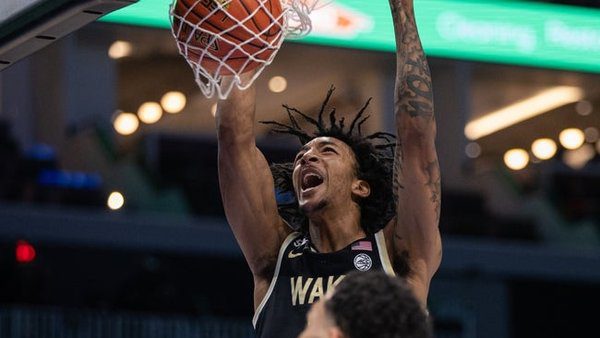
Bash is ignoring the ACC brand name and backing the Missouri Valley defense in a NIT first-round matchup where the model sees Wake Forest overpriced by nearly four points.
The Line and the Thesis
Wake Forest is laying 7.5 points at home against Illinois State in Sunday’s NIT first-round matchup at LJVM Coliseum, and I’m already seeing the narrative take shape. ACC program, home court, Juke Harris dropping 20.7 PPG. But when you dig into the collegebasketballdata.com numbers, this spread doesn’t hold up. The Demon Deacons check in at #75 in KenPom with a +13.6 adjusted net rating, while the Redbirds sit at #103 with a +9.2 mark. That’s a 4.4-point efficiency gap, and Wake is getting 7.5. My model projects Wake by just 3.7 points including home court, which means we’re looking at nearly four points of value on Illinois State in a single-elimination NIT spot where motivation cuts both ways.
This qualifies as a mid-major metric gap versus Power 5 public perception play. The market is pricing Wake Forest’s ACC pedigree over what the numbers actually say about these two teams.
The Injury Situation
Wake Forest is dealing with a significant absence in the backcourt. Guard Nate Calmese, who averaged 8.1 PPG and ranked #28 nationally with 5.9 APG, has been shut down for the remainder of the season with an undisclosed injury. That’s your primary facilitator gone, and while Juke Harris has shouldered the scoring load, losing 5.9 assists per game doesn’t get replaced quietly. Forward Marqus Marion is also listed as questionable with an undisclosed injury, though he’s not among Wake’s top statistical contributors.
Illinois State has no significant injuries reported, which matters in a tournament setting where depth and continuity become magnified.
Why the Market Landed Here
The market is giving Wake Forest 7.5 points at home, and I understand the logic. The Demon Deacons posted a 14-6 home record and went 5-0 at LJVM Coliseum over their last ten games. They’ve got the offensive firepower at #66 in adjusted offense (117.6 rating) compared to Illinois State’s #133 ranking (111.3). Wake also played a significantly tougher schedule, checking in at #19 in strength of schedule per Warren Nolan compared to Illinois State’s #132.
But here’s what the market is missing: Illinois State brings elite-level defense to Winston-Salem. The Redbirds rank #61 in adjusted defensive efficiency (102.1), while Wake Forest sits at #83 (104.0). When you match Wake’s offense against Illinois State’s defense, you get a projected 109.8 points per 100 possessions. That’s good, but it’s not blowout territory. And when Illinois State has the ball against Wake’s mediocre defense, they’re projecting at 107.7 per 100. This isn’t a mismatch—it’s a grind-it-out NIT game between teams separated by 28 spots in KenPom, not 70.
The total sitting at 149.5 also feels inflated. My model projects 145.9 points in a game with a 67.1-possession pace blend. Neither team cracks the top 140 nationally in tempo, and Illinois State’s defensive rating of 101.6 (allowing just 68.1 PPG, #40 nationally) suggests they’ll make Wake Forest work for everything.
The Redbirds’ Defensive Identity
Illinois State’s calling card is defense, and the numbers back it up. They rank #11 nationally in defensive rebounding percentage (25.1% per KenPom’s four factors), which means second-chance points—where Wake Forest holds a 3.6-point offensive rebounding edge—won’t come easy. The Redbirds force opponents into a 43.3% field goal percentage (#116) and hold teams to 32.4% from three (#99). Wake Forest shoots just 34.2% from deep (#169 nationally), so the Demon Deacons aren’t built to exploit a defensive weakness that doesn’t exist.
I also like Illinois State’s bubble motivation angle here. This is a Missouri Valley program that went 12-9 in conference play and finished 21-12 overall. They didn’t make the NCAA Tournament, but they earned an NIT bid and have something to prove. Ryan Pedon’s squad ranks #13 nationally in continuity per KenPom (0.5378), meaning this roster has played together and knows its identity. That matters in March, even if it’s the NIT.
The Matchup Contrast
Wake Forest’s offense is predicated on Juke Harris (20.7 PPG, #22 nationally) and a supporting cast that includes Tre’Von Spillers (14.2 PPG, 6.0 RPG). But the Demon Deacons rank just #208 in defensive effective field goal percentage allowed (51.8%), and Illinois State has enough balanced scoring—Johnny Kinziger and Ty’Reek Coleman both average 13.0 PPG—to exploit that weakness. Chase Walker adds 11.4 PPG and 5.4 RPG, giving the Redbirds a versatile forward who can create mismatches.
From a resume perspective, Wake Forest’s 1-10 record in Quadrant 1 games tells you they struggled against elite competition. Illinois State went 0-2 in Q1 but posted a 4-4 mark in Quadrant 2, showing they can compete in quality matchups. The Redbirds’ RPI sits at #88 with a strength of schedule ranked #132, while Wake checks in at #77 RPI with a #19 SOS. That SOS gap is real, but it also means Illinois State didn’t get the same battle-tested opportunities. This is a chance to prove they belong.
Model Breakdown and Style Clash
| Metric | Illinois State | Wake Forest |
|---|---|---|
| KenPom Rank | #103 | #75 |
| RPI / NET | #88 RPI | #77 RPI |
| Strength of Schedule | #132 | #19 |
| Quadrant 1 Record | 0-2 | 1-10 |
| Adj. Offensive Efficiency | 111.3 (#133) | 117.6 (#66) |
| Adj. Defensive Efficiency | 102.1 (#61) | 104.0 (#83) |
| Adj. Net Rating | +9.2 (#89) | +13.6 (#61) |
The pace blend projects at 67.1 possessions, which favors Illinois State’s defensive structure. Wake Forest wants to push tempo slightly (68.2 adjusted tempo, #136) compared to Illinois State’s 66.7 (#221), but the Redbirds control possessions through defensive rebounding and limiting turnovers. Both teams post identical turnover ratios (0.2), so neither has an edge forcing mistakes.
Wake Forest’s free throw rate (35.1%, #174) gives them a slight advantage over Illinois State’s 31.7% (#262), but the Redbirds shoot a respectable 70.2% from the line. In a close NIT game, that gap matters less than Wake’s inability to defend consistently. The Demon Deacons allow 53.9% on two-point attempts per KenPom, which ranks outside the top 200 nationally. Illinois State shoots 54.5% on twos, so the paint will be there.
The Bet
BASH’S BEST BET: Illinois State +7.5 for 2 units.
The model sees 3.8 points of value here, and I’m trusting the defense. Illinois State’s #61 adjusted defensive efficiency is legit, and Wake Forest’s offense isn’t explosive enough to blow past that number at home. The Demon Deacons went 9-11 ATS at LJVM Coliseum this season, and their 16-18 overall ATS record suggests the market has consistently overvalued them. Illinois State went 17-14-1 ATS, including 10-4-1 at home, showing they cover when respected.
The primary risk is Juke Harris going nuclear and Wake’s home crowd providing juice in a single-elimination NIT game. But Harris is one player, and Illinois State’s defensive rebounding and rim protection will limit his second-chance opportunities. I’ll take the points with the Missouri Valley defense and the team that’s been undervalued all season.