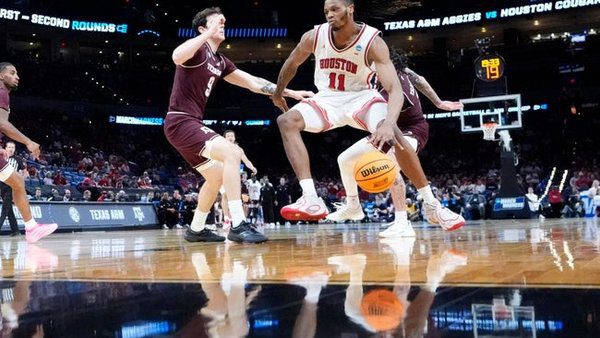
Bash sees a coin-flip matchup in the Sweet 16 where the market’s giving Houston home-court equity on a neutral floor. The adjusted efficiency gap is razor-thin, and Illinois’s #1 offensive rating against a top-five defense sets up a grind-it-out Sweet 16 survivor showdown.
The Line and the Ledger
No. 2 seed Houston is laying 3.5 points against No. 3 seed Illinois in an NCAA Elite Eight matchup at Toyota Center on Thursday night, and the market’s treating this like the Cougars have home-court advantage. They don’t. This is a neutral-site game, and when you dig into the collegebasketballdata.com numbers, the efficiency gap between these two teams is 1.5 points of net rating. That’s not a 3.5-point spread. That’s a pick’em with some brand-name equity baked in.
Illinois checks in at #6 in KenPom with a 33.27 adjusted efficiency margin. Houston’s #4 at 34.44. The Illini are 26-8 with the #1 adjusted offensive efficiency in the country at 133.9. The Cougars are 30-6 with the #3 adjusted defensive efficiency at 89.3. This is an Elite Eight game that pits the best offense against one of the best defenses, and the market’s asking you to lay nearly four points with the defense. I’m not doing it.
Why Houston -3.5 Exists
The market landed here because Houston’s resume screams “battle-tested.” The Cougars are #5 in RPI with a 7-6 record in Quadrant 1 games and a perfect 7-0 mark in Quadrant 2 contests. They’ve been in the trenches all season in the Big 12, and Kelvin Sampson’s defensive system is built for March. Houston’s forcing turnovers at a 20.7% clip (14th nationally), and they’re holding opponents to a 46.0% effective field goal percentage (11th). That’s elite.
Illinois, meanwhile, is #18 in RPI with a 7-7 record in Quadrant 1 games. The Illini are more top-heavy in the Big Ten, but their strength of schedule (#13) is actually stronger than Houston’s (#18). The difference here is perception. Houston’s been a Top-5 team all season. Illinois has been lurking in the teens. The market’s giving the Cougars credit for their defensive identity and their ability to win ugly. Fair enough. But 3.5 points on a neutral floor against the nation’s most efficient offense? That’s too much.
Illinois’s Offensive Edge
Brad Underwood’s Illini are scoring 132.0 points per 100 possessions (2nd nationally) with a true shooting percentage of 59.5% (33rd). They don’t turn the ball over—8.8 turnovers per game ranks 5th nationally, and their 13.1% turnover rate is 9th. They’re rebounding at an elite level (41.0 rebounds per game, 10th nationally), and they’re shooting 78.4% from the free-throw line (11th). This is a team that takes care of the basketball, crashes the glass, and converts at the stripe. Those are the three pillars of tournament offense, and Illinois checks every box.
Kylan Boswell (17.0 PPG) and Andrej Stojakovic (14.9 PPG) give the Illini two perimeter scoring threats who can operate in the halfcourt. David Mirkovic (13.8 PPG, 9.6 RPG) is a legitimate double-double threat in the frontcourt, and Tomislav Ivisic (11.7 PPG, 5.2 RPG) provides size and rim protection. Illinois has the personnel to attack Houston’s defense in multiple ways, and their 39.2% offensive rebounding rate (3rd in KenPom’s four factors) means they’re getting second-chance opportunities even when the initial shot doesn’t fall.
Houston’s Defensive Identity vs. Illinois’s Tempo
Houston’s defensive rating of 95.8 (5th nationally) is built on discipline and length. Emanuel Sharp (17.6 PPG) and Kingston Flemings (15.9 PPG, 5.0 APG) anchor the perimeter, while Chris Cenac Jr. (9.7 PPG, 8.0 RPG) patrols the paint. The Cougars are forcing 20.7% of possessions into turnovers, and they’re converting those mistakes into 624 points off turnovers this season. That’s their formula: disrupt, transition, and capitalize.
But Illinois doesn’t turn the ball over. The Illini’s 13.1% turnover rate is 9th nationally, and they’re playing at a 61.5 pace (359th). This is a slow, methodical offense that values every possession. Houston’s going to struggle to generate the chaos they need to fuel their transition game. The projected pace blend for this matchup is 63.0 possessions, which favors Illinois’s halfcourt execution over Houston’s defensive pressure. The Cougars’ 7-6 Quadrant 1 record tells you they can win these games, but they’re not blowing teams out in these spots. They’re grinding. And in a grind, the team with the better offense has the edge.
The Metrics Table
| Team | KenPom Rank | RPI | Strength of Schedule | Q1 Record | Adj. Off Efficiency | Adj. Def Efficiency |
|---|---|---|---|---|---|---|
| Illinois | #6 | #18 | #13 | 7-7 | 133.9 (#1) | 97.6 (#23) |
| Houston | #4 | #5 | #18 | 7-6 | 124.1 (#21) | 89.3 (#3) |
The style clash here is clear: Illinois’s #1 offensive efficiency against Houston’s #3 defensive efficiency. The model projects Illinois to score 111.6 points per 100 possessions in this matchup, which translates to 70.2 points in a 63-possession game. Houston’s projected to score 110.8 points per 100 possessions, or 69.8 points. That’s a half-point edge for Illinois in a neutral-site Sweet 16 game. The market’s asking you to lay 3.5 with Houston. The math doesn’t support it.
Bash’s Best Bet
BASH’S BEST BET: Illinois +3.5 for 2 units.
I’m taking the points with the better offense in a game that’s projected to be decided by half a point. Illinois has the #1 adjusted offensive efficiency in the country, they don’t turn the ball over, and they’re playing at a pace that neutralizes Houston’s transition game. The Cougars are a tremendous defensive team, but this spread is giving them credit for home-court advantage they don’t have. This is a neutral-site Sweet 16 game, and the Illini have the offensive firepower to keep this within a possession. The risk here is that Houston’s defense forces Illinois into contested shots late and the Cougars pull away in the final four minutes. But at 3.5, I’ll take that risk. Give me Illinois and the points in a game that should come down to the final possession.