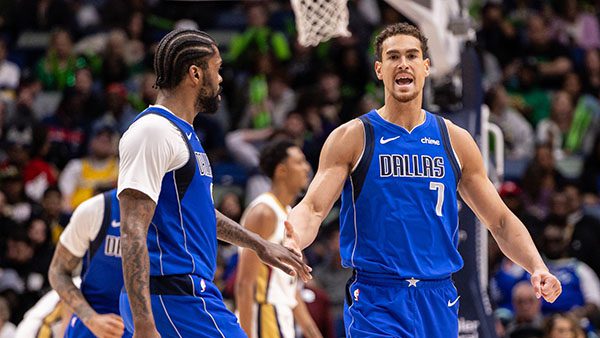
Bash sees a double-digit spread that’s pricing in a blowout the metrics don’t fully support, and he’s finding value on the wrong side of the talent ledger in Denver.
The Setup: Dallas Mavericks at Denver Nuggets
Denver sits as a 13.5-point home favorite Wednesday night against a Dallas team that’s limping through a rebuild, and at first glance, that number feels about right. The Nuggets are 45-28 and fighting for playoff seeding. The Mavericks are 23-49 and playing out the string without Kyrie Irving. Jokic just dropped a 23-17-17 triple-double in Phoenix. Cooper Flagg is learning on the job in Dallas. This should be a mismatch.
But here’s the thing—the projection for this game sits at Denver by 6.7 points, which means we’re looking at nearly seven points of air between what the market is asking and what the efficiency profile suggests. That’s a gap worth investigating. The Mavericks are bad, sure, but they’re not 13.5-points-on-the-road bad when you dig into the possession math. This is a number that’s pricing in narrative more than numbers, and that’s where we start hunting.
Game Info & Betting Lines
When: Wednesday, March 25, 2026, 10:00 PM ET
Where: Ball Arena
Watch: Altitude Sports (home), KFAA-TV, Mavs.com, NBA League Pass (away)
Spread: Denver Nuggets -13.5 (-110)
Total: 245.0 (Over/Under -110)
Moneyline: Nuggets -769 | Mavericks +506
Why This Line Exists
The market is looking at a 22-game gap in the win column and doing the obvious math. Denver’s got Jokic averaging a triple-double, Jamal Murray putting up 25 a night, and a top-four seed in the West to protect. Dallas is down Kyrie Irving for the season, lost Dereck Lively II to foot surgery, and just dropped their 12th straight home game—their longest skid in 32 years. The optics scream blowout.
But spreads aren’t built on records alone—they’re built on efficiency, and that’s where this number gets interesting. Denver’s net rating sits at +4.4 per 100 possessions. Dallas checks in at -5.0. That’s a 9.4-point gap in season-long efficiency, which is real separation. But when you account for the expected pace blend of 100.8 possessions and the actual offensive-defensive matchups, the math points to a tighter margin than 13.5 suggests. Denver’s offensive rating of 120.3 against Dallas’s 115.0 defensive rating creates a 5.3-point mismatch. Going the other way, Dallas’s 110.1 offensive rating against Denver’s 115.9 defense yields a -5.8 mismatch. Those gaps are medium-sized, not massive, and they don’t support a double-digit demolition when you run them through a possession lens.
The total at 245.0 is another story entirely. With a projected total of 232.6, we’re looking at a 12.4-point cushion baked into that over/under. The pace blend sits around 101 possessions, which is decent tempo but nothing explosive, and both teams trend toward the under in efficiency-based projections. That total feels inflated by recent scoring outputs rather than structural pace realities.
Dallas Mavericks Breakdown
The Mavericks are running out a rotation that’s part development project, part veteran scrap heap. Cooper Flagg leads the way at 20.3 points per game on 47.2% shooting, and he’s showing flashes of the two-way upside that made him the top pick. Naji Marshall has been a pleasant surprise at 15.3 points on 51.9% shooting, and P.J. Washington continues to provide steady two-way minutes at 14.2 and 6.9 boards.
The problem isn’t effort—it’s depth and execution. Brandon Williams is questionable with a concussion, which thins out an already shaky backcourt. Daniel Gafford is also questionable with a shoulder sprain after exiting Monday’s overtime loss to Golden State, which leaves Dallas dangerously thin in the paint behind Dwight Powell and Marvin Bagley. The Mavericks turn it over 15 times a game and shoot just 34.5% from three, which limits their ability to stay in games when the pace slows down.
But here’s what Dallas does have: a 110.1 offensive rating that’s not terrible, a true shooting percentage of 56.7% that’s respectable, and a clutch record of 15-26 that shows they’ve been in games late. They’re not getting blown out every night. They’re losing close, and that matters when you’re catching 13.5.
Denver Nuggets Breakdown
Denver is healthy, clicking, and playing with purpose. Nikola Jokic is putting together another MVP-caliber season at 27.9 points, 12.7 rebounds, and 10.7 assists per game. He’s shooting 57.3% from the field and 38.3% from three, which is borderline absurd for a big man. Jamal Murray is back to full strength at 25.0 points and 7.1 assists, and the two-man game between them remains one of the most efficient actions in basketball.
Aaron Gordon provides the defensive versatility and transition finishing at 16.6 points and 5.9 boards, while Tim Hardaway Jr. has been a solid bench scorer at 13.8 points on 40.8% from deep. Peyton Watson is out for this game as part of a back-to-back rest plan, but his absence doesn’t crater the rotation—Denver’s got enough shooting and playmaking to compensate.
The Nuggets rank fourth in the West at 45-28, and they’re 21-13 at Ball Arena. Their offensive rating of 120.3 leads the league in efficiency, and their 61.4% true shooting percentage is elite. The issue, if there is one, is that their defensive rating sits at 115.9, which is middle-of-the-pack. They win by outscoring you, not by locking you down, and that style tends to keep games closer than the talent gap suggests.
The Matchup
This is a pace and execution game. Denver wants to push tempo, get Jokic operating in space, and force Dallas into rotations where the Mavericks’ lack of rim protection gets exposed. Dallas wants to slow it down, limit transition opportunities, and keep the game in the half-court where Flagg and Marshall can hunt mismatches.
The shooting efficiency gap is real—Denver’s 4.7-point edge in true shooting percentage and 4.3-point edge in effective field goal percentage are strong indicators of offensive quality. But Dallas has shown the ability to hang around when the pace stays controlled. The Mavericks’ turnover rate is higher by 1.3 percentage points, which gives Denver a small edge in ball security, but it’s not a massive gap that screams runaway margin.
The rebounding battle is basically even, with Denver holding just a 1.3-point edge in rebounding differential. The offensive glass is within noise at a 0.2-point gap, so there’s no second-chance domination to lean on here. What this game likely comes down to is whether Denver can force turnovers and get out in transition, or whether Dallas can muck it up and keep possessions in the 90s. If it’s the latter, 13.5 is a big number to cover against a team that’s been competitive in clutch situations.
Denver’s clutch record sits at 19-19, which is .500 ball in tight games, and their clutch plus-minus is -1.0. Dallas is 15-26 in clutch situations with a -0.8 plus-minus. Neither team has been dominant late, which suggests this game has a chance to stay within striking distance deeper than the spread implies.
Bash’s Best Bet & The Play
I’m taking Dallas Mavericks +13.5. This is a pure margin play—my model projects Denver by 6.7 points, and the market is asking me to lay nearly double that. The efficiency gap is real, but it’s not 13.5-points-on-a-neutral-floor real, and it’s certainly not 13.5-with-home-court real when you account for the pace and turnover profiles.
Dallas has been in games late all season, and their clutch record shows they’re not folding when it gets tight. Denver’s been great, but they’re not a team that consistently blows people out—their net rating is +4.4, not +12. This spread is pricing in a blowout that the possession math doesn’t support, and I’ll take the points with the dog in a game where the talent gap doesn’t match the number.
The risk here is obvious—Denver’s got the best player on the floor, the better roster, and home court. If Jokic gets rolling early and Dallas can’t score in the half-court, this could get ugly. But I’m betting on the efficiency profile, the pace blend, and the idea that 13.5 is just too many points to give a team that’s been competitive in close games all year. Lay the points at your own risk. I’m taking the value with Dallas.