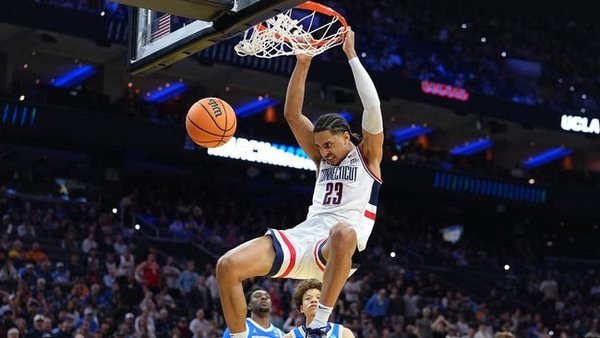
Bash sees a coin-flip Sweet 16 battle where the market’s slight lean toward UConn ignores Michigan State’s superior defensive metrics and Tom Izzo’s tournament pedigree in neutral-site elimination games.
The Line and the Ledger
No. 2 seed UConn is laying 1.5 points against No. 3 seed Michigan State in a Friday night Sweet 16 showdown at Capital One Arena, and the market is essentially calling this a pick’em. The total sits at 135.5, and when you dig into the collegebasketballdata.com numbers, you understand why this spread is razor-thin. These are two of the eleven best teams in the country by adjusted net rating—Michigan State at #10 (AdjNet +29.8) and UConn at #11 (+29.1). The gap between them is seven-tenths of a point. This is a classic NCAA Tournament Sweet 16 matchup where the seed differential means almost nothing and the efficiency metrics tell you everything.
We’re looking at a neutral-site elimination game at 9:45 PM ET between two programs built on defensive identity. Michigan State ranks #10 in adjusted defensive efficiency (93.2), while UConn checks in at #12 (94.0). Both teams play slow—the Spartans rank #242 in tempo (65.5 possessions), UConn even slower at #343 (62.6). The projected possession count is 64, and the model projects a total of 138.8 with Michigan State favored by 0.2 points. The market disagrees slightly, giving UConn the nod.
Why the Market Landed Here
The 1.5-point spread reflects what happens when two top-12 adjusted efficiency teams meet on a neutral floor with nearly identical profiles. UConn’s offensive rating of 123.1 (#27 in adjusted offense) barely edges Michigan State’s 123.0 (#29). The Huskies shoot 55.3% effective field goal percentage (#36 nationally) compared to the Spartans’ 54.1% (#80), giving them a slight shooting quality advantage. That 1.2-percentage-point gap in eFG% is real, and it matters in a game projected for 64 possessions.
But here’s the counter: Michigan State’s defense is legitimately better. The Spartans hold opponents to 41.1% field goal percentage (#35 nationally) and 32.7% from three (#121). UConn allows 40.2% overall (#19) and 30.7% from three (#33)—superior perimeter defense. The Huskies also block 5.1 shots per game (#13) compared to Michigan State’s 4.2 (#66), which matters when you’re defending the rim in a halfcourt grind.
The Warren Nolan resume data adds context. Michigan State sits at RPI #7 with a 6-6 Quadrant 1 record and a strength of schedule ranked #11. UConn doesn’t have RPI data listed, but the Spartans’ battle-tested Big Ten slate (15-5 in conference) includes six Q1 wins. They’ve been here before, and Tom Izzo’s tournament pedigree in neutral-site games is well-documented. The market is giving UConn a small edge, likely because of their #7 AP ranking versus Michigan State’s #11, but the efficiency metrics say this should be dead even.
Interpreting the Strengths
Michigan State’s identity is built around ball movement and defensive discipline. They rank #4 nationally in assists per game (18.8), led by Jeremy Fears Jr., who’s the #1 assist man in the country at 9.7 dimes per game. Jaxon Kohler (14.2 PPG, 9.6 RPG) and Carson Cooper (10.3 PPG, 6.9 RPG) give them size inside, and Coen Carr (11.1 PPG) provides athleticism on the wing. The Spartans don’t force turnovers—just 5.1 steals per game (#335)—but they defend without fouling and rebound at an elite level (39.7 RPG, #26).
I think the key for Michigan State is their offensive rebounding rate of 31.3% (#154), which isn’t elite but becomes valuable in a low-possession game. Every extra possession matters when you’re projected for 64 trips. Their 76.4% free throw shooting (#38) also gives them an edge in a close game late, and in March, free throw shooting wins and loses games.
UConn counters with Tarris Reed Jr. (15.5 PPG, 8.2 RPG) anchoring the paint and Solo Ball (14.6 PPG) providing scoring punch. Alex Karaban (13.4 PPG, 5.8 RPG) is their most versatile weapon, and Silas Demary Jr. (10.4 PPG, 5.6 APG) runs the show. The Huskies rank #9 in assists per game (18.4), nearly matching Michigan State’s ball movement. Their 32.0% offensive rebounding rate (#126) is slightly better, and they score 1,294 points in the paint compared to Michigan State’s 1,106, reflecting their interior dominance.
The Matchup Contrast
This is a game where tempo becomes the silent killer. Both teams want to play in the low 60s for possessions, which means every defensive possession is magnified. Michigan State’s #10 adjusted defensive efficiency is the best unit on the floor, and that matters when you’re trying to slow down a UConn offense that ranks #27 in adjusted offense. The Spartans’ ability to limit opponent field goal percentage and protect the rim without fouling gives them a real chance to keep this game in the 60s.
UConn’s advantage is shooting quality. Their 55.3% eFG% is elite, and they’ve been efficient all season despite a slower pace. The Huskies also have the experience edge—2.42 years of average experience compared to Michigan State’s 1.40 years, a full year gap. In a Sweet 16 game, that maturity matters. Dan Hurley’s continuity rating of 0.5241 (#17) also tops Tom Izzo’s 0.4171 (#51), meaning UConn’s core has played together longer.
The Quadrant 1 data tells me Michigan State has faced this level of competition repeatedly. Six Q1 wins and a 6-0 Q2 record show they don’t fold against elite opponents. They lost two of their last five—84-88 to UCLA and 80-90 at Michigan—but both were competitive games against tournament-caliber teams. UConn’s recent 52-72 loss at St. John’s is their only blemish in the last five, and they bounced back with a dominant 73-57 win over UCLA in the Round of 32.
The Numbers That Matter
| Metric | Michigan State | UConn |
|---|---|---|
| KenPom Rank | #9 | #10 |
| RPI Rank | #7 | data pending |
| Strength of Schedule | #11 | data pending |
| Q1 Record | 6-6 | data pending |
| Adj. Defensive Efficiency | 93.2 (#10) | 94.0 (#12) |
| Adj. Offensive Efficiency | 123.0 (#29) | 123.1 (#27) |
The style clash here is fascinating. Michigan State’s offensive rating of 118.1 (#53) against UConn’s defensive rating of 101.7 (#42) projects to roughly 108.2 points per 100 possessions for the Spartans. UConn’s 121.3 offensive rating (#23) against Michigan State’s 102.4 defensive rating (#50) projects to 108.5 per 100. Over 64 possessions, that’s a projected score of Michigan State 69.5, UConn 69.3. The model says Michigan State by 0.2, the market says UConn by 1.5. That’s a 1.7-point gap, and in a Sweet 16 game, that’s everything.
The Verdict
I’m taking the points with Michigan State. The model projects them as a slight favorite, and I trust the #10 adjusted defensive efficiency more than I trust UConn’s 1.2-percentage-point edge in effective field goal percentage. This is a neutral-site NCAA Tournament game where Tom Izzo’s experience and Michigan State’s battle-tested Big Ten resume give them the edge in a coin-flip scenario. The Spartans have the better defense, they shoot free throws better, and they’ve been in six Quadrant 1 games already this season. UConn is excellent, but 1.5 points is too many in a game the model calls even.
The risk is UConn’s shooting quality and experience advantage. If the Huskies get hot from the perimeter and Solo Ball or Alex Karaban go off, Michigan State doesn’t have the offensive firepower to keep pace in a shootout. But I don’t think this becomes a shootout. I think this stays in the 60s, and in a defensive grind, I want the team with the better defensive metrics and the free points.
BASH’S BEST BET: Michigan State +1.5 for 2 units.