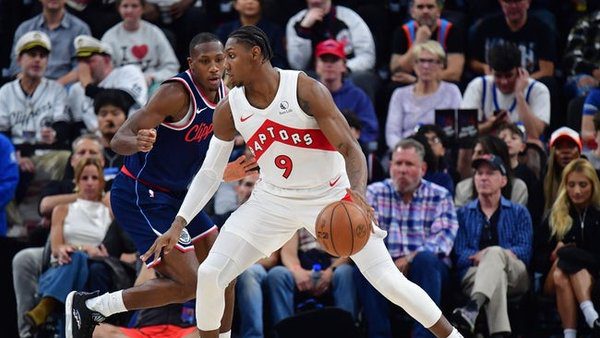
Bash is backing the road underdog in a Friday night matchup where the market is overvaluing the home side’s recent form and undervaluing the visitor’s ability to keep this one competitive despite injury concerns.
The Setup: New Orleans Pelicans at Toronto Raptors
Toronto is catching eight points at home Friday night against a New Orleans squad that’s been gutted by injuries and limping through the final stretch of a lost season. The Raptors are 40-32 and fighting for playoff positioning in the East, while the Pelicans sit at 25-48 with nothing to play for but draft positioning. On the surface, this looks like a spot to lay the number with the home side and move on.
But I’m not buying it. The projection sees this game landing closer to a 4.6-point margin, which creates a significant gap against the 8-point spread. That’s the kind of separation that gets my attention. When you’re getting nearly three and a half points of cushion on a number that already accounts for home court, you’ve got a betting angle worth exploring. The Pelicans are 9-26 on the road, sure, but this price feels like the market is punishing them for their record rather than evaluating the actual matchup.
Game Info & Betting Lines
New Orleans Pelicans at Toronto Raptors
When: Friday, March 27, 2026, 8:30 PM ET
Where: Scotiabank Arena
TV: Sportsnet (Home), GCSEN, Pelicans.com, NBA League Pass (Away)
Spread: Toronto Raptors -8.0 (-110) | New Orleans Pelicans +8.0 (-110)
Total: 229.0 (Over -110 / Under -110)
Moneyline: Raptors -333 | Pelicans +260
Why This Line Exists
The market is pricing in everything that looks bad about New Orleans on paper. They just got blown out in Detroit 129-108, their third straight loss after a brief stretch of competitiveness. Trey Murphy III is questionable with a right ankle injury, and Dejounte Murray is likely sitting again as the team manages his workload coming back from Achilles surgery. The Pelicans shot 45.8% from the free-throw line in that Detroit disaster, and they’re running out a roster that’s clearly in evaluation mode rather than win-now mode.
Toronto, meanwhile, is coming off a loss to the Clippers but has been solid at home with a 19-16 record at Scotiabank Arena. They’re sixth in the East and trying to hold off Philadelphia for playoff positioning. Brandon Ingram has been excellent for them since the trade, averaging 21.5 points, and they’ve got enough depth to handle a depleted opponent. The narrative writes itself: playoff-hungry home team against a tanking road squad with key injuries.
But here’s what the market is missing: the efficiency gap between these teams isn’t nearly as wide as eight points suggests. The net rating differential is 5.2 points per 100 possessions, which is meaningful but not overwhelming. My model projects this closer to a 4.6-point game, and that includes the standard two-point home court adjustment. We’re talking about a three-and-a-half-point cushion on a spread that’s already inflated by perception.
New Orleans Pelicans Breakdown
The Pelicans are a mess right now, no question. They’re 25-48 with a minus-3.6 net rating, and their road record of 9-26 tells you everything about their ability to steal games away from home. They just got torched by Detroit, allowing Jalen Duren to drop 30 and 10 while the Pistons shot 53.6% from three. When you’re letting Detroit—one of the worst three-point shooting teams in the league—go 15-of-28 from deep, you’ve got defensive breakdowns that can’t be ignored.
But let’s talk about what they do well. This team plays at a 101.0 pace, which is faster than Toronto’s 99.2, and they can score when they get out in transition. Zion Williamson is still putting up 21.4 points per game on 60.1% shooting, and even without Murphy, they’ve got Saddiq Bey averaging 17.4 points against his former team. The offensive rating of 113.6 isn’t terrible—it’s actually competitive with Toronto’s 114.2. The problem is the defense, which sits at 117.2 and gives up too many easy looks.
The injury situation is worth monitoring. If Murphy sits, that’s a 21.7-point scorer off the floor, and Murray’s absence means less playmaking. But this roster still has enough offensive talent to stay within striking distance, especially if they can push the pace and create transition opportunities against a Toronto team that prefers to play slower.
Toronto Raptors Breakdown
Toronto is in a much better spot, both in the standings and on the injury front. They’re 40-32 and holding down the sixth seed in the East, though they’re just a half-game ahead of Philadelphia and can’t afford to sleepwalk through games against inferior competition. Brandon Ingram has been the difference-maker since arriving, giving them a legitimate scoring threat alongside Scottie Barnes and RJ Barrett. That trio combines for nearly 59 points per game, and Ingram’s 47.2% shooting with 37.8% from three gives them floor spacing they desperately needed.
The Raptors’ defensive rating of 112.6 is solid, and they’ve been better at home than on the road. Immanuel Quickley is out with plantar fasciitis, which shifts more ball-handling responsibility to Jamal Shead, but the offense hasn’t suffered much. They’re still generating 29.1 assists per game with a 68.8% assist rate, which tells you they’re moving the ball and creating quality looks.
Where Toronto struggles is in clutch situations. They’re 21-13 in clutch games, which is respectable, but they shoot just 27.2% from three in those spots and 72.9% from the line. That’s a concern if this game stays tight down the stretch. They’re also not a dominant rebounding team, with an offensive rebounding rate of 25.6% that’s actually lower than New Orleans’ 27.1%. That 1.5 percentage point rebounding edge for the Pelicans might not sound like much, but it could matter in a game with 100 possessions.
The Matchup
This game sets up as a pace differential that works in New Orleans’ favor. The projected pace of 100.1 possessions is closer to the Pelicans’ preferred tempo than Toronto’s, and that creates more opportunities for transition scoring where New Orleans can exploit their athleticism. Zion in the open floor is still a problem, even for a competent defense like Toronto’s, and if the Pelicans can get out and run, they’ll generate enough easy buckets to stay competitive.
The shooting quality gap is minimal. Toronto has a 1.2-point edge in effective field goal percentage, which is basically noise when you’re talking about a single game sample. The true shooting percentage difference is just 0.6 points—again, not enough to justify an eight-point spread. Both teams are around 57% in true shooting, which tells you they’re creating similar quality looks on a per-possession basis.
Where Toronto should have an advantage is on the defensive end. Their 112.6 defensive rating is five points better than New Orleans’ 117.2, and that’s the foundation of the spread. But here’s the thing: the Pelicans’ offensive rating of 113.6 is actually better than Toronto’s defensive rating suggests they should allow. When you match New Orleans’ offense against Toronto’s defense, you get a one-point mismatch in favor of the Pelicans. That’s not a typo—the numbers say New Orleans should be able to score on this defense.
The clutch numbers favor Toronto significantly, with a 61.8% win rate in close games compared to New Orleans’ 31.6%. But that only matters if this game stays within five points in the final five minutes. If the Pelicans are getting eight points, they don’t need to win—they just need to keep it respectable. And with the efficiency gap being much smaller than the spread suggests, that’s entirely plausible.
Bash’s Best Bet & The Play
I’m taking New Orleans Pelicans +8.0 on Friday night. The market is overreacting to the Pelicans’ recent blowout loss and their injury situation, while undervaluing the actual efficiency matchup. The projection has this game at 4.6 points, which gives us nearly three and a half points of cushion on a spread that’s already accounting for home court. That’s real value.
Toronto is the better team, no doubt. But eight points is too many when the net rating gap is only 5.2 points per 100 possessions and the pace favors the visitor. The Pelicans can score—they’ve got a 113.6 offensive rating that matches up fine against Toronto’s defense—and if they push the tempo, they’ll create enough transition opportunities to stay within the number. Zion, Bey, and whoever else suits up have enough firepower to keep this competitive, even if they don’t win outright.
The risk here is obvious: if Murphy and Murray both sit and the Pelicans mail it in on the second night of a road trip, this could get ugly. But I’m betting that the talent gap isn’t as wide as the spread suggests, and that the efficiency numbers tell a more accurate story than the win-loss records. Give me the points with New Orleans and let’s see if Toronto can actually cover a number this inflated.