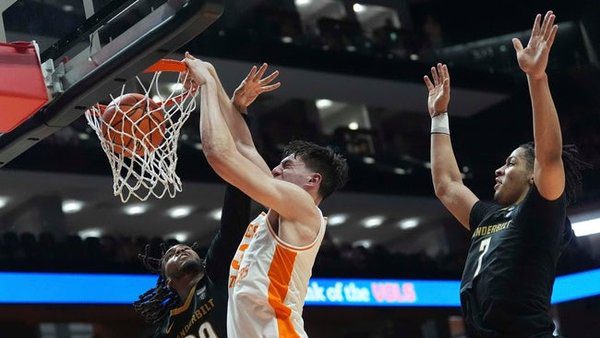
Bash sees a 6-seed with elite glass work facing a 1-seed that lives by shooting efficiency. The model says Tennessee has 3.4 points of value, but Michigan’s defensive versatility in March is the real separator.
Michigan’s laying 7.5 over Tennessee in this Elite 8 matchup at the United Center, and I can already hear the pushback. A 6-seed getting more than a touchdown from a 1-seed in the NCAA Tournament feels steep, especially when Tennessee ranks #11 in adjusted net efficiency and just took down Iowa State as an underdog. But when you dig into the collegebasketballdata.com numbers, this spread reflects a fundamental style clash that favors the Wolverines’ versatility. Michigan checks in at #2 nationally in adjusted net rating with a +40.7 mark, while Tennessee sits at #12 with +28.6. That 12.1-point gap in net efficiency is legitimate, and it shows up in how these teams generate offense. This is a classic tournament spot where rebounding dominance meets shooting precision, and the neutral court at United Center eliminates Tennessee’s one potential equalizer.
Breaking Down the 7.5-Point Spread
The market landed on Michigan -7.5 for a reason that goes beyond seed differential. Tennessee’s calling card is offensive rebounding—they rank #2 nationally at 37.2% and lead the country in second-chance opportunities. That 15.8 offensive boards per game creates extra possessions that mask their pedestrian shooting efficiency. But Michigan’s #2 defensive efficiency rating of 89.6 is built on rim protection and defensive rebounding discipline. The Wolverines allow just 38.6% from the field, second-best in the nation, and they rank #2 in blocks per game at 6.0. Aday Mara’s 8.9 rebounds per game and Michigan’s length make them uniquely equipped to neutralize Tennessee’s bread-and-butter.
The tempo split matters here. Tennessee crawls at 65.8 possessions per game (#220 nationally), while Michigan operates at a more efficient 69.8 pace (#51). KenPom projects 68 possessions, which favors Michigan’s ability to execute in the halfcourt. Tennessee’s 55.9% true shooting and 52.0% effective field goal percentage are both outside the top 170 nationally. When you can’t generate easy looks and the opponent controls defensive glass, those extra possessions dry up fast. Michigan’s 62.4% true shooting (#7) and 58.7% eFG (#8) create a 6.5-point shooting efficiency gap that compounds over 68 possessions.
Tennessee’s Tournament Path and Limitations
Tennessee enters 25-11 with an RPI of #24 and a respectable 9-9 record in Quadrant 1 games. That Q1 mark shows they’ve been battle-tested, and their wins over Iowa State and Virginia in this tournament prove they can execute in March. Ja’Kobi Gillespie’s 17.3 points and 5.4 assists per game provide steady guard play, and Nate Ament’s 16.3 points with 7.1 rebounds give them a versatile forward. But here’s the issue: Tennessee’s 69.4% free throw shooting ranks #279 nationally, and their 34.0% three-point percentage (#179) makes them one-dimensional when the offensive glass gets neutralized. They’re 17-19 against the spread this season, and their 4-6 road ATS record exposes struggles in hostile or neutral environments.
Rick Barnes’ squad went 6-4 in their last 10 games with scoring dropping to 74.0 points per game in that stretch. That late-season offensive regression shows up in their recent shooting splits—37.5% from the field in their loss to Vanderbilt, 43.1% against Auburn. When Tennessee can’t dominate the glass, they don’t have a secondary plan. Michigan’s defensive versatility and shot-blocking presence take away the paint touches that fuel their offense. I respect Tennessee’s toughness, but this matchup exposes their ceiling.
Michigan’s Elite Two-Way Balance
Michigan comes in 34-3 with an RPI of #3 and a dominant 16-2 record in Quadrant 1 games. That Q1 résumé is the best in this tournament, and their #2 strength of schedule means they’ve seen every style and survived. Dusty May’s system generates 87.5 points per game (#8 nationally) with balanced scoring—Yaxel Lendeborg’s 15.8 points and 7.6 rebounds, Morez Johnson Jr.’s 14.2 points and 6.2 boards, and depth from Roddy Gayle Jr. and Trey McKenney. The Wolverines rank #4 in assists per game at 18.8, which speaks to their ball movement and shot quality. They don’t force bad looks, and their 51.1% field goal shooting (#4) reflects disciplined offense.
Defensively, Michigan allows just 69.8 points per game and forces opponents into contested shots. Their 30.7% opponent three-point percentage and elite rim protection make them a nightmare for teams that rely on second chances. The Wolverines went 9-1 in their last 10 games, and their recent wins over Alabama (90-77) and Saint Louis (95-72) in this tournament showed their ability to pull away late. Michigan’s 17-20 ATS record might raise eyebrows, but that’s largely due to inflated spreads as a 1-seed. In neutral-site tournament games, their two-way excellence translates directly to margin.
Style Clash and Possession Value
| Metric | Tennessee | Michigan |
|---|---|---|
| KenPom Rank | #11 | #2 |
| RPI Rank | #24 | #3 |
| Strength of Schedule | #15 | #2 |
| Quadrant 1 Record | 9-9 | 16-2 |
| Adj. Net Rating | +28.6 (#12) | +40.7 (#2) |
| True Shooting % | 55.9% (#185) | 62.4% (#7) |
The head-to-head history between these programs shows Michigan winning all three previous meetings with a 74.7 to 61.3 scoring average and a dominant 52.1% field goal percentage compared to Tennessee’s 43.7%. That shooting gap is the story, and it’s even wider now with Michigan’s 2025-26 roster improvements. Tennessee’s offensive rebounding rate of 45.0% per KenPom (#1 nationally) is their best weapon, but Michigan’s 27.0% defensive rebounding rate (#38) and shot-blocking presence limit second-chance points. When you project 68 possessions and apply the 6.5-point true shooting gap, Michigan’s efficiency advantage compounds into double-digit separation.
The CBB Edge Engine projects Michigan winning by 4.1 points, which suggests 3.4 points of value on Tennessee at +7.5. I see the model’s logic—Tennessee’s elite glass work and defensive intensity keep this from becoming a blowout. But the model underweights Michigan’s tournament experience and their ability to execute in tight possessions. This is the Sweet 16, and 1-seeds don’t give away possessions. Michigan’s 74% win probability per KenPom feels right, and I trust their two-way balance to cover a modest number.
The Betting Recommendation
I’m laying the points with Michigan at -7.5. Tennessee’s rebounding dominance is real, but Michigan’s shooting efficiency and defensive versatility neutralize it on a neutral court. The Wolverines’ 16-2 Quadrant 1 record proves they show up in big spots, and their balanced scoring makes them difficult to game-plan against. Tennessee’s poor free throw shooting and limited perimeter shooting create late-game risk, and I don’t trust them to stay within a possession if Michigan extends a lead in the final five minutes. The primary risk is Tennessee winning the offensive glass by double digits and turning this into a rock fight under 65 possessions, but even then, Michigan’s shooting quality should create enough separation. This is a 1-seed playing like a 1-seed, and 7.5 points feels fair in a Sweet 16 matchup where experience and efficiency matter most.
BASH’S BEST BET: Michigan -7.5 for 2 units.