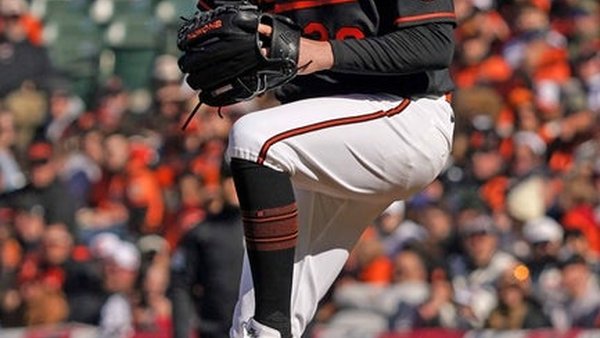
Rodriguez’s 0.50 ERA and pristine command face Bradish’s 5.27 mark and nine walks through 13.2 innings. The surface numbers favor Baltimore — the pitching profiles tell a different story entirely.
Eduardo Rodriguez vs Kyle Bradish: Arizona Diamondbacks at Baltimore Orioles Betting Preview
The market is pricing this game like Baltimore’s home field advantage and better offensive numbers override what should be the primary factor in MLB handicapping: the starting pitcher gap. Eduardo Rodriguez brings a pristine 0.50 ERA and 1.00 WHIP to face Kyle Bradish, who’s sporting a bloated 5.27 ERA and 1.68 WHIP through his early starts. Yet Arizona sits at +135, essentially giving us plus money on the superior starter.
Yes, the Diamondbacks are hitting .229 as a team and just scored 4 runs in a comeback win last night. Yes, Baltimore’s .249 average and .735 OPS look more threatening on paper. But in baseball, elite starting pitching typically trumps marginal offensive advantages, especially when you’re getting paid to take the better arm.
Game Info & Betting Lines
- Date/Time: Wednesday, April 15, 2026 | 12:35 PM ET
- Venue: Oriole Park at Camden Yards (Park Factor: 1.01)
- Probable Starters: Eduardo Rodriguez (ARI) vs Kyle Bradish (BAL)
- Moneyline: Arizona +135 / Baltimore -163
- Run Line: Arizona +1.5 (-149) / Baltimore -1.5 (+123)
- Total: 9 (Over -108 / Under -112)
Why This Number Is Wide
The market is weighing Baltimore’s home field, better team offensive metrics (.735 OPS vs .669), and recent series momentum after taking two of the first three games. The Orioles have shown they can rally—they erased a 7-1 deficit Monday night before losing 4-3 yesterday. Their lineup, led by Gunnar Henderson’s .911 OPS and Pete Alonso’s power, presents legitimate threats.
But the line overcompensates for these factors while undervaluing the massive pitching disparity. Rodriguez has been dominant through 18 innings, allowing just 1 home run with an 11 K to 5 BB ratio that demonstrates excellent command. Meanwhile, Bradish’s 9 walks in 13.2 innings signal command issues that create constant traffic and stress. Getting +135 on the better starter feels like the market is pricing yesterday’s comeback win and home field at premium rates.
What Separates the Pitching
This matchup presents a study in early-season extremes. Rodriguez’s changeup has been his signature weapon, throwing it 33.8% of the time at 85.2 mph with a .265 xwOBA against and 23.4% whiff rate. His four-seam fastball complements it perfectly at 91.3 mph, creating a velocity differential that’s kept hitters off balance. The veteran left-hander has induced weak contact consistently, evidenced by that microscopic 0.50 ERA over 18 innings.
Bradish relies heavily on his slider (34.9% usage) and sinker (33.4% usage), but the execution has been inconsistent. While his slider generates a solid 30.9% whiff rate and .256 xwOBA, his sinker at 94.4 mph has been vulnerable with just a 6.5% whiff rate. The concerning element is his control—9 walks in 13.2 innings creates constant baserunners and extended pitch counts. Against Arizona’s patient hitters like Geraldo Perdomo (8.2% K rate), those command lapses become amplified.
The Statcast data reveals telling matchup advantages. Henderson (.540 xwOBA vs LHP) and Ward (.457 xwOBA vs LHP) profile well against Rodriguez, but the rest of Baltimore’s order shows notable left-handed struggles. Conversely, Arizona’s top bats like Corbin Carroll (.510 xwOBA) and Jose Fernandez (.349 xwOBA vs RHP) should find opportunities against Bradish’s inconsistent command.
The Pushback
The concern is Arizona’s anemic offense failing to capitalize on Bradish’s struggles. This is a team hitting .229 with a .669 OPS, and their recent cold stretch is real. Even when they get baserunners, the power is limited—just 13 home runs through 17 games. Nolan Arenado’s .204 average and .548 OPS represents a significant drop-off from his typical production.
Baltimore’s offensive depth also works against this thesis. Beyond Henderson and Alonso, players like Jordan Westburg (.770 OPS) and Samuel Basallo provide secondary threats that Arizona’s current lineup lacks. The sample size concern with Rodriguez is legitimate too—18 innings of dominance can evaporate quickly in baseball, and we’re potentially buying his peak performance level.
That said, the fundamental principle remains: in a sport where starting pitching drives 60-70% of the outcome, getting plus money on a clear advantage at the most important position creates value. Rodriguez’s track record suggests this isn’t fluky dominance, and Bradish’s control issues aren’t easily correctable mid-start.
Run Environment & Game Shape
The total sits at 9 with neutral park factors at Camden Yards (1.01), suggesting the market expects a moderate scoring environment. This setup actually favors the better starter—in lower-scoring games, each run carries more weight, and the team with superior pitching typically has the advantage in tight margins.
Rodriguez’s ability to limit big innings should keep Arizona within striking distance, while Bradish’s walk issues create opportunities for crooked numbers. The projected scoring range of 4-5 runs per side means Arizona doesn’t need an offensive explosion—just enough execution to support their pitching advantage. Last night’s 4-3 win demonstrated they can manufacture runs when needed.
The Pick
Arizona Diamondbacks +135 (2 units)
This line provides excellent value on the superior starter in what projects as a close game. Rodriguez’s early dominance looks sustainable given his arsenal and command, while Bradish’s control problems create multiple avenues for Arizona to capitalize. The market is overvaluing Baltimore’s offensive edge and home field while underpricing the pitching disparity. Take the plus money on the better arm.