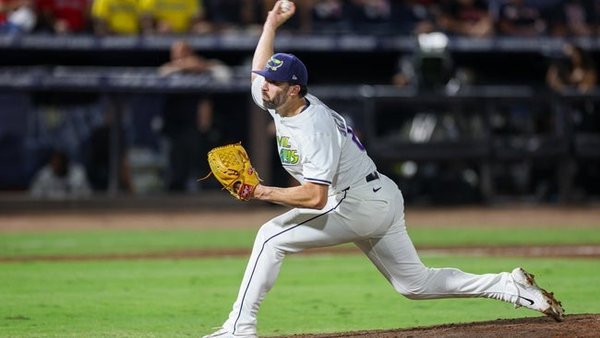
The matchup screams Tampa Bay advantage — Scholtens’ elite control metrics against a Chicago offense hitting .191 as a team. The market has this priced like a competitive game at -118 when the talent gap suggests otherwise.
Jesse Scholtens vs Sean Burke: Tampa Bay at Chicago Betting Preview
The market is treating this as a relatively even matchup, with the Rays favored by just 16 cents on the moneyline. On the surface, that makes sense — both teams entered the season with modest expectations, Chicago gets the home field bump, and early-season variance creates uncertainty around small samples. But dig into what’s actually happening on the field, and this line feels disconnected from reality.
Chicago’s offensive collapse isn’t just a cold streak — it’s a systematic failure that’s produced a .587 OPS across 17 games. Meanwhile, Tampa Bay just hung eight runs on this same White Sox pitching staff yesterday, and Jesse Scholtens brings elite control metrics that should neutralize an already-struggling Chicago offense. The pitching matchup heavily favors the visitors, but the price hasn’t caught up.
Game Info & Betting Lines
- Date/Time: Wednesday, April 15, 7:40 PM ET
- Venue: Guaranteed Rate Field (Park Factor: 0.98)
- Probable Starters: Jesse Scholtens (TB) vs Sean Burke (CWS)
- Moneyline: Tampa Bay -118 / Chicago -102
- Run Line: Chicago +1.5 (-175) / Tampa Bay -1.5 (+144)
- Total: 8 (Over -105 / Under -115)
Why This Number Is Too Close
The market is balancing legitimate concerns about small sample sizes — Scholtens has just 4.2 innings of MLB work this season, and early-season offensive numbers can be misleading. There’s also the natural home field bias, and Chicago did manage five runs yesterday, suggesting they’re not completely lifeless. The -118 price reflects these uncertainties.
But the market is underweighting the sheer magnitude of Chicago’s offensive struggles. This isn’t a team in a temporary funk — they’re hitting .191/.280/.307 as a unit, numbers that border on historically bad territory. When you combine that level of offensive incompetence with a clear pitching disadvantage, -118 doesn’t capture the true probability gap. Tampa Bay should be closer to -140 in this spot.
What Separates the Pitching
The arsenal data reveals why Scholtens should dominate this matchup. His slider, thrown 36.1% of the time at 88.6 mph, is holding hitters to just .222 xwOBA — a devastating weapon against right-handed heavy Chicago lineup. Sean Burke relies heavily on his 93.9 mph four-seamer (41.7% usage), but it’s generating just 20.0% whiffs and allowing .261 xwOBA against.
More importantly, Scholtens brings elite control with a 1.07 WHIP and 7.7 K/BB ratio, compared to Burke’s 5.0 K/BB mark. Against a Chicago offense that’s already struggling to make contact consistently — they’re striking out 24.5% of the time — Scholtens’ command advantage should create extended scoreless stretches. His sinker-slider combination at 92.7 mph and 88.6 mph respectively gives him multiple ways to attack the strike zone.
Burke’s knuckle curve (20.2% usage) has shown decent results with .258 xwOBA against, but his changeup is getting hammered (.435 xwOBA) and his slider isn’t missing enough bats at 23.5% whiffs. Tampa Bay’s top-of-order guys — Yandy Díaz (.359 xwOBA), Jonathan Aranda (.423 xwOBA), and Junior Caminero (.352 xwOBA) — profile as significant mismatches against Burke’s pedestrian secondary offerings.
The Pushback
Here’s the problem with this thesis: Scholtens has thrown just 4.2 innings this season, making any statistical analysis inherently noisy. What looks like elite control could easily be a small-sample mirage, and we’ve seen plenty of pitchers dominate in limited exposure only to crater once hitters get multiple looks. His slider whiff rate of just 6.7% is actually concerning — that pitch needs to miss more bats to be truly effective.
The bigger concern is Chicago’s sudden offensive output yesterday. After scoring just 11 runs in their previous six games, they managed five against Tampa Bay’s pitching staff. Munetaka Murakami showed power with a three-run homer, and the White Sox demonstrated they can capitalize when mistakes are made. If Scholtens nibbles too much or falls behind in counts, this offense has shown it can punish hanging breaking balls.
That said, yesterday’s five-run outburst came against Tampa Bay’s bullpen after Shane McClanahan dominated for five innings. The pattern matches exactly what we’d expect: Chicago struggling against quality starting pitching, then capitalizing late against relievers. Scholtens’ control metrics suggest he’ll throw more strikes than McClanahan, giving the White Sox fewer free baserunners to work with.
Run Environment & Game Shape
Guaranteed Rate Field’s 0.98 park factor creates a slight pitcher-friendly environment, which amplifies Scholtens’ control advantage. The total sitting at 8 suggests the market expects a moderate-scoring game, but Tampa Bay’s recent offensive surge — including yesterday’s eight-run explosion — indicates they’re capable of carrying the scoring load alone.
This projects as a 5-3 or 6-2 type game, where Tampa Bay builds an early lead through superior plate discipline and Scholtens maintains it by limiting Chicago’s already-scarce scoring opportunities. The run environment favors the team with better starting pitching, and the gap there is substantial enough to overcome the modest home field advantage.
Joe Jensen’s Pick
JENSEN’S PICK: Tampa Bay Rays Moneyline -118 — 2 Units
Projected Score: Tampa Bay Rays 5, Chicago White Sox 3
I looked at the run line here, but that requires a two-run margin against a team that just scored five runs yesterday. While Tampa Bay should win, Scholtens’ limited track record makes it harder to guarantee the type of dominant performance needed for run line coverage. The straight moneyline captures the pitching and offensive edges without requiring a specific margin.
At -118, we’re getting reasonable value on what should be closer to a -140 favorite. Chicago’s offensive struggles run deeper than normal early-season variance — this is systematic failure meeting superior pitching. Two units reflects strong confidence in the directional outcome while acknowledging the inherent volatility of small samples in April baseball.