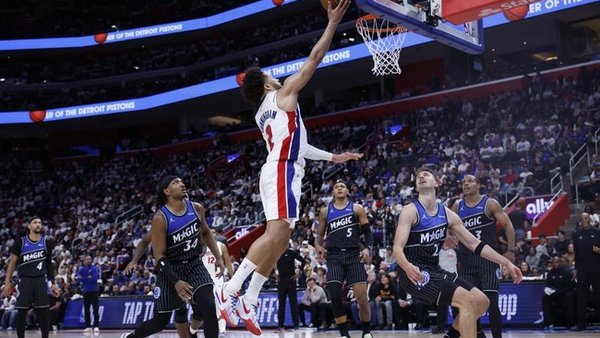
Bash sees a top-seeded home favorite facing real pressure after a Game 1 stumble, and the market may be overreacting to a single playoff performance in a series that could tighten quickly.
The Setup: Orlando Magic at Detroit Pistons
Detroit opened as a 9-point home favorite Wednesday night, and that number feels like the market is screaming recency bias after Orlando’s Game 1 win. The Pistons dropped the opener 112-101 at home, extending an ugly 11-game home playoff losing streak that dates back to 2008. Cade Cunningham went nuclear for 39 points, but the supporting cast disappeared when it mattered. Now the market is asking Detroit to cover nine against an eighth seed that just controlled the game wire-to-wire.
Here’s the thing: Detroit is still a 60-win team with a +8.4 net rating and the top seed for a reason. Orlando is 45-37 with a +0.6 net rating. The projection here sits around 5.9 points in Detroit’s favor, which creates a meaningful gap against the posted nine. The Pistons are the better team by a wide margin over 82 games, but the market is pricing in a blowout correction that may not materialize in a playoff series where Orlando has already proven they can execute in this building.
The total opened at 218.5, and that’s where things get interesting. Both teams played at a controlled pace during the regular season—Detroit at 99.9 possessions per game, Orlando at 100.6. The pace blend projects around 100 possessions, which should push scoring opportunities higher than this number suggests. Game 1 finished with 213 total points in what felt like a deliberate, half-court game. I’m not buying that we see the same script twice in a row when Detroit needs to generate more offense from someone other than Cunningham.
Game Info & Betting Lines
- Game: Orlando Magic at Detroit Pistons
- Date: Wednesday, April 22, 2026
- Time: 7:30 PM ET
- TV: ESPN
- Spread: Detroit Pistons -9.0 (-110) | Orlando Magic +9.0 (-110)
- Total: Over 218.5 (-110) | Under 218.5 (-110)
- Moneyline: Detroit Pistons -417 | Orlando Magic +305
Why This Line Exists
The market built this number around two competing narratives. First, Detroit is objectively the superior team by every efficiency metric that matters. Their 117.3 offensive rating crushes Orlando’s 114.2 mark, and the defensive gap is even wider—108.9 for Detroit versus 113.6 for Orlando. That’s a +7.8 net rating edge per 100 possessions, which is the foundation of why Detroit was favored by this margin in the first place.
Second, the market is banking on regression. Tobias Harris scored 17 in Game 1, but the rest of Detroit’s rotation combined for just 55 points while Cunningham carried the load. Duncan Robinson, Kevin Huerter, and the bench units were invisible. The assumption baked into this nine-point spread is that Detroit’s depth shows up in Game 2 and the Pistons play closer to their season-long identity.
But here’s the tension: Orlando just proved they can win this matchup by double digits without trailing once. Paolo Banchero controlled the paint with 23 points and nine rebounds. Franz Wagner closed the game with 11 fourth-quarter points. Desmond Bane and Wendell Carter both hit 17. That’s four guys in double figures with balanced production, and Jalen Suggs added 16 more. Orlando’s offensive execution wasn’t a fluke—it was a game plan that worked against Detroit’s defensive scheme.
The market is also pricing in home court desperation. Detroit hasn’t won a home playoff game since 2008, and that’s the kind of narrative that creates emotional betting action. The assumption is that the Pistons come out with more urgency, more defensive intensity, and more offensive balance. Maybe that happens. But nine points is a lot to ask from a team that just lost by 11 in this exact building against this exact opponent.
Orlando Magic Breakdown
Orlando’s regular season profile shows a team that plays disciplined basketball without elite offensive firepower. They scored 115.7 points per game with a 114.2 offensive rating, which is solid but not explosive. The shooting splits are fine—46.4% from the field, 34.3% from three, 80.1% from the line—but nothing jumps off the page. What stands out is their ability to protect the ball (14.2 turnovers per game) and defend without fouling (21.0 fouls per game).
The clutch numbers tell you everything about how Orlando wins close games. They went 27-16 in clutch situations with a +0.1 net rating in the final five minutes when the score was within five. That’s a team that executes under pressure and doesn’t panic when the game tightens. Franz Wagner shooting 40.1% in clutch moments isn’t ideal, but the Magic found ways to close games all season long.
Banchero is the engine here—22.2 points, 8.4 rebounds, 5.2 assists per game during the regular season. He’s not an efficient shooter (45.9% FG, 30.5% 3PT), but he creates offense in the half-court and punishes mismatches in the paint. Wagner and Bane give Orlando two more scoring options who can create their own looks, and Suggs runs the offense with 5.5 assists per game. This isn’t a one-dimensional offense, and Game 1 proved they can score against Detroit’s defense when the rotations are sound.
Jonathan Isaac remains doubtful with a left knee sprain, but his absence doesn’t crater Orlando’s rotation. The Magic have enough frontcourt depth to survive without him, and they just won Game 1 without his rim protection.
Detroit Pistons Breakdown
Detroit built a 60-22 record on the back of elite two-way efficiency. The 117.3 offensive rating ranked among the league’s best, and the 108.9 defensive rating was even more impressive. They scored 117.8 points per game while allowing opponents to shoot just 45% from the field. The Pistons controlled the glass with 13.1 offensive rebounds per game, which created second-chance opportunities and extended possessions.
Cunningham is the focal point—23.9 points and 9.9 assists per game during the regular season. He’s a high-usage point guard who can score at all three levels, and his 46.1% field goal percentage shows he’s efficient despite the volume. Jalen Duren gives Detroit an interior presence with 19.5 points and 10.5 rebounds per game, and his 65.0% shooting from the field is elite. That’s a pick-and-roll combination that should dominate most defenses.
The problem in Game 1 was the supporting cast. Harris scored 17, but Robinson, Huerter, and the rest of the rotation combined for minimal production. Detroit’s offensive rebounding edge (30.9% OREB rate versus Orlando’s 25.1%) should have created more second-chance points, but the Pistons couldn’t capitalize. The shooting quality gap is real—Detroit’s 54.6% effective field goal percentage is 1.6 points better than Orlando’s 53.1% mark—but that edge didn’t show up when it mattered.
Detroit’s clutch profile is slightly better than Orlando’s—27-15 in clutch games with a +1.2 net rating—but the gap isn’t large enough to create separation in a tight playoff series. The Pistons are built to win by controlling pace and executing in the half-court, but Orlando just proved they can hang in that environment.
The Matchup
The pace matchup here is critical. Detroit played at 99.9 possessions per game during the regular season, while Orlando pushed the tempo slightly higher at 100.6. The expected pace blend sits around 100 possessions, which means this game should generate more scoring opportunities than the 218.5 total suggests. Game 1 finished with 213 points, but that felt like both teams feeling each other out in a playoff opener. I’d expect more offensive rhythm in Game 2 as both sides adjust.
The offensive rebounding gap is one of Detroit’s biggest advantages. The Pistons grabbed 30.9% of their missed shots during the regular season, compared to Orlando’s 25.1% mark. That’s a 5.8-percentage-point edge that should create extra possessions and second-chance points. Duren is a monster on the glass, and Detroit’s size advantage in the paint should translate to more offensive boards. But Orlando defended the glass well in Game 1, and they’ll need to repeat that effort to keep this game close.
The shooting quality gap favors Detroit by 1.6 percentage points in effective field goal percentage, which is a small but real edge. Detroit’s ability to generate high-quality looks around the rim and from three-point range should give them more efficient scoring opportunities. But Orlando’s defense held up in Game 1, and the Magic have enough versatility to switch across multiple positions and disrupt Detroit’s offensive flow.
The real question is whether Detroit’s depth shows up. Cunningham can’t score 39 every night and expect to win by nine. Harris, Robinson, and Huerter need to contribute more than 17 combined points if the Pistons are going to cover this number. Orlando’s defensive scheme clearly targeted Detroit’s role players in Game 1, and I’m not convinced the market has properly adjusted for the possibility that the Magic execute the same game plan again.
Bash’s Best Bet & The Play
I’m looking at Orlando +9 and the over 218.5, and both numbers feel like value. The projection sits around 5.9 points in Detroit’s favor, which creates a three-point cushion against the posted spread. Orlando just won this game by 11 without trailing, and the market is asking me to believe Detroit flips that result into a double-digit win at home. I’m not buying it. The Magic have the defensive scheme to slow down Detroit’s role players, and Banchero gives them enough offensive firepower to keep this game within a possession or two.
The total is the sharper play. My model projects 227.5 total points, which is nine points higher than the posted 218.5. The pace blend supports more possessions than Game 1, and both teams should generate better offensive rhythm as the series develops. Detroit needs more production from their depth, which means more shot attempts and more scoring opportunities. Orlando proved they can score in the half-court, and I’d expect Wagner and Bane to stay aggressive after Game 1’s success.
The play: Over 218.5 (-110). Detroit’s depth should contribute more in Game 2, and Orlando has enough offensive balance to keep pace. The expected possessions and shooting quality gaps point to a higher-scoring game than the market is pricing. Risk the standard unit and expect both teams to push the tempo more than they did in the playoff opener.