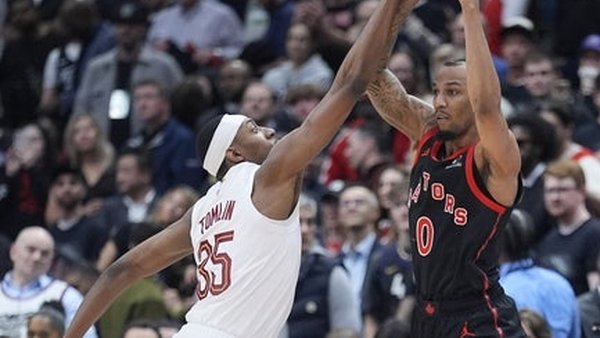
Bash examines a playoff spread that looks generous given the matchup dynamics, with Toronto’s Game 3 explosion creating a narrative trap that may be overvaluing their position in this series.
The Setup: Cleveland Cavaliers at Toronto Raptors
Cleveland comes into Game 4 as a 4-point road favorite after Toronto’s dominant 126-104 win in Game 3 snapped a 12-game playoff losing streak to the Cavaliers. The projection has this closer to a pick’em with home court, making that 4-point spread worth examining. Toronto got career playoff performances from Scottie Barnes and RJ Barrett in Game 3, but the question is whether that explosion represents a sustainable shift or a one-game outlier against a Cleveland team that still holds a 2-1 series lead.
The Raptors are catching 4 points at home in an elimination-avoidance spot, which typically draws public support. But the efficiency picture tells a different story than Thursday’s blowout might suggest. Cleveland’s offensive rating advantage creates real pressure on Toronto’s defense, even at home, and the Cavaliers’ ability to control pace could neutralize the crowd factor that fueled Game 3’s momentum.
This is a situational spot where recency bias meets playoff reality. One dominant performance doesn’t erase the structural advantages Cleveland has shown throughout this series.
Game Info & Betting Lines
When: Sunday, April 26, 2026 | 7:30 PM ET
Where: TBD
Watch: ESPN
Spread: Cavaliers -4.0 (-105) | Raptors +4.0 (-115)
Total: 219.5 (Over -110 / Under -110)
Moneyline: Cavaliers -170 | Raptors +145
Why This Line Exists
The market is pricing in Toronto’s Game 3 performance while respecting Cleveland’s series control and superior efficiency profile. That 4-point spread reflects the home court adjustment plus a small bump for the Raptors’ momentum, but it’s not giving Toronto full credit for replicating their 33-point performances from Barnes and Barrett.
Cleveland’s 118.3 offensive rating sits 3.3 points higher than Toronto’s 115.0 mark, and that gap matters more than one game’s box score. The Cavaliers’ offense against Toronto’s defense projects to a 6.2-point advantage per 100 possessions—a strong mismatch that suggests Cleveland should score efficiently regardless of venue. Meanwhile, Toronto’s offense against Cleveland’s defense shows only a 0.9-point edge, which is basically within noise.
The pace projection sits at 100.0 possessions, which favors Cleveland’s half-court execution over Toronto’s transition game. That deliberate tempo limits the Raptors’ ability to generate the kind of fast-break points that fueled their Game 3 explosion. The total at 219.5 seems low given both teams’ offensive capabilities, but it’s accounting for playoff intensity and the expectation that Cleveland will slow this game down to their preferred rhythm.
Cleveland Cavaliers Breakdown
The Cavaliers posted a 52-30 record with a plus-4.1 net rating, going 25-16 on the road during the regular season. Donovan Mitchell averaged 27.9 points per game while shooting 48.3% from the field and 36.4% from three. James Harden added 23.6 points and 8.0 assists per game, giving Cleveland two elite creators who can operate in the half-court.
Cleveland’s 59.4% true shooting percentage and 56.1% effective field goal percentage demonstrate elite shot quality. The Cavaliers’ offensive rating of 118.3 ranks among the league’s best, and their ability to generate efficient looks through Mitchell and Harden’s pick-and-roll actions creates consistent scoring pressure. Evan Mobley and Jarrett Allen provide rim protection and interior finishing, with Allen shooting 63.8% from the field.
The Cavaliers went 24-18 in clutch situations during the regular season, shooting 44.0% from the field in close games. That clutch competency matters in a playoff environment where possessions tighten and execution becomes paramount. Cleveland’s 100.7 pace suggests they prefer controlled possessions over transition chaos, which should help them manage Toronto’s home crowd energy.
Toronto Raptors Breakdown
Toronto finished 46-36 with a plus-2.9 net rating, going 24-17 at home during the regular season. The Raptors are without Immanuel Quickley, who suffered a setback with his right hamstring strain and won’t be available for this series. That absence removes 16.4 points and 5.9 assists per game from Toronto’s rotation, forcing more creation responsibility onto Barnes and Barrett.
Brandon Ingram led Toronto with 21.5 points per game on 47.7% shooting, while Barrett added 19.3 points and Barnes contributed 18.1 points with 7.5 rebounds and 5.9 assists. Both Barrett and Barnes exploded for 33 points in Game 3, but those career playoff highs came on a combined 22-of-37 shooting—an efficiency level that’s difficult to replicate consistently.
Toronto’s 115.0 offensive rating trails Cleveland’s mark by 3.3 points, and their 58.1% true shooting percentage sits 1.4 points below the Cavaliers’ efficiency. The Raptors’ effective field goal percentage gap of 1.4 points and offensive rebounding disadvantage of 1.4 percentage points create incremental edges for Cleveland that compound over 100 possessions. Toronto went 21-14 in clutch situations but shot just 27.2% from three in those spots, which could be problematic if this game tightens late.
The Matchup
The efficiency mismatch favors Cleveland’s offense significantly. When the Cavaliers have the ball against Toronto’s defense, the projection shows a 6.2-point advantage per 100 possessions—that’s a strong edge that suggests Cleveland should score efficiently throughout this game. The Raptors’ defensive rating of 112.1 is solid, but it’s not built to contain Mitchell and Harden’s two-man game when both are operating in space.
Toronto’s offense against Cleveland’s 114.1 defensive rating shows minimal advantage, basically in line with the market’s expectation. The Raptors need Barnes and Barrett to replicate their Game 3 shot-making while also getting secondary contributions from Collin Murray-Boyles and Jamison Battle. That’s a lot of variables that need to align perfectly against a Cleveland defense that will make adjustments after Thursday’s defensive breakdown.
The pace element works in Cleveland’s favor. At 100.0 projected possessions, this game should play to the Cavaliers’ strengths in the half-court rather than Toronto’s transition attack. The Raptors thrive when they can push tempo off misses and turnovers, but Cleveland’s 12.2% turnover rate matches Toronto’s exactly, eliminating that potential fuel source. The shooting quality gap of 1.4 percentage points in effective field goal percentage gives Cleveland a small but consistent edge on shot selection and execution.
One game doesn’t redefine a series. Toronto’s Game 3 performance was impressive, but the underlying metrics suggest it was more aberration than revelation. Cleveland still holds structural advantages in offensive efficiency, shot quality, and half-court execution that should reassert themselves in a playoff environment where variance tends to decrease.
Bash’s Best Bet & The Play
The spread at Cavaliers -4.0 offers value given the efficiency mismatch and Cleveland’s ability to control game flow. My model projects this closer to a pick’em with home court factored in, which makes laying 4 with the road team a tougher sell on paper. But the matchup dynamics and pace control suggest Cleveland should cover that number if they execute their half-court game plan.
The total at 219.5 presents the stronger opportunity. The projection sits above 229, and that 10-point gap represents significant value on the over. Both teams have the offensive firepower to push this number higher, especially with Cleveland’s 118.3 offensive rating and Toronto’s need to keep pace. The 100-possession game script should generate enough scoring opportunities for both sides to clear this total comfortably.
The Play: Over 219.5 (-110)
This total is pricing in defensive intensity and playoff grinding that may not materialize given both teams’ offensive capabilities. Cleveland will score efficiently against Toronto’s defense, and the Raptors will need to match that output to stay competitive at home. The shooting quality on both sides supports a higher-scoring environment than this number suggests, and the pace projection gives us enough possessions to get there. Risk exists if Cleveland blows this open early and both teams empty their benches, but the series context suggests Toronto will fight to avoid going down 3-1, keeping this game competitive and the scoring flowing throughout.