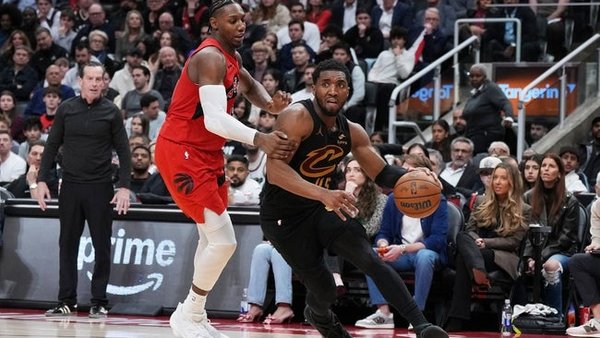
The home team has won all six games in this series, but Bash sees the market overpricing Cleveland’s home edge in a Game 7 where Toronto’s stars have proven they can deliver in hostile territory.
The Setup: Raptors at Cavaliers
Cleveland sits as an 8-point favorite at home in Game 7, and the market is banking hard on the home-court trend that’s defined this series. Every game has gone to the host, and the Cavaliers earned that advantage for a reason—they won six more games than Toronto during the regular season. But here’s the issue: the projection puts this closer to a field goal game, and that’s a massive gap when you’re laying nearly two possessions in a win-or-go-home scenario.
The Raptors just survived an overtime thriller in Game 6, with RJ Barrett drilling a three with 1.2 seconds left to force this deciding contest. Scottie Barnes orchestrated the offense with 25 points and 14 assists, and Ja’Kobe Walter added 24 in a balanced attack that pushed Cleveland to the brink. Now Toronto walks into Rocket Mortgage FieldHouse needing to break the home-court pattern, but they’ve got the offensive firepower to do it—and the Cavaliers’ defense hasn’t shown it can consistently contain this group.
Brandon Ingram’s status looms large. He logged just 11 minutes in Game 5 and missed Game 6 entirely, spotted in a walking boot Friday. If he can’t go, Jamal Shead stays in the starting lineup, but Toronto’s depth has held up without him. The real concern is whether Cleveland can create enough separation without relying on the home crowd to bail them out in crunch time.
Game Info & Betting Lines
When: Sunday, May 3, 2026 | 7:30 PM ET
Where: TBD
Watch: NBC, Peacock
Spread: Cavaliers -8.0 (-110) | Raptors +8.0 (-110)
Total: 211.0 (Over -110 / Under -110)
Moneyline: Cavaliers -300 | Raptors +250
Why This Line Exists
The market is pricing Cleveland’s home-court advantage like it’s a guarantee, and the series trend supports that narrative. Six straight wins for the home team creates a psychological anchor, and the Cavaliers’ 27-14 home record during the regular season adds credibility. Cleveland also holds a slight edge in net rating—plus-4.1 compared to Toronto’s plus-2.9—and their offensive efficiency at 118.3 points per 100 possessions is legitimately elite.
But eight points in a Game 7? That’s asking Cleveland to dominate, not just win. The offensive matchup shows Cleveland scoring 6.2 points per 100 possessions better than Toronto’s defense allows, which is a strong edge. But Toronto’s offense against Cleveland’s defense sits at just 0.9 points per 100 possessions above expectation, which is basically within noise. The Cavaliers can score, but they haven’t proven they can shut down Toronto’s balanced attack when it matters.
The total at 211.0 is where the market gets really interesting. Both teams averaged well over 114 points per game during the season, and the pace blend projects around 100 possessions. That total feels suppressed for a Game 7 that could turn into a track meet if either defense cracks under pressure. The shooting quality gap—Cleveland’s 1.4-percentage-point edge in effective field goal percentage and true shooting—is small enough that Toronto can hang in a high-scoring environment.
Raptors Breakdown
Toronto’s offense runs through Barnes, Barrett, and the supporting cast that’s stepped up throughout this series. Barnes averaged 18.1 points and 5.9 assists during the regular season, but he’s elevated in the playoffs, and his 25-point, 14-assist performance in Game 6 showed he can control tempo against Cleveland’s switching defense. Barrett’s clutch three in overtime was the dagger, and he’s shooting 33.9 percent from deep this season—not elite, but good enough to punish closeouts.
Immanuel Quickley remains out with a hamstring setback, which shifts more ball-handling to Shead and Walter. Walter’s 24 points in Game 6 proved he can handle the moment, and his usage bump has been productive. The Raptors shot 48.2 percent from the field this season with a 35.4 percent three-point mark, and their 69.2 percent assist rate shows they move the ball well enough to generate quality looks.
Defensively, Toronto allowed 112.1 points per 100 possessions during the regular season, which is solid but not lockdown. They’ve struggled to contain Donovan Mitchell and James Harden in this series, but they’ve done enough to keep games competitive. The real issue is whether they can survive Cleveland’s interior presence—Evan Mobley and Jarrett Allen combined for 24.6 rebounds per game this season, and Toronto’s 25.5 percent offensive rebounding rate gives up too many second chances.
Cavaliers Breakdown
Cleveland’s offense is built around Mitchell and Harden, and both delivered during the regular season. Mitchell averaged 27.9 points on 48.3 percent shooting, while Harden orchestrated at 23.6 points and 8.0 assists per game. That’s a devastating pick-and-roll duo, and Toronto hasn’t found a consistent answer. Mobley’s 18.2 points and 9.0 rebounds provide interior balance, and Jaylon Tyson’s 44.6 percent three-point shooting stretches the floor.
But Cleveland’s defense has been inconsistent in this series. They allowed 114.1 points per 100 possessions during the regular season, and Toronto just hung 112 in regulation before winning in overtime. The Cavaliers’ 1.4-percentage-point edge in offensive rebounding (26.8 percent vs. 25.5 percent) gives them extra possessions, but they’ve turned the ball over at the same rate as Toronto—12.2 percent for both teams—so there’s no real gap in ball security.
The clutch numbers are interesting. Cleveland went 24-18 in clutch situations this season with a plus-1.4 net rating, while Toronto went 21-14 with a plus-0.9 mark. That’s basically even, and we saw it play out in Game 6—Mobley had a clean look to win it at the buzzer and couldn’t convert. The Cavaliers are good in tight games, but they’re not dominant, and that matters when you’re laying eight points in a Game 7.
The Matchup
The pace blend projects around 100 possessions, which is deliberate but not grinding. Both teams want to push in transition when they can, but this game will likely settle into half-court execution down the stretch. Cleveland’s offensive rating advantage is real—118.3 points per 100 possessions is elite—but Toronto’s ability to score 115.0 points per 100 possessions keeps them in striking distance.
The shooting quality gap is small. Cleveland’s 59.4 percent true shooting and 56.1 percent effective field goal percentage edge Toronto’s 58.1 percent and 54.6 percent marks, but those are 1.4-percentage-point differences that can evaporate in a single hot quarter. Toronto’s 35.4 percent three-point shooting isn’t elite, but it’s good enough to punish Cleveland’s switching defense when Barnes and Barrett create advantages.
Rebounding is where Cleveland should dominate. Their 1.4-percentage-point edge in offensive rebounding rate translates to extra possessions, and Mobley’s 1.7 blocks per game disrupts Toronto’s rim attacks. But the Raptors have survived without controlling the glass all series, and their 69.2 percent assist rate shows they can generate quality looks without needing second chances.
The total at 211.0 feels too low for a game that projects closer to 230 combined points. My model sees Cleveland around 115 and Toronto around 114, which puts the total near 229. That’s an 18-point gap from the posted number, and it’s driven by the pace and efficiency both teams showed all season. If this game stays competitive—and Game 7s usually do—the scoring environment should push well over 211.
Bash’s Best Bet & The Play
The spread at Cavaliers -8.0 is inflated by the home-court narrative, but the projection puts this at a 2.6-point game. That’s a five-point edge on Toronto plus the points, and I’m backing the Raptors to keep this within a possession. Cleveland is the better team, but eight points in a Game 7 asks them to dominate, and Toronto’s offensive balance gives them enough firepower to hang around. Barrett and Barnes have proven they can deliver in hostile territory, and the Cavaliers’ defense hasn’t shown it can shut them down.
The real value is on the total. Over 211.0 is the play, and it’s not particularly close. Both teams scored well over 114 points per game during the season, the pace projects around 100 possessions, and the shooting quality on both sides supports a high-scoring environment. The market is pricing this like a defensive grind, but the matchup points to a track meet if either defense cracks. Game 7s are tense, but they’re not always low-scoring, and this total is begging to go over.
The Play: Raptors +8.0 (-110) and Over 211.0 (-110). Both bets carry risk—Toronto needs to avoid a slow start, and the over needs both teams to stay aggressive—but the value is too strong to pass up. Cleveland wins at home, but Toronto keeps it close, and the scoring environment pushes this well over the posted total.