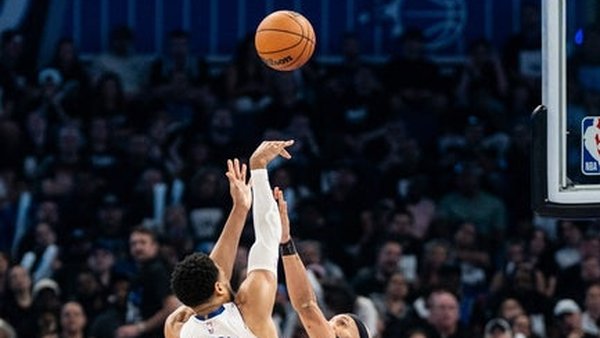
Bash sees a playoff total that’s been crushed by recent scoring droughts, but the matchup math and pace profile suggest the market has overreacted to a single defensive meltdown.
The Setup: Magic at Pistons
Detroit is laying 8 points at home in Game 7, and the total sits at 202. That number is what happens when the market watches Orlando score 14 points in a half and assumes the offense is broken forever. The Pistons are the top seed, they just erased a 24-point deficit in Orlando, and Cade Cunningham dropped 32 while the Magic fell apart in historic fashion. I get why the public thinks this is a defensive slugfest waiting to happen.
But here’s the thing: one catastrophic offensive collapse doesn’t rewrite the entire season. Orlando averaged 115.7 points per game this year. Detroit put up 117.8. These teams play at a combined pace that projects over 100 possessions, and the projection lands at 227.5 total points. That’s a 25-point gap between what the market is pricing and what the efficiency data suggests. The total is the play here, and it’s not particularly close.
Game Info & Betting Lines
Game: Orlando Magic at Detroit Pistons
Date: Sunday, May 3, 2026
Time: 7:30 PM ET
TV: ABC
Spread: Pistons -8.0
Total: 202.0
Moneyline: Pistons -320 | Magic +260
Why This Line Exists
The market watched Orlando score 79 points in Game 6 and decided the Magic can’t function offensively anymore. That’s recency bias doing the heavy lifting. Detroit’s defensive rating sits at 108.9 for the season, which is elite, but Orlando’s offensive rating is 114.2. The Pistons allowed 5.3 points per 100 possessions above their season defensive average when facing Orlando’s offense this year. That’s a medium-level mismatch, and it doesn’t scream shutout.
Detroit’s offense operates at 117.3 per 100 possessions, and Orlando’s defense checks in at 113.6. That’s a 3.7-point edge for the Pistons when they have the ball, also a medium-level advantage. The pace blend projects 100.2 possessions, which is up-tempo enough to create scoring opportunities on both ends. The market is pricing this like a rock fight, but the math says otherwise.
The 8-point spread makes sense when you account for home court and the net rating gap of 7.8 points per 100 possessions in Detroit’s favor. The Pistons are the better team, no question. But the total at 202 is reacting to one game where Orlando forgot how to score for 24 minutes. That’s not a sustainable trend, and it’s not how playoff totals should be set.
Magic Breakdown
Orlando is down Franz Wagner, who’s out with a right calf strain. That’s a real loss—Wagner averaged 20.6 points on 48.1% shooting this season. Anthony Black and Jamal Cain are absorbing those minutes, and Black has been solid at 15.0 points per game with 44.7% shooting. The offensive structure doesn’t collapse without Wagner; it just shifts more responsibility to Paolo Banchero and Desmond Bane.
Banchero put up 22.2 points per game this year, and Bane added 20.1 on 48.4% shooting with 39.1% from three. That’s two legitimate scoring options who can operate in the half-court and in transition. Orlando’s true shooting percentage sits at 57.6%, and their effective field goal percentage is 53.1%. Those are quality shooting metrics, and they don’t disappear because of one bad half in Game 6.
The Magic’s offensive rebounding rate is 25.1%, which trails Detroit’s 30.9% by a strong margin of 5.8 percentage points. That’s a real problem in terms of second-chance points, but it doesn’t mean Orlando can’t score in the flow of the game. Jonathan Isaac is doubtful, but he’s played one game in two months, so his absence is already baked into the rotation.
Pistons Breakdown
Detroit’s offense is built around Cade Cunningham, who averaged 23.9 points and 9.9 assists this season. He just dropped 32 in Game 6, and he’s the engine that makes everything work. Jalen Duren provides interior scoring at 19.5 points per game on 65.0% shooting, and the Pistons have enough floor spacing with Tobias Harris and Duncan Robinson to keep defenses honest.
Robinson shot 41.0% from three this year, and Harris added 13.3 points on 46.9% shooting with 36.8% from deep. That’s a balanced offensive attack that doesn’t rely on one guy to carry the load. Detroit’s offensive rating of 117.3 is strong, and their true shooting percentage of 58.3% is slightly better than Orlando’s 57.6%. That’s within noise, but it suggests the Pistons can score efficiently when the game is played at their pace.
Kevin Huerter is questionable after missing Games 5 and 6, but his 10.0 points per game aren’t make-or-break for this offense. Daniss Jenkins and Javonte Green can handle spot minutes, and head coach J.B. Bickerstaff has leaned on the starters to absorb most of the workload anyway. Detroit’s defensive rating of 108.9 is elite, but they’re not shutting down quality offenses over 48 minutes. The net rating gap of 7.8 points per 100 possessions is strong, and it supports the spread, but it also suggests both teams will score when they execute.
The Matchup
This is a Game 7 at home for the top seed, and the market is treating it like a defensive grind because of what happened in Game 6. But the pace blend at 100.2 possessions creates enough opportunities for both teams to hit their offensive marks. Detroit’s offensive rebounding edge of 5.8 percentage points is strong, and it will generate second-chance points that push the total higher. Orlando’s shooting quality is still intact—Bane and Banchero can create offense even without Wagner.
The projection lands at 227.5 total points, which is 25.5 points above the posted total of 202. That’s a strong edge, and it’s driven by the pace, the efficiency metrics, and the fact that both teams have capable offenses. Detroit’s net rating advantage of 7.8 points per 100 possessions supports a margin closer to 5.9 points, which means the Pistons should win, but both teams will contribute to the scoring.
The clutch stats are roughly even—Orlando went 27-16 in clutch situations this year, and Detroit went 27-15. Neither team has a significant edge in close games, which suggests this could stay competitive longer than the 8-point spread implies. That means more possessions, more shot attempts, and more opportunities to push the total over a number that’s been set way too low.
Bash’s Best Bet & The Play
The total at 202 is a gift. The market watched Orlando fall apart in Game 6 and decided both teams forgot how to score. That’s not how this works. The pace blend projects over 100 possessions, both teams have offensive ratings above 114, and the projection lands at 227.5 total points. That’s a 25-point edge over the posted number, and I’m not passing that up.
The Play: Over 202 (-110)
This is a Game 7, and there will be nerves early, but the talent and efficiency on both sides will show up over 48 minutes. Detroit can score, Orlando can score, and the pace creates enough possessions to get this number well over 202. The risk is a defensive slog in the first half, but even if that happens, the second half should open up as both teams adjust. I’ll take the over and trust the math.