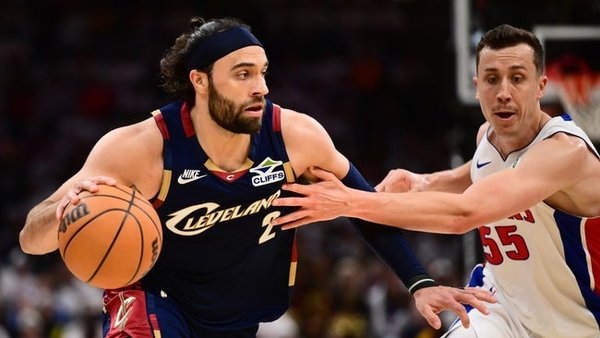
Bash sees a playoff series at a crossroads and a total that doesn’t reflect the expected game shape or the offensive firepower both teams can deploy in a must-win situation.
The Setup: Pistons at Cavaliers
Cleveland hosts Detroit on Monday night with the Eastern Conference semifinals tied at 2-1 after the Cavaliers finally closed out a playoff game. The market has Cleveland -3.5 at home with a total of 213.0, and that number immediately stands out. The projection here points to a much faster, higher-scoring affair than the market is pricing — we’re looking at a game that should push well past 220 possessions worth of offense if both teams play to their season-long tendencies.
Detroit took the first two games of this series by winning in the clutch, but Cleveland answered in Game 3 with timely plays from James Harden and Max Strus down the stretch. Donovan Mitchell dropped 35 and 10, Harden added 19, and Jarrett Allen chipped in 18. The Cavaliers are 52-30 overall and 27-14 at home, while the Pistons sit at 60-22 with a 28-13 road mark. This is a playoff game between two teams that can score, and the total feels like it’s pricing a defensive grind that neither team’s profile supports.
Game Info & Betting Lines
When: Monday, May 11, 2026 | 7:30 PM ET
Where: TBD
Watch: NBC, Peacock
Spread: Cleveland Cavaliers -3.5 (-110) | Detroit Pistons +3.5 (-110)
Total: 213.0 (Over -110 / Under -110)
Moneyline: Cleveland -161 | Detroit +131
Why This Line Exists
The market is giving Cleveland a short home number because they just won Game 3 and have home court for Game 4. The Cavaliers needed that win to stay alive in the series, and the betting public sees a team with momentum facing a must-hold situation. Detroit is still up 2-1, but the Pistons didn’t close well in Game 3, and that’s enough to shift the spread a bit toward the home side.
The total at 213.0 feels like it’s reacting to the playoff context — tighter rotations, more halfcourt offense, defensive intensity ramping up. But that’s not what the numbers say about these two teams. Cleveland posted a 118.3 offensive rating during the regular season, Detroit checked in at 117.3, and both teams play at a pace right around 100 possessions per game. My model projects a total closer to 230, and that’s a massive gap. The market is underpricing the offensive firepower and the pace at which this game should be played.
Cleveland’s defense has been leaky all year — they gave up 114.1 points per 100 possessions during the regular season, which ranks them in the bottom half of the league. Detroit’s defense is better at 108.9, but the Pistons aren’t a shutdown unit either. When you blend the pace and the efficiency metrics, you get a game that should produce significantly more scoring than 213 points.
Pistons Breakdown
Detroit is the top seed in the East for a reason. The Pistons went 60-22 during the regular season, and they’ve got the offensive firepower to score on anyone. Cade Cunningham is the engine, averaging 23.9 points and 9.9 assists per game while shooting 46.1% from the floor. Jalen Duren gives them an interior presence at 19.5 points and 10.5 rebounds per game on 65.0% shooting. The Pistons also have spacing with Duncan Robinson (12.2 points, 41.0% from three) and Tobias Harris (13.3 points, 36.8% from three).
Detroit’s offensive rating of 117.3 is elite, and they shoot 54.6% effective field goal percentage with a true shooting mark of 58.3%. They also crash the offensive glass at a 30.9% rate, which gives them second-chance opportunities that Cleveland struggles to limit. The Pistons are dealing with a couple of injury questions — Kevin Huerter is questionable with a left adductor strain and could miss his seventh straight game, while Caris LeVert is questionable with a heel issue. Neither player is a rotation centerpiece in the playoffs, so the impact is minimal.
The clutch numbers for Detroit are solid but not dominant. They’re 27-15 in clutch situations during the regular season, shooting 42.0% from the floor and 21.9% from three in the final five minutes of close games. They’ve won the close games in this series so far, but Game 3 showed they can be had late.
Cavaliers Breakdown
Cleveland’s offense is the story here. The Cavaliers posted a 118.3 offensive rating during the regular season, which is actually better than Detroit’s mark. Donovan Mitchell is the go-to scorer at 27.9 points per game on 48.3% shooting and 36.4% from three. James Harden gives them a second creator at 23.6 points and 8.0 assists per game, and he’s shooting 37.5% from three. Evan Mobley (18.2 points, 9.0 rebounds) and Jarrett Allen (15.4 points, 8.5 rebounds) provide interior scoring and rebounding.
The Cavaliers shoot 56.1% effective field goal percentage and 59.4% true shooting, both of which are better than Detroit’s marks. They also turn the ball over at just a 12.2% rate, which is slightly better than the Pistons. The problem for Cleveland is the defense — they gave up 114.1 points per 100 possessions during the regular season, and that’s a real issue against a Detroit offense that can score in multiple ways.
Cleveland’s clutch record is 24-18, and they shoot 44.0% from the floor and 34.0% from three in clutch situations. They finally came through in Game 3 with Harden hitting big shots and Strus making the key steal and go-ahead basket. That’s the kind of execution they’ll need again in Game 4.
The Matchup
This game sets up as an offensive showcase. Cleveland’s offense against Detroit’s defense projects to a 9.4-point advantage per 100 possessions when you match the Cavaliers’ offensive rating against the Pistons’ defensive rating. Detroit’s offense against Cleveland’s defense projects to a 3.2-point advantage per 100 possessions. Both teams have the edge when they have the ball, which tells you everything you need to know about how this game should play out.
The pace should settle around 100 possessions, which is right in line with both teams’ season-long tendencies. Cleveland plays at 100.7 possessions per game, Detroit plays at 99.9, and the blend puts us right at 100.3. That’s an up-tempo game by playoff standards, and it’s going to create more scoring opportunities than the market is accounting for.
Detroit has a significant edge on the offensive glass — they grab 30.9% of their misses compared to Cleveland’s 26.8%. That’s a 4.1-percentage-point gap, and it’s going to give the Pistons extra possessions and second-chance points. Cleveland has a slight edge in shooting efficiency and ball security, but those gaps are small enough to be within noise. The real story is that both teams can score, both teams will have plenty of possessions, and the defense on both sides is not good enough to slow down the opposing offense.
The spread at Cleveland -3.5 feels about right given the home court and the series context. The Cavaliers need this game to even the series, and they’ve got the offensive firepower to keep it close or win outright. But the total at 213.0 is way off. We’re looking at two teams that should combine for 230 points based on their efficiency, pace, and defensive limitations.
Bash’s Best Bet & The Play
The Play: Over 213.0 (-110)
This total is mispriced by a significant margin. The projection points to 230 points, and that’s a 17-point gap between the market number and what the matchup should produce. Cleveland’s offense is elite, Detroit’s offense is elite, and neither defense is equipped to slow down the other team. You’ve got two teams playing at a pace around 100 possessions per game, and you’ve got offensive ratings in the 117-118 range. That’s a recipe for a high-scoring game, and the market is pricing it like a defensive slugfest.
The risk here is that playoff rotations tighten and both teams lean into halfcourt execution, which could slow the game down. But the season-long data doesn’t support that outcome. Both teams have shown they can score in multiple ways, and the defensive metrics suggest neither team can consistently get stops. I’m backing the over with confidence that this game plays faster and higher-scoring than the market expects.