Bash sees a pace differential and offensive mismatch creating a tighter game than the market expects, with Cleveland’s firepower keeping this one closer than the spread suggests.
The Setup: Cleveland Cavaliers at New York Knicks
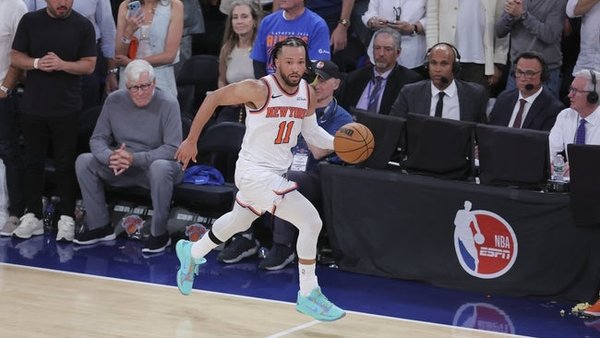
The Knicks are laying 6.5 points at home Thursday night against a Cavaliers team that just watched a 22-point fourth-quarter lead evaporate in Game 1 of the Eastern Conference finals. New York rallied from 93-71 down with under eight minutes left, Jalen Brunson went supernova with 38 points, and the Garden crowd lost its mind in a 115-104 overtime win. That’s the kind of comeback that shifts momentum in a series, and the market is pricing New York as a clear favorite in Game 2.
But here’s the tension: Cleveland controlled 40 minutes of that game before the collapse. The Cavs’ offensive firepower didn’t disappear—they just couldn’t close. Now the projection has this game landing around three points, which creates a meaningful gap against a 6.5-point spread. The Knicks are the better home team and they’ve got the crowd behind them, but this number feels inflated after one dramatic finish.
The total sits at 216, which is interesting given both teams pushed well past that in Game 1’s overtime affair. But regulation scoring suggests a more deliberate pace, and that’s where the game shape gets tricky.
Game Info & Betting Lines
Game Time: 7:30 PM ET
Location: TBD
TV: ESPN
Date: Thursday, May 21, 2026
Current Spread: New York Knicks -6.5 (-110) | Cleveland Cavaliers +6.5 (-110)
Moneyline: Knicks -240 | Cavaliers +189
Total: Over 216.0 (-110) | Under 216.0 (-110)
Why This Line Exists
The market is reacting to what just happened: a historic comeback, a home crowd that turned Madison Square Garden into a pressure cooker, and a Knicks team that now has all the momentum in this series. New York’s 30-10 home record supports the home favoritism, and Brunson’s late-game heroics reinforce the idea that the Knicks are clutch when it matters.
But this 6.5-point spread is also pricing in recency bias. Cleveland didn’t lose because they couldn’t score—they put up 104 points in 48 minutes and were cruising until the wheels came off. James Harden and Donovan Mitchell combined for quality looks throughout that game, and the Cavs’ offensive rating of 118.3 suggests they can generate efficient offense against most defenses.
The Knicks’ defensive rating of 112.3 is strong, but Cleveland’s offense-versus-New York’s defense creates a mismatch worth 6.0 points per 100 possessions. That’s a strong edge that doesn’t just vanish because of one fourth-quarter meltdown. The market is asking you to lay nearly a touchdown with a team that’s only projected to win by a field goal, and that’s where the value conversation starts.
Cleveland Cavaliers Breakdown
The Cavs are 52-30 overall and 25-16 on the road, which is solid but not elite away from home. Donovan Mitchell is averaging 27.9 points per game and remains the primary scoring engine, while James Harden is facilitating at 8.0 assists per game and providing secondary scoring at 23.6 points. That’s a legitimate two-headed offensive attack that can punish defenses in different ways.
Evan Mobley and Jarrett Allen give Cleveland size and rim protection, with Mobley chipping in 18.2 points and 9.0 rebounds while Allen provides efficient scoring at 15.4 points on 63.8% shooting. The frontcourt depth matters in a series where physicality and rebounding become critical.
Cleveland’s pace of 100.7 possessions per game is faster than New York’s 97.7, which creates a stylistic clash. The Cavs want to push tempo and generate transition opportunities, while the Knicks prefer a more methodical halfcourt game. That pace differential will shape how this game unfolds, and it’s a factor the market may be undervaluing.
The clutch numbers are basically even—Cleveland is 24-18 in clutch situations with a 44.0% field goal percentage in the final five minutes. They’re not a team that folds under pressure, even if Game 1’s collapse suggests otherwise.
New York Knicks Breakdown
The Knicks are 53-29 overall and an impressive 30-10 at home, where they’ve been one of the league’s toughest outs all season. Jalen Brunson is the engine, averaging 26.0 points and 6.8 assists, and his ability to attack downhill and create for others makes him a nightmare in late-game situations. Game 1 was a perfect example—he relentlessly attacked Harden in the fourth quarter and overtime, and Cleveland had no answer.
Karl-Anthony Towns provides size and spacing at 20.1 points and 11.9 rebounds, while OG Anunoby and Mikal Bridges give New York perimeter defense and secondary scoring. Josh Hart is the glue guy, contributing 12.0 points, 7.4 rebounds, and 4.8 assists while doing all the little things that don’t show up in the box score.
New York’s offensive rebounding edge is worth 2.6 percentage points over Cleveland, which translates to extra possessions and second-chance scoring opportunities. That’s a medium-level advantage that can add up over the course of a playoff game, especially in a slower-paced environment where every possession matters.
The Knicks’ clutch record is 21-13 with a 47.0% field goal percentage in tight situations, and they’ve shown they can execute when the game is on the line. The Garden crowd is a legitimate factor—this building gets loud, and it can rattle opponents in key moments.
The Matchup
This game comes down to pace and execution. The expected pace blend lands around 99 possessions, which is deliberate but not glacial. That tempo favors New York’s halfcourt execution and defensive discipline, but it also limits the total number of scoring opportunities for both teams.
The key tension is Cleveland’s offensive mismatch. My model projects the Cavs’ offense against New York’s defense at a 6.0-point advantage per 100 possessions, which is a strong edge that suggests Cleveland can score efficiently even in a hostile environment. Harden and Mitchell are capable of creating high-quality looks in isolation and pick-and-roll situations, and the Knicks don’t have a lockdown defender who can eliminate either player.
New York’s offensive rebounding advantage creates extra possessions, but Cleveland’s size with Mobley and Allen can limit some of that edge. The Cavs’ defensive rating of 114.1 isn’t elite, but it’s competent enough to make the Knicks work for their points.
The shooting quality is basically within noise—both teams post similar true shooting and effective field goal percentages, so there’s no real gap in shot-making efficiency. Turnover rates are also nearly identical, which means this game won’t be decided by careless mistakes or ball security issues.
What matters is whether Cleveland can avoid another late-game collapse. The Cavs have the offensive firepower to stay within striking distance, and the pace differential keeps this game from turning into a blowout. New York will control tempo and lean on Brunson’s playmaking, but Cleveland’s ability to generate efficient offense keeps them in this game longer than the spread suggests.
Bash’s Best Bet & The Play
The play is Cleveland Cavaliers +6.5. The projection has this game landing around three points, which creates a meaningful cushion with the Cavs getting nearly a touchdown. Cleveland’s offensive mismatch is real, and their ability to score efficiently against New York’s defense keeps this game competitive deep into the fourth quarter.
The market is overreacting to Game 1’s dramatic finish, and that recency bias is baked into this inflated number. The Cavs didn’t lose because they couldn’t compete—they lost because they couldn’t close. But over the course of 48 minutes, Cleveland has the offensive weapons to stay within this number, and the pace differential limits New York’s ability to pull away.
The risk is obvious: the Knicks have the crowd, the momentum, and the home-court advantage. Brunson is playing at an elite level, and New York’s defensive discipline can force Cleveland into tough shots late. But 6.5 points is a lot to lay in a playoff game between two teams separated by only 2.3 points in net rating. Take the points with the Cavs and trust their offensive firepower to keep this one closer than the market expects.