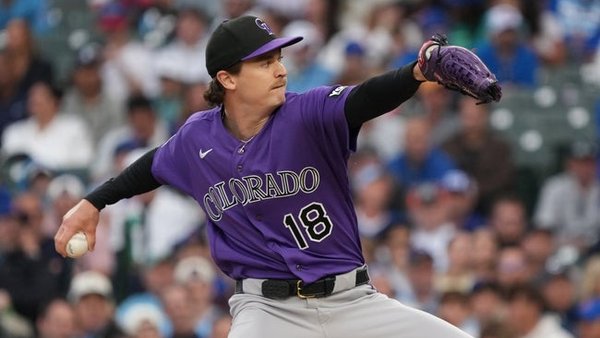
Two starters with true ERAs north of 5.40 are set to take the mound at Coors Field — a park running a 1.38 run factor — yet the under is priced at -119 as if one of them is dominant. The market is leaning into a defensive outcome this run environment simply does not support, and Colorado’s bullpen ERA of 5.42 removes any late-inning safety net.
Kyle Leahy vs Ryan Feltner: St. Louis Cardinals at Colorado Rockies Betting Preview
The market has built a number that looks reasonable on the surface. Eleven and a half runs at Coors Field isn’t a timid total — it’s already elevated compared to a neutral-park game. But when you peel back the pitcher profiles behind this matchup, the structural case for the over becomes difficult to argue against. This isn’t about the Cardinals being a powerhouse or the Rockies suddenly finding their offensive rhythm. It’s about two vulnerable arms throwing in the most run-friendly park in baseball, with a projected combined total that clears 11.5 by more than a full run. The play: Over 11.5 (-101), 2 units.
The Cardinals arrive from Los Angeles, where they just closed out a series that saw them score 13 in a blowout win Tuesday before dropping a walk-off on Thursday. Colorado is coming off a pair of wins against Baltimore, including a wild 11-inning comeback. Neither team’s recent form is the story here — the pitching gap and the altitude are.
The total over is the cleanest expression of this game. Both starters project to get hit hard. The park amplifies every run-scoring mistake. And the under price of -119 tells you the market is leaning the wrong way.
Game Info & Betting Lines
- Date/Time: Friday, September 4, 2026 — 8:40 PM ET
- Venue: Coors Field | Park Factor: 1.38 (one of the highest in baseball)
- Probable Starters: Kyle Leahy (STL) vs Ryan Feltner (COL)
- Moneyline: Cardinals -131 / Rockies +109
- Run Line: Cardinals -1.5 (+113) / Rockies +1.5 (-136)
- Total: 11.5 — Over -101 / Under -119
Why This Number Is Off
The market’s lean toward the under at -119 isn’t irrational. Sportsbooks see Coors Field and bake in the park factor automatically — but sharp money sometimes fades inflated totals in Denver, betting on the idea that the number already prices in the altitude premium and then some. That’s a legitimate counterargument, and I won’t dismiss it.
But here’s the problem: 11.5 at Coors with these two pitchers is still light. The under is priced as if there’s a dominant arm on one side suppressing offense. There isn’t. Kyle Leahy’s true ERA is 5.41 with a WHIP of 1.47 — the 3.13 figure ESPN surfaces is a record-tied illusion that conflates wins with efficiency. Leahy has allowed 25 home runs across 134.2 innings, a rate that spikes dangerously in thin air. On the other side, Ryan Feltner carries a 5.84 career ERA per ESPN, with his current 3.00 mark resting on a 9-inning sample that’s too small to trust and a WHIP of 1.44 that signals ongoing contact problems.
The under at -119 requires the market to be right that these two guys will hold a combined offense to roughly five runs apiece in a park with a 1.38 run factor. The over at -101 asks for one thing: the math to play out. At near-even odds, the over is the value side.
What Separates the Pitching
Comparing Leahy and Feltner is less a study in contrast and more an exercise in identifying which pitcher’s vulnerabilities are larger. On balance, Leahy’s sample is more concerning because it’s larger and more predictive — 134.2 innings is a season’s worth of evidence. His four-seam fastball sits at 94.3 mph and accounts for 30.6% of his pitches, generating a .390 xwOBA against — meaning hitters are making strong contact against his primary offering. His slider (.258 xwOBA, 36.5% whiff) and curveball (.240 xwOBA, 38.6% whiff) are genuine put-away weapons, but they haven’t prevented the 25 home runs that have piled up. Leahy creates innings where strikeouts and hard contact coexist — and at Coors, the hard contact wins.
Feltner’s arsenal is built around a sinker (28.2% usage, 92.1 mph) that generated only a 4.0% whiff rate — a ground-ball approach that flatly doesn’t work at altitude where the ball carries. His sweeper is a liability: .503 xwOBA against at 12.8% usage. The curveball (57.1% whiff, .054 xwOBA) is elite, but at 16.8% usage, it isn’t deployed frequently enough to define his outings. Against a Cardinals lineup featuring Jordan Walker (.443 xwOBA, 28 HR) and Joshua Báez (.441 xwOBA, 10.3% barrel rate), Feltner’s sinker-heavy approach is a mismatch. Leo Bernal further complicates matters — sitting at a .501 xwOBA with a 46.7% hard-hit rate overall.
Neither arm projects to eat deep into this game. Short outings mean bullpen exposure on both sides — and Colorado’s bullpen carries a team ERA of 5.42. That’s not a firewall; it’s an accelerant.
The Pushback
The under at -119 isn’t random. The market is sending a signal that sharper money may be sitting on the defensive side of this number. That warrants genuine respect. There’s also the reality that 11.5 is already an elevated total — the sportsbook has priced in Coors Field. To cash the over, both offenses need to outperform the already-generous baseline the market has established.
The concern that cuts deepest: Feltner is listed Day-To-Day with illness. That sounds like it helps the over — a compromised pitcher in the thin Denver air is a nightmare scenario for the under. But the wrinkle is that an illness scratch means a spot starter steps in, and a fresh arm on short notice sometimes suppresses offenses that haven’t seen that pitcher’s stuff. It’s a real variable. I’m not ignoring it. I’m just not weighting it heavily enough to flip sides, because a replacement-level arm at Coors Field carries the same structural vulnerabilities Feltner does — and potentially worse command.
Run Environment & Game Shape
Colorado is 54-86 and playing out the string. Their offense ranks among the more active in the NL West by raw counting stats — 154 home runs, a .738 OPS — and they play half their games in a park that inflates every number. The Cardinals sit at .700 OPS as a team but feature genuine power throughout the lineup: Walker (28 HR), Alec Burleson (.422 xwOBA, 21 HR), and a second unit built around hard-contact profiles rather than plate discipline. Against Feltner’s sinker-heavy mix and Colorado’s bullpen ERA of 5.42, St. Louis has multiple avenues to cross the plate in bunches.
The Rockies’ recent offense has been streaky — they lost three straight before winning two against Baltimore, including an 11-inning thriller — but their home environment does the heavy lifting. Leahy’s 25 home runs allowed in 134.2 innings becomes a more alarming number once you factor in the 1.38 park multiplier. Hunter Goodman (.455 xwOBA, 36 HR) sits in the heart of the Colorado lineup and has the barrel profile to punish a four-seamer generating a .390 xwOBA against. TJ Rumfield and Jake McCarthy add contact volume at the top of the order.
The game shape here points to a mid-to-high scoring affair that bleeds into the bullpens early. When both starters have true ERAs above 5.40, neither is likely to give you seven clean innings. Once Colorado goes to a relief corps posting a 5.42 ERA, and St. Louis works through its own pen in a park playing at 1.38, runs accumulate. That’s a scoring environment, not a low-run defensive showcase — and the 11.5 total underestimates it. The over at -101 is the right number at the right price.
The play: Over 11.5 (-101), 2 units.