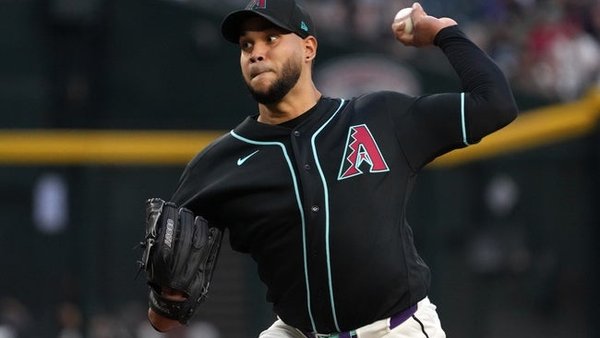
Eduardo Rodriguez’s 2.59 ERA over 167 innings is an ace-caliber body of work — yet the posted total of 8.0 prices this game as if both starters are equals. After applying Daikin Park’s run-suppressing 0.96 park factor and crediting Rodriguez’s full-season suppression edge over Lambert, the adjusted run expectation slides to the under side of 8.0, and the market still hasn’t fully closed that gap.
Eduardo Rodriguez vs. Peter Lambert: Arizona Diamondbacks at Houston Astros Betting Preview
After yesterday’s 4-3 extra-inning finish, the pitching matchup shifts significantly today. Arizona sends Eduardo Rodriguez (14-5, 2.59 ERA, 1.22 WHIP in 167.0 IP) to the mound — a legitimate ace-caliber season by any measure. Houston counters with Peter Lambert (8-7, 3.66 ERA, 1.24 WHIP in 132.2 IP), a serviceable mid-rotation arm who has done a reasonable job keeping games in hand.
The market has priced this as essentially a coin-flip game: Arizona -108, Houston -112, with a total of 8.0. That near-parity pricing is understandable on the surface — both offenses are mediocre, neither team is on a hot streak. But a coin-flip moneyline doesn’t capture the pitching gap between these two starters, and the posted 8.0 total may be slightly generous to run-scoring when Rodriguez is on the hill in a park that plays below league average.
The numbers project a combined 8.7 runs — sitting 0.7 over the posted number, which sounds like a raw over lean until you apply the two adjustments that actually move the needle. Apply Daikin Park’s 0.96 park factor and that 8.7 drops to roughly 8.35 combined runs. Then layer in Rodriguez’s ERA-based suppression edge over a replacement-level left-hander — his 2.59 ERA tracks roughly a full run better than a league-average starter — and the adjusted expectation falls closer to 7.9 to 8.1, right at or below the posted number. The raw projection technically leans over; the adjusted projection lands on the under side of 8.0, which is exactly where I want to be at -115.
Game Info & Betting Lines
- Date/Time: Sunday, September 6, 2026 | 2:10 PM ET
- Venue: Daikin Park (Minute Maid Park) — Dome | Park Factor: 0.96 (run-suppressing)
- Probable Starters: Eduardo Rodriguez (ARI, 14-5, 2.59 ERA) vs. Peter Lambert (HOU, 8-7, 3.66 ERA)
- Moneyline: Arizona -108 / Houston -112
- Run Line: Houston +1.5 (-186) / Arizona -1.5 (+153)
- Total: 8.0 (Over -105 / Under -115)
Why This Number Is Close (But Slightly Off)
The market is doing something rational by posting 8.0 here. Both teams carry below-average offenses — Arizona’s OPS sits at .708, Houston’s at .723 — and the dome environment in Houston plays at a 0.96 park factor, which shaves run scoring relative to a neutral site. Sportsbooks are accounting for mediocre lineups in a pitcher-friendly setting. That’s the correct framework.
The legitimate case for the over centers on yesterday’s game going to extras (4-3 final) and the broader pattern of this series staying competitive. Tight, contested games can flip over 8.0 runs with one multi-run inning. Houston’s bullpen — operating in a team ERA context of 4.52 — isn’t a lockdown unit, and if Rodriguez exits after five or six innings with a modest lead, the back end of that staff carries real risk.
But here’s the problem: the 8.0 line prices Lambert as a virtual equal to Rodriguez, and he simply isn’t. Once you apply the park factor math (8.7 × 0.96 ≈ 8.35) and then credit Rodriguez’s ERA-based suppression, the adjusted expectation slides to the under side of 8.0. Rodriguez’s ability to hold Houston’s lineup in check is the variable most likely to push final totals below that threshold. The under at -115 is a fair price that the market hasn’t fully closed.
What Separates the Pitching
Rodriguez and Lambert represent two very different profiles, and the gap between them is the central argument for the under.
Rodriguez built his arsenal around a 92.0 mph four-seamer used 39.3% of the time (xwOBA .327, whiff 18.0%) paired with an elite changeup at 85.5 mph that generates a 24.7% whiff rate and a .281 xwOBA against — that’s a true put-away pitch at 26.7% usage. His curveball adds another whiff dimension at 19.8%. The cumulative effect is a pitcher who limits hard contact by design: the Houston lineup’s soft spots amplify this. Isaac Paredes posts an xwOBA of just .304 with a 2.3% barrel rate against pitchers like Rodriguez, and Yainer Diaz checks in at .343 xwOBA — hitters whose surface production overstates their actual contact quality. Rodriguez’s changeup is especially punishing for contact-reliant right-handed bats who can’t square up premium velocity change.
Lambert operates with a different arsenal: a 94.0 mph four-seamer at 31.0% usage (xwOBA .322, whiff 20.8%) and an above-average changeup that generates a remarkable 32.4% whiff rate with a .242 xwOBA. That changeup is legitimately elite — arguably Lambert’s best weapon. He also throws a slider (26.2% whiff, .283 xwOBA) and a sweeper (.282 xwOBA). Lambert is not a liability; his numbers suggest he can limit Arizona to the 3-4 run range.
The gap, though, is in run prevention floor. Rodriguez’s 2.59 ERA over 167 innings isn’t a small-sample anomaly — it’s a full-season body of work that translates to a meaningful suppression edge. Lambert at 3.66 ERA is serviceable; Rodriguez at 2.59 ERA is elite. In a game projected this close, that one-plus-run gap in starter quality is exactly where the under finds its margin.
The Pushback
The strongest argument against this ticket walks to the plate batting second for Houston: Yordan Alvarez. A 1.031 OPS, 37 home runs, and an xwOBA of .521 — that’s not a hitter you navigate carelessly. Against Rodriguez specifically, Alvarez is hitting .500 in 21 plate appearances, which sounds terrifying. But here’s the deeper context that actually reinforces the under: Alvarez has zero home runs in those 21 PA and has struck out five times. He’s making contact, yes — but he hasn’t done damage, and the whiff data (.521 xwOBA notwithstanding) shows Rodriguez is keeping the ball in the park against him. That’s not a hitter who is teeing off for three-run bombs; that’s a hitter who is getting on base in a frustrating but ultimately contained way. The engine’s suppression case doesn’t require Rodriguez to retire Alvarez every at-bat — it requires him to prevent the crooked number, which the BvP record suggests he’s doing.
I also considered the Arizona -1.5 run line at +153 as an alternative play. The math is tempting — you’re getting plus money on a team I think wins this game more often than not. But I rejected it, and here’s why: Arizona’s .708 OPS offense is not a multi-run margin machine. This lineup doesn’t blow teams out. Look at the evidence from this very series: a 4-3 extra-inning finish on Saturday, a 3-1 Houston win on Friday. These are tight finishes, not blowouts, and asking Arizona to cover -1.5 against a decent Lambert start in a run-suppressing dome is asking too much of an offense that ranks among the weaker units in the National League. The run line at +153 is a seductive price; the matchup says no.
The over case does have one other legitimate hook: Lambert’s walk rate. He’s issued 56 free passes in 132.2 innings, and free baserunners in a dome can pile up quickly. If Lambert works into a three-ball count early against Arizona’s patient spots — Perdomo at 12.3% walk rate, Moreno at 11.4% — the Diamondbacks can make him work without needing elite contact. That’s a real path to runs. I’m factoring it in, and it’s part of why I’m grading this moderate confidence rather than high.
Run Environment & Game Shape
The recent series context matters here. Friday’s 3-1 game and Saturday’s 4-3 extra-inning finish both came in at or under the 8.0 total, and Saturday’s game required 10 innings to get there. Neither offense has shown the ability to string together sustained multi-run rallies in this matchup. Arizona is 5-5 in its last 10 games with a -2 run differential — a team living on the margins. Houston is 7-3 in its last 10 but carries a -37 run differential for the season, meaning those wins have been closer than the record implies.
In a dome with a 0.96 park factor and Rodriguez on the mound, the most likely game shape is a low-scoring pitchers’ duel through six innings, with bullpens trading zeros or allowing one run at a time in the later frames. Even a 4-4 tie going to extras, like Saturday’s game, lands exactly on the number — and with Rodriguez pitching instead of Pecko, the path to that kind of late-game offensive volume gets significantly harder for Houston to achieve. The realistic over scenario requires Lambert to serve up crooked numbers early, which his recent body of work doesn’t strongly suggest, and requires Rodriguez to surrender a multi-run inning, which his 2.59 ERA over 167 innings makes an outlier outcome.
The Bet
Under 8.0 (-115) | 2 Units | Moderate Confidence
The park-adjusted, Rodriguez-adjusted projection lands just below 8.0, the series has already handed us two games under this number in the last 48 hours, and you’re getting the under at a price that still represents value — because Rodriguez’s suppression ability is the one variable this market hasn’t fully priced in.