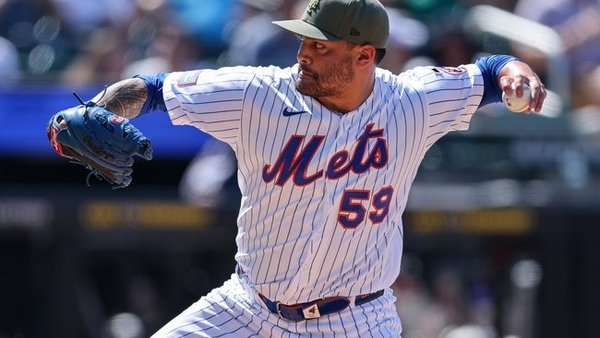
Manaea brings 144.2 innings, a 4.67 ERA, and a sweeper generating a 29.3% whiff rate — Herz has thrown 4.0 big league innings at a 9.00 ERA. The moneyline lists both sides at -110, a flat split that treats this like a true coin flip. The pitching gap says otherwise.
Sean Manaea vs. DJ Herz: New York Mets at Washington Nationals Betting Preview
The Mets dropped the series opener Friday, bounced back with a dominant 7-1 win Saturday, and now close out the 2026 regular season in Washington on Sunday afternoon. After yesterday’s blowout, the pitching matchup shifts dramatically — and the line hasn’t moved to reflect it. Both sides are listed at -110, a flat, even-money split that implies a true toss-up. The problem with that framing is the starting pitchers are nowhere close to equivalent.
Sean Manaea brings 144.2 innings of experience, a 4.67 ERA, and a three-pitch mix anchored by a sweeper that generates a 29.3% whiff rate. DJ Herz has thrown 4.0 innings this season, owns a 9.00 ERA and a 1.75 WHIP, and is one of the most volatile arms in the active pitcher pool. The market is pricing this game as a 50/50 proposition. The pitching data does not support that.
The core thesis here is simple: Manaea represents a clear starter advantage at a -110 price that sits comfortably under any reasonable juice ceiling. The Mets’ offense is coming off a seven-run output against this same Nationals pitching staff. That combination — pitching mismatch plus live lineup momentum — is where the edge lives today.
Game Info & Betting Lines
- Date/Time: Sunday, September 27, 2026 | 1:05 PM ET
- Venue: Nationals Park | Park Factor: 0.98 (neutral, slight run suppression)
- TV: MLB.TV, Nationals.TV, SNY
- Probable Starters: Sean Manaea (NYM) vs. DJ Herz (WSH)
- Moneyline: New York Mets -110 / Washington Nationals -110
- Run Line: New York Mets -1.5 (+153) / Washington Nationals +1.5 (-186)
- Total: 8.0 (Over -118 / Under -102)
Why This Number Is Off
Flat -110 on both sides makes sense when the market can’t find a clear edge. The legitimate case for the Nationals is real: they’re 6-4 over their last 10, they’re playing with something to prove in a lost-season NL East race to avoid last place, and their lineup (.743 OPS, 208 home runs on the season) can punish any pitcher who leaves pitches up. CJ Abrams has 33 home runs and 105 RBI. James Wood carries a .533 xwOBA that leads this data set. These are legitimate threats, and the market knows it.
But here’s the problem — the Nationals are handing the ball to a pitcher who has thrown 4.0 big league innings this season at a 9.00 ERA and a 1.75 WHIP. That’s not a small-sample concern worth contextualizing around. That’s a shell of a starting pitcher. The market is also accounting for Mets motivation concerns (74-87, last place, final weekend of a lost season) and the very real Juan Soto hand injury that clouds lineup construction. Those concerns are valid. But they don’t come close to closing the pitching gap that exists between these two starters.
The numbers project a 58.8% win probability for the Mets — an 11.2% implied probability advantage over what -110 prices in. At this price, you don’t need a blowout. You just need to be right more than 52.4% of the time, and the starting pitcher data suggests you will be.
What Separates the Pitching
Manaea’s arsenal is built around two weapons that play well in neutral parks. His sweeper, thrown 30.1% of the time at 75.7 mph, holds hitters to a .277 xwOBA and generates a 29.3% whiff rate — that’s a legitimate bat-misser. His four-seam fastball sits at 91.1 mph with a 21.5% whiff rate and a .336 xwOBA against. The combination creates a pitcher who can work through lineups without relying on overwhelming velocity. At 8.77 K/9, he misses bats at a rate that keeps high-upside lineups honest. The concern with Manaea is the sinker — it carries a .395 xwOBA and only a 6.5% whiff rate, which means it’s a contact pitch that can get squared up. Against a Nationals lineup that makes contact (.246 BA, low strikeout rate relative to power output), that pitch needs to stay off the barrel. His 23 home runs allowed this season reflect that vulnerability.
Herz is a different conversation entirely. In 4.0 innings of work, his four-seam fastball — thrown 47.6% of the time at 93.0 mph — has actually generated a 28.6% whiff rate and a .195 xwOBA against. That’s the legitimate upside the Nationals are betting on. But the changeup, thrown 31.7% of the time, has been a disaster: .519 xwOBA against with a 20.0% whiff rate that hasn’t translated to run prevention. His slider sits at a .582 xwOBA with a 0.0% whiff rate in this sample. The fastball shows promise; everything else creates damage, and the Mets lineup is built with left-handed bats who project well against right-handed pitchers. Carson Benge hits right-handers with a .390 xwOBA — a legitimate threat in this spot, and the matchup-relevant number since Herz is a RHP. His .435 split against left-handers is the more eye-catching figure but it’s simply not applicable today. Francisco Lindor holds a .391 xwOBA vs. right-handers with a 6-for-12 BvP line against Herz in a tiny 6-PA sample. The type of innings each pitcher creates matters: Manaea generates weak contact and strikeouts; Herz generates loud contact on off-speed pitches that hang.
Run Environment & Game Shape
The posted total is 8.0, and the numbers project 9.5 runs — a 1.5-run gap that would ordinarily point toward the over. I’m not going there. The over is priced at -118, and the juice cost alone eats into the value. More importantly, Manaea’s profile — capable strikeout arm, fly-ball suppressor in a 0.98 park factor environment — points toward a game that stays tighter on the New York side of the ledger. The over’s case is almost entirely dependent on a Herz implosion: if he gets knocked around early, runs pile up fast, and the total clears. But that’s a one-sided scoring argument, not a clean two-sided projection that justifies laying the extra juice. I need both offenses contributing to trust the over, and Manaea’s strikeout-heavy mix (.277 xwOBA on the sweeper, 29.3% whiff rate) makes meaningful Mets run suppression a real possibility even if Washington’s lineup is dangerous. The game shape I’m pricing in is a moderate-scoring contest where the Mets’ starter edge holds through five or six innings — not a shootout.
Herz’s short leash matters here too. A pitcher with 4.0 innings of experience this season is not going deep, and the Nationals bullpen is already running on fumes — four arms on the IL (Mitchell Parker, PJ Poulin, Orlando Ribalta, and Matt Waldron) before the game even starts. That’s meaningful bullpen exposure if Herz exits in the third or fourth inning with the Mets in the middle of a rally. The Mets carry their own bullpen concerns with two relievers on the IL (Robert Stock, Daniel Duarte), but those are two arms against four for Washington. The bullpen edge doesn’t neutralize — it tilts toward New York, and it reinforces the moneyline case without requiring a run-line commitment.
Lineup Factors & Injury Watch
The Juan Soto situation is worth flagging directly. He left Saturday’s game in the ninth inning after being hit on the right hand by a 91.7 mph sinker. X-rays were negative, and he’s listed day-to-day. If Soto is out of the lineup, the Mets lose their most dangerous bat — a .919 OPS hitter with a .436 xwOBA and a 13.2% walk rate. That’s a genuine swing factor. It doesn’t change the pitching mismatch, and it doesn’t change the price, but it’s a variable I’m watching closely. If Soto is active and in the lineup, the Mets’ offensive ceiling goes up considerably. If he’s sitting, the lineup is thinner at the top and the game gets closer in expected run terms.
On the Washington side, the Nationals ran out a lineup Saturday that includes real threats. James Wood (.533 xwOBA, 9.8% barrel rate, 36.1% hard-hit rate) is one of the most dangerous contact profiles in this matchup, and his vsLHP xwOBA of .478 is the more relevant split against Manaea — a lefty. Manaea’s BvP sample against Wood is 13 PA, with a .154 average and 4 strikeouts, though that sample is too thin to weight heavily. CJ Abrams carries a .405 xwOBA against left-handers and represents a legitimate middle-of-the-order threat. The Nationals have real offensive capability, which is exactly why the line is flat. But Manaea has the track record and arsenal depth to work through that lineup, and Saturday’s 7-1 result shows this Mets offense can do damage against Washington’s staff.
Pushback
The honest version of the case against this bet: Herz’s fastball is actually good. A 28.6% whiff rate and a .195 xwOBA against on a 93.0 mph four-seamer is a real weapon. If he leans on that pitch and limits the off-speed disasters, you could see a longer, more competitive outing than the surface stats imply. The Nationals also carry legitimate motivation — they’re 76-85, two games ahead of the Mets for third in the NL East, and they’ve won 6 of their last 10. This is not a team in collapse mode. And the Mets, at 74-87 on the final Sunday of a lost season, don’t have much to play for. End-of-season motivation edges are real, and Washington has one here.
I’m also acknowledging that Soto’s injury status introduces lineup uncertainty I can’t fully resolve before first pitch. If he sits, the Mets are running out a lineup without their .919 OPS anchor, which compresses their run-scoring ceiling in a meaningful way.
None of that is enough to flip the play. The pitching gap is too real, the price is too flat, and Washington’s bullpen depth problems are too significant to dismiss. But I’d be lying if I said this was a high-conviction slam-dunk — it’s a moderate-confidence call built on a structural edge, not a hammer spot.
The Pick
New York Mets moneyline (-110), 2 units, moderate confidence. The thesis is straightforward: Manaea holds a clear and meaningful starter edge over a pitcher with 4.0 innings of big league experience this year, and the market is pricing this game as a pure coin flip. Flat -110 clears my juice ceiling comfortably — I’m not laying -130 or -140 to back a slight favorite, but at even money with a projected 58.8% win probability, this is exactly the kind of low-vig spot I’m looking for at the end of the schedule. The Mets just dropped seven runs on this same Nationals pitching staff on Saturday, the lineup carries momentum, and Herz’s off-speed arsenal (.519 xwOBA on the changeup, .582 on the slider) is a damage machine against a left-handed-leaning Mets lineup. I’m not playing the run line at -1.5 — the Mets’ bullpen vulnerabilities and Soto’s injury uncertainty make the margin bet too risky. I’m not playing the over at -118 — the juice cost isn’t worth it when the scoring argument is one-sided and Manaea’s strikeout profile suppresses the ceiling. The moneyline at -110 is the clean, right-sized play. Mets ML, 2 units.