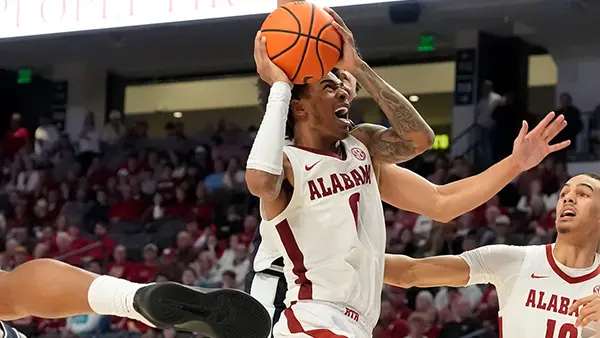
The high-octane Alabama Crimson Tide head to Auburn for a top-tier SEC showdown featuring the league’s most prolific scoring offense. Our analytical preview breaks down the efficiency gap and provides an ATS pick based on the Tide’s elite adjusted offensive rating and the Tigers’ home-court dominance.
The Setup: Alabama at Auburn
Auburn’s laying 2.5 to 3.5 points at home against Alabama, and this is the kind of line that gets people talking. Two SEC heavyweights, both playing at elite offensive levels, and the market’s essentially calling this a pick’em with home court. But here’s what matters: When you dig into the collegebasketballdata.com efficiency numbers, Alabama’s adjusted offensive rating sits at 125.4, ranking 4th nationally. Auburn checks in at 120.9, 19th in the country. That’s a significant gap. Meanwhile, Alabama’s adjusted defensive rating of 102.1 (#65) gives them a substantial edge over Auburn’s 106.2 (#141). The adjusted net efficiency tells the story—Alabama at 23.2 (#12) versus Auburn at 14.6 (#45). This isn’t just a rivalry game. It’s a clash between Alabama’s elite offensive firepower and Auburn’s home court advantage at Neville Arena.
Game Info & Betting Lines
Matchup: Alabama (7-2) @ Auburn (7-3)
Date: February 7, 2026
Time: 4:00 PM ET
Location: Neville Arena, Auburn, AL
Betting Lines:
- Bovada: Auburn -3.5 | O/U 174 | ML: Auburn -160, Alabama +135
- DraftKings: Auburn -2.5 | O/U 174.5 | ML: Auburn -125, Alabama +105
Why This Number Makes Sense (or Doesn’t)
The market’s hedging its bets here, and I get why. Auburn’s home court typically carries weight, but the efficiency gap between these teams is substantial. Alabama’s 23.2 adjusted net efficiency ranks 12th nationally—that’s top-15 territory. Auburn’s 14.6 net efficiency at 45th is solid, but we’re talking about nearly a nine-point difference in adjusted metrics. That’s not negligible.
Here’s where it gets interesting: The tempo contrast. Alabama plays at a blistering 75.6 pace, ranking 10th nationally. Auburn? They’re at 68.5, sitting 179th. That seven-possession difference per game is massive. Alabama wants to run, push transition, and leverage their 125.7 offensive rating (#37 in raw efficiency). Auburn wants to slow it down, crash the offensive glass at 36.0% (31st nationally), and control possessions.
The total at 174-174.5 reflects this tension. Alabama’s averaging 95.1 points per game (7th nationally) while allowing 79.2 (299th in defensive points allowed). Auburn’s at 85.9 PPG (55th) and 76.7 allowed (258th). If Alabama dictates tempo, we’re flying over. If Auburn grinds this into a halfcourt battle, the under’s in play. The spread at 2.5 to 3.5 suggests the market respects Alabama’s efficiency edge but can’t ignore Auburn’s home court. I think there’s value to be found here.
Alabama Breakdown: The Analytical Edge
Let’s talk about what makes Alabama dangerous. Labaron Philon Jr. is putting up 21.4 PPG (8th nationally) with 5.4 assists per game (46th). That’s your primary engine. Add Aden Holloway at 18.2 PPG (87th nationally), and you’ve got two guards who can break down defenses in multiple ways. Alabama’s assist rate sits at 18.2 per game (34th), showing excellent ball movement for a team that plays this fast.
The efficiency numbers are elite. That 57.2% effective field goal percentage ranks 39th nationally, and their 60.9% true shooting (41st) shows they’re not just running and gunning—they’re scoring efficiently. The turnover ratio of 0.1 ranks 3rd nationally with just 9.9 turnovers per game (29th). That’s remarkable discipline for a team playing at the 10th-fastest pace.
Defensively, Alabama’s got issues—that 104.9 defensive rating ranks 165th—but they compensate with 6.2 blocks per game (8th nationally). They protect the rim. The concern? They’re 299th in opponent points per game at 79.2. When you play fast, you’re going to give up points. It’s the efficiency that matters, and at 102.1 adjusted defensive rating, they’re above average.
Auburn Breakdown: The Counterpoint
Auburn’s got its own weapons. Keyshawn Hall is averaging 20.8 PPG (20th nationally) with 8.2 rebounds per game (68th). He’s a legitimate two-way threat. Tahaad Pettiford adds 15.7 PPG (236th), giving Auburn a solid one-two punch. But here’s the difference: Auburn’s assist rate is just 13.3 per game, ranking 250th nationally. They’re more isolation-heavy, less ball movement.
The offensive glass is Auburn’s calling card. That 36.0% offensive rebound rate ranks 31st nationally—they’re getting second chances. They’ve scored 372 points in the paint compared to Alabama’s 344, and they’re converting 164 points off turnovers. Auburn forces 8.4 steals per game (82nd) and creates chaos defensively.
But the pace concern is real. At 68.5 possessions per game, Auburn’s playing seven fewer possessions than Alabama wants. Their 121.2 offensive rating (63rd) is solid but not elite. The 107.7 defensive rating ranks 214th—they’re allowing 1.077 points per possession in raw terms. Against Alabama’s tempo and efficiency, that’s problematic. Auburn needs to control the glass, slow the game down, and make this a physical halfcourt battle.
The Matchup: Where This Gets Decided
This game comes down to tempo control and transition defense. Alabama’s averaging 152 fast break points through nine games. Auburn’s at 122. That 30-point difference in transition scoring tells you everything about how these teams want to play. If Alabama gets out and runs, Auburn’s in trouble.
The other critical factor: Three-point defense. Alabama’s allowing 30.6% from deep (96th nationally). Auburn’s giving up 32.8% (185th). Neither team locks down the perimeter, but Alabama’s got the edge. With Alabama shooting 34.7% from three (141st) and Auburn at 33.9% (172nd), we’re looking at two teams that can score from distance but aren’t elite shooters.
The rebounding battle matters. Auburn’s 36.0% offensive rebound rate could neutralize Alabama’s pace advantage if they’re consistently getting second chances. But Alabama’s 42.7 rebounds per game (20th nationally) shows they’re not getting pushed around on the glass. Alabama’s 29.2% offensive rebound rate ranks just 256th—they’re not crashing hard because they’re sprinting back on defense.
Amari Allen’s 7.7 rebounds per game (112th nationally) needs to show up for Alabama. If Auburn’s dominating the offensive glass and getting extra possessions, this game tightens up. But if Alabama controls the defensive boards and pushes transition, Auburn’s pace becomes irrelevant.
Bash’s Best Bet
I’m taking Alabama +2.5 to +3.5, and I’d play it up to +2. The efficiency gap is too significant to ignore. Alabama’s 12th in adjusted net efficiency, Auburn’s 45th. That’s not a three-point difference on a neutral court—that’s closer to six or seven points. Yes, Auburn’s home court matters, but we’re talking about a team that’s 141st in adjusted defensive rating trying to contain the 4th-ranked adjusted offense in the country.
The tempo advantage favors Alabama. If they get even 72-73 possessions in this game, they’re going to score 85-plus. Auburn’s defensive rating suggests they’ll allow it. I’d also lean over 174 as a secondary play. Alabama’s involved in shootouts—they just put up 100 against Texas A&M and 90 against Missouri. Auburn’s last five games include an 88-82 win over Texas. The pace might not hit Alabama’s ideal number, but we’re still looking at 170-plus possessions combined, and both teams can score.
The value’s with the road dog that’s statistically superior. Auburn’s home court is worth maybe three points. The market’s giving us Alabama plus the points. I’ll take the better team getting points every time.