When a top-ranked scoring unit travels to a hostile environment without its primary engine, the betting market often struggles to adjust the line quickly enough. This SEC clash in Norman presents a unique situational spot for those hunting a best bet on Tuesday night.
The Setup: Auburn at Oklahoma
Auburn’s laying just 1.5 points on the road at Oklahoma on Tuesday night, and something doesn’t add up here. The Tigers are ranked #21 in the AP poll with a 15-12 record, but they’re 2-8 away from home this season and limping into Norman having lost four of their last five. Meanwhile, Oklahoma sits at 13-14 but owns a 10-5 home mark. The market’s basically calling this a pick’em, and when you dig into the collegebasketballdata.com efficiency numbers, that feels generous to the Sooners.
Here’s what the data actually tells us: Auburn checks in at #8 nationally in adjusted offensive efficiency (125.2) while Oklahoma ranks #31 (121.3). That’s elite versus very good. On defense, it flips—Auburn’s #105 (105.7) while Oklahoma sits at #180 (109.4). The net rating gap is 7.6 points in Auburn’s favor, yet they’re getting just 1.5 on the road. The model projects Auburn by 4.5, which means there’s potentially three points of value hiding in this number depending on how you read the injury situation.
Oh, and about that injury situation—Keyshawn Hall, Auburn’s leading scorer at 20.8 PPG and top rebounder at 8.2 boards per game, is OUT due to suspension with no clear return date. That’s not a minor detail. That’s the engine of this offense sitting on the bench, and it explains why this line looks so tight.
Game Info & Betting Lines
Game: Auburn Tigers at Oklahoma Sooners
Date: Tuesday, February 24, 2026
Time: 9:00 PM ET
Location: Lloyd Noble Center, Norman, OK
Conference: SEC
Spread: Auburn -1.5
Total: 159.5/160
Moneyline: Auburn -125 / Oklahoma +105
Why This Number Makes Sense (or Doesn’t)
Let’s start with why Auburn’s only laying 1.5 despite that massive efficiency advantage. Hall’s suspension is the obvious answer—you’re talking about a guy who accounts for nearly 25% of Auburn’s scoring and leads them in rebounding. Without him, the Tigers have morphed from an elite offensive unit into something far more pedestrian. In their last five games, they’re averaging just 78.5 points compared to their season mark of 83.7, and they’ve gone 2-8 ATS over their last 10.
The road splits tell an even uglier story. Auburn’s 2-8 straight up away from home and 3-7 ATS in those games. They score just 72.6 PPG on the road and allow 86.4—that’s a 14-point swing from their overall defensive numbers. Oklahoma, meanwhile, is 10-5 at home and averages 87.1 PPG at Lloyd Noble Center. The Sooners are 5-9 ATS at home, but that number improves when you isolate conference play.
The total sitting at 159.5/160 feels low given both teams’ offensive capabilities, but the model projects 167. That’s a seven-point gap, and it makes sense when you consider the pace (67.8 possessions projected) and the fact that both teams rank in the top 50 nationally in offensive rating. Auburn’s true shooting percentage of 57.6% ranks #98 nationally, while Oklahoma’s 58.4% checks in at #66. These teams can score when they’re clicking.
Auburn Breakdown: The Analytical Edge
Even without Hall, Auburn’s offensive infrastructure remains impressive. That #8 adjusted offensive efficiency ranking doesn’t materialize from one player—it’s built on elite offensive rebounding (37.2%, #2 nationally) and taking care of the basketball (10.0 turnovers per game, #42 nationally). Tahaad Pettiford (15.7 PPG) and Kevin Overton (11.5 PPG) provide secondary scoring, but neither has shown the ability to consistently replace Hall’s production.
The Tigers’ defensive issues are real and worsening. They rank #308 in defensive rating (114.1) and #317 in opponent points per game (79.3). Opponents are shooting 45.7% from the field (#267) and a ghastly 36.2% from three (#318). In SEC play, they’re 6-8 overall and 4-10 ATS, allowing 81.6 PPG in conference games. That’s not a recipe for road success.
Auburn’s one clear advantage is on the glass. Their 37.2% offensive rebounding rate creates second-chance opportunities, and against Oklahoma’s 32.6% offensive rebounding rate, there’s a 4.6-point rebounding edge in Auburn’s favor. They’ve generated 972 points in the paint this season, and attacking Oklahoma’s interior could be their path to covering.
Oklahoma Breakdown: The Counterpoint
Oklahoma’s 13-14 record masks some legitimate strengths, particularly at home. The Sooners rank #31 in adjusted offensive efficiency (121.3) and shoot the ball significantly better than Auburn—46.3% from the field (#121) versus Auburn’s 45.6% (#160), and 35.8% from three (#74) compared to Auburn’s 33.3% (#230). That shooting quality matters in a tight game.
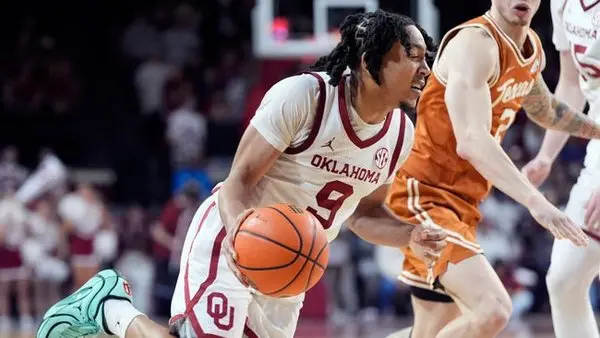
Nijel Pack leads the offense at 17.2 PPG with Tae Davis (13.3 PPG, 6.8 RPG) and Xzayvier Brown (13.1 PPG, 3.4 APG) providing balance. The Sooners distribute the ball better than Auburn (14.2 assists per game versus 12.8) and generate a better assist-to-turnover ratio (1.41 versus 1.29). In a home environment where they’re averaging 87.1 PPG, they have the firepower to exploit Auburn’s defensive weaknesses.
The concern is their recent form. Oklahoma’s 2-8 over their last 10 games and just 3-11 in SEC play, averaging 77.6 PPG in conference games while allowing 83.3. They’ve lost five of six at home, and their defense has cratered—allowing 84.5 PPG over that last 10-game stretch. If Auburn’s offense shows up even without Hall, Oklahoma might not be able to keep pace.
The Matchup: Where This Gets Decided
This game comes down to whether Auburn can score enough without Hall to cover a tiny road number against a home team that can light it up. The head-to-head history heavily favors Auburn—they’re 3-0 straight up and 3-0 ATS in the last three meetings, including a 98-70 demolition in Norman last season. But that was with Hall, and this Auburn team looks nothing like that version.
The pace matchup is neutral—both teams hover around 67-68 possessions per game. The shooting edge goes to Oklahoma, particularly from three. Auburn’s #2 offensive rebounding rate could be the difference maker, but only if they can convert those second chances against a defense that’s been equally porous as their own.
The betting trends point toward Oklahoma. Auburn’s 3-8 ATS in their last 11 road games and 2-9 straight up. Oklahoma’s 2-4 ATS at home in their last six, but they’re 11-5 straight up at Lloyd Noble Center over a longer sample. The under has hit in four of Auburn’s last five road games and four of Oklahoma’s last five home games, which contradicts the model’s projection of 167 total points.
Bash’s Best Bet
I’m taking Oklahoma +1.5 and sprinkling the moneyline at +105. Auburn without Hall is a fundamentally different team, and asking them to win on the road—where they’re 2-8 this season—against a home team with legitimate offensive firepower feels like a bridge too far. The model sees three points of value on Oklahoma, and I agree. Auburn’s 3-7 ATS on the road, and their defense ranks #308 nationally. Oklahoma shoots better, distributes better, and plays with more confidence at home.
The total is trickier. The model projects 167, but the under trends are screaming at us. I’m leaning over 159.5 because both teams rank top-50 in offensive rating, and Auburn’s defensive issues are legitimate. If Oklahoma gets hot from three like they did against Georgia (14 threes in a 94-78 win), this total gets torched. But if you’re risk-averse, the side is the play. Give me the home dog with the better shooting and the opponent missing their best player.