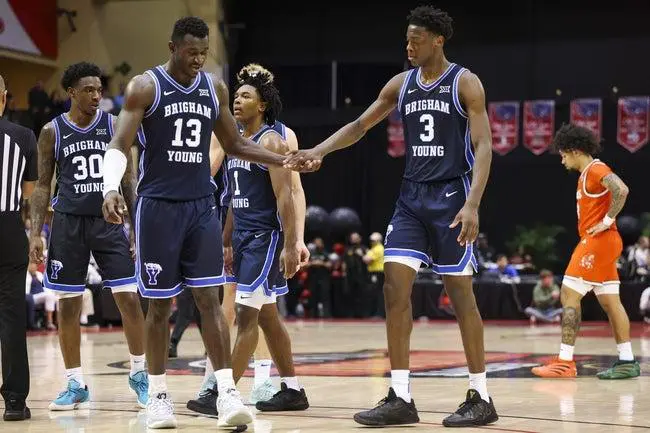
Following a rare home setback, the #4 Wildcats look to leverage their top-ranked Big 12 defense against a BYU offense that has struggled to find its rhythm on the road.
The Setup: BYU at Arizona
Arizona’s laying 11.5 at McKale Memorial Center against BYU on Wednesday night, and the first thing you need to understand is that this isn’t just another Big 12 home favorite situation. The Wildcats are #4 in the country for a reason, and when you dig into the collegebasketballdata.com efficiency numbers, this spread makes more sense than the recent head-to-head history might suggest. BYU won the first meeting this season 96-95 in Provo, but that game tells you almost nothing about what’s happening here. Arizona’s adjusted defensive efficiency sits at #3 nationally—90.1 points per 100 possessions—while BYU’s defense ranks a pedestrian #51 at 101.6. That’s a 11.5-point gap in defensive quality alone, and when you’re getting that kind of elite defense at home against a team that’s 1-4 ATS in its last five road games, you start to see why the market landed where it did.
The Cougars are 19-6 and ranked #23 in the AP poll, but they’re hemorrhaging value lately. They’re 1-9 ATS in their last 10 games overall, and the efficiency numbers explain why. BYU’s defensive rating has cratered to 109.1 on the season—that’s #213 nationally—and when you’re facing an Arizona offense that ranks #14 in adjusted efficiency at 123.7, that’s a recipe for getting carved up in Tucson.
Game Info & Betting Lines
Game: BYU at Arizona
Date: Wednesday, February 18, 2026
Time: 9:00 PM ET
Venue: McKale Memorial Center, Tucson, AZ
Conference: Big 12
Betting Lines:
- Spread: Arizona -11.5
- Total: 165.5
- Moneyline: Arizona -950, BYU +600
Why This Number Makes Sense (or Doesn’t)
The 11.5-point spread tells a story about defensive dominance meeting offensive vulnerability. Arizona’s net rating advantage is +10.6 points per 100 possessions, which translates to about 7-8 points over a full game at the projected pace of 69.6 possessions. Add in the 3.5-point home court advantage at McKale—where Arizona is 20-1 straight up in its last 21 games—and you’re looking at a projected margin around 10-11 points. The market nailed this one.
Here’s what matters: BYU’s offense is elite (#10 in adjusted efficiency at 124.6), but they’re running into the #3 defense in the country. When you match BYU’s offensive rating against Arizona’s defensive rating, you get a +34.5 mismatch in BYU’s favor. But flip it around—Arizona’s offense versus BYU’s defense creates only a +22.1 edge for the Wildcats. The difference? Arizona’s defense is so suffocating that it neutralizes BYU’s offensive advantages.
The total at 165.5 is interesting. Both teams play at similar tempos—BYU at 67.3 possessions per game (#177 nationally) and Arizona at 71.9 (#17)—so we’re looking at a moderate-paced game around 70 possessions. Arizona’s been under-hitting totals lately, going under in four of their last five home games. But BYU’s gone over in four of their last five road games, and these two teams have gone over in all five of their last five meetings. The model projects 172.8, which is 7.3 points over the market number.
BYU Breakdown: The Analytical Edge
The Cougars bring legitimate firepower with AJ Dybantsa (19.4 PPG) and Richie Saunders (19.1 PPG) leading the charge, but the real engine here is Robert Wright III. The guard averages 17.0 points and 6.1 assists per game—that’s #19 nationally in assists—and he’s the primary reason BYU’s offensive rating sits at 126.7 (#7 nationally). Their true shooting percentage of 59.6% and effective field goal percentage of 55.8% both rank in the top 40 nationally.
The problem is what happens on the other end. BYU allows 74.5 points per game (#206 nationally) and opponents shoot 43.4% from the field against them (#132). They’re getting torched in Big 12 play, allowing 83.1 points per game in conference games. When you’re facing an Arizona team that shoots 50.7% from the field (#11 nationally) and dominates the glass with 43.8 rebounds per game (#2 nationally), those defensive deficiencies get exposed quickly.
BYU’s 4.8 blocks per game (#26 nationally) with Keba Keita (7.1 RPG) anchoring the paint gives them some rim protection, but it hasn’t been nearly enough to stop the bleeding lately. They’ve lost three of their last five, and in those losses they’ve allowed 90, 99, and 77 points.
Arizona Breakdown: The Counterpoint
The Wildcats are 23-2 for a reason, and it starts with that suffocating defense. They hold opponents to 38.9% from the field (#8 nationally) and 31.6% from three (#67). Their defensive rating of 93.8 is #4 in the country, and the adjusted defensive efficiency of 90.1 ranks #3 nationally. This isn’t just a good defense—it’s an elite unit that’s built to shut down high-powered offenses like BYU’s.
Offensively, Arizona doesn’t have a single dominant scorer, but they’ve got balance. Koa Peat leads at 15.9 PPG, followed by Jaden Bradley at 14.5. They distribute the ball beautifully with 17.7 assists per game (#23 nationally), and their assist-to-turnover ratio of 1.56 is significantly better than BYU’s 1.37. Motiejus Krivas (7.9 RPG) and the Wildcats’ rebounding dominance—43.8 boards per game—gives them second-chance opportunities and limits opponents to one shot.
The concern? Arizona’s coming off back-to-back losses to Texas Tech (75-78 at home) and Kansas (78-82 on the road). They’re 5-5 ATS in their last 10 games, which suggests some value fade. But context matters—those were against top-tier Big 12 competition, and BYU’s defensive metrics suggest they’re not in that class right now.
The Matchup: Where This Gets Decided
This game comes down to whether BYU’s elite offense can overcome Arizona’s elite defense. History says no. When you’re facing the #3 adjusted defense in the country, even a top-10 offense struggles to hit its usual efficiency marks. BYU’s offensive rating of 124.6 is impressive, but Arizona’s defensive rating of 90.1 means the Cougars are likely looking at scoring around 100-105 points per 100 possessions—well below their season average.
The rebounding battle tilts heavily toward Arizona. They grab 43.8 boards per game compared to BYU’s 39.6, and more importantly, Arizona’s defensive rebounding (30.56 per game) is significantly better than BYU’s (27.08). That means fewer second chances for the Cougars and more transition opportunities for the Wildcats.
BYU’s 1-4 ATS record in their last five road games tells you everything about how they’ve performed away from Provo lately. They’re 5-3 straight up on the road this season, but the quality of those wins matters. Against top-tier competition in hostile environments, they’ve struggled to cover. Arizona’s 9-7 ATS at home isn’t spectacular, but they’re 20-1 straight up at McKale in their last 21 games. That’s dominance.
The pace matchup favors Arizona slightly. They play at 71.9 possessions per game compared to BYU’s 67.3, and at home, Arizona can dictate tempo. More possessions favor the better team, and Arizona’s +33.6 net rating (#3 nationally) compared to BYU’s +23.0 (#25) makes that clear.
Bash’s Best Bet
Arizona -11.5
I’m laying the points with the Wildcats at home. BYU’s defensive metrics are too poor to hang with Arizona’s balanced attack, and the Cougars’ 1-9 ATS slide in their last 10 games isn’t a coincidence—it’s a reflection of a team that’s overvalued by the market based on their 19-6 record. Arizona’s #3 adjusted defensive efficiency is the trump card here. Even with BYU’s elite offense, they’re facing a unit that holds opponents to 38.9% shooting and dominates the glass.
The model projects Arizona by 15.5, which gives us four points of cushion on the 11.5-point spread. McKale Memorial Center is a nightmare for visitors—Arizona’s 20-1 at home in their last 21—and BYU’s road struggles (1-4 ATS in last five away games) suggest they’re not built to steal this one. Take the Wildcats and don’t overthink it.
Lean on the total: Over 165.5. These teams have gone over in all five of their last five meetings, and the model projects 172.8. BYU’s offense is too potent to get completely shut down, and Arizona’s pace at home (71.9 possessions per game) should push this game into the 170s. The under trend at McKale is real, but the matchup history and offensive firepower suggest this one sails over.