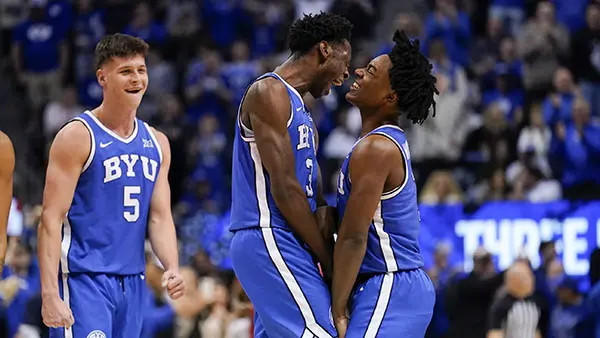
The No. 8 Houston Cougars bring the nation’s second-ranked defense into Provo to face a BYU squad desperate to snap a three-game skid. Our analytical preview breaks down the efficiency gap and provides an ATS pick for this Saturday night Big 12 headliner.
The Setup: Houston at BYU
Houston’s laying 1.5 points at BYU on Saturday night, and if you’re scratching your head wondering why the Cougars are getting points in Provo, you’re not alone. The Marriott Center is one of the toughest venues in college basketball, and BYU’s sporting a 7-1 record with an adjusted net efficiency that ranks 14th nationally. But here’s the thing—when you dig into the collegebasketballdata.com efficiency numbers, this line isn’t just defensible, it’s damn near perfect. Houston’s defense remains an absolute wrecking ball, checking in at 6th in adjusted defensive efficiency at 94.1, while BYU’s defensive rating of 98.4 (31st) is respectable but not elite. The Cougars are 1-4 in their last five games, and that slide includes losses to Oklahoma State, Kansas, Arizona, and Texas Tech. Meanwhile, Houston’s won four straight and looks like the team we expected to dominate the Big 12. This number tells you the market respects both BYU’s home court and their offensive firepower, but it’s not buying the recent results.
Game Info & Betting Lines
Game: Houston @ BYU
Date: February 7, 2026
Time: 10:30 PM ET
Venue: Marriott Center, Provo, UT
Point Spread: Houston -1.5
Total: 149.5
Moneyline: Houston -162, BYU +136
Why This Number Makes Sense (or Doesn’t)
Let’s start with the efficiency gap. Houston’s adjusted net efficiency sits at 18.4 (26th nationally), while BYU checks in at 21.6 (14th). On paper, that favors the Cougars by about three points, but flip the script when you account for Houston’s defensive dominance. The Cougars are allowing 60 points per game (5th nationally) with an opponent field goal percentage of just 37.8% (17th) and an opponent three-point percentage of 25.9% (7th). That’s suffocating.
Now look at BYU’s offensive profile. They rank 21st in adjusted offensive efficiency at 120.0, averaging 85.2 points per game (65th) with a true shooting percentage of 60.5% (50th). AJ Dybantsa and Richie Saunders are legitimate weapons, and Robert Wright III ranks 19th nationally in assists at 6.1 per game. The Cougars can score. But here’s the rub—they’ve been doing it at a pace of 60.9 possessions per game (340th nationally). Houston plays even slower at 63.8 (315th). When two teams this methodical collide, the total of 149.5 makes perfect sense, and the spread becomes a pure efficiency battle.
The market landed on Houston -1.5 because it’s giving BYU roughly 3.5 points for home court, then adjusting for recent form. That 1-4 stretch isn’t a mirage—BYU’s defensive rating of 111.7 (268th) in conference play suggests they’re getting carved up by elite competition. Houston’s the best defensive team they’ll face all season.
Houston Breakdown: The Analytical Edge
Houston’s identity hasn’t changed under Kelvin Sampson’s successor—they’re still a defensive juggernaut that grinds opponents into dust. That 90.6 defensive rating (14th) in adjusted metrics tells you everything. Emanuel Sharp leads the scoring at 17.6 points per game (105th nationally), while Kingston Flemings adds 15.9 (216th) and facilitates at 5.0 assists per game (79th). Milos Uzan provides secondary playmaking at 4.7 assists (101st), giving Houston multiple ball-handlers who can navigate BYU’s pressure.
The Cougars’ offensive rebounding percentage of 35.8% (38th nationally) is a legitimate weapon against BYU’s weak offensive rebounding rate of just 26.7% (324th). Houston creates second chances, and in a slow-paced game, those extra possessions become gold. Chris Cenac Jr. pulls down 8.0 boards per game (80th), and Joseph Tugler adds 5.4 (491st). This is a team built to win ugly, and they’ve got the defensive metrics to back it up.
Houston’s turnover rate is also elite—just 9.8 per game (25th) with a turnover ratio of 0.1 (38th). They don’t beat themselves, and against a BYU team that forces just 8.2 steals per game (96th), Houston should get clean looks in their half-court sets.
BYU Breakdown: The Counterpoint
BYU’s offensive firepower is legitimate. Dybantsa, the freshman phenom, is averaging 19.4 points per game (49th nationally) with 6.2 rebounds (275th). Richie Saunders matches him at 19.1 points (53rd), and Wright runs the show with that 6.1 assist average. The Cougars shoot 49.5% from the field (47th) and 37.4% from three (46th), with an effective field goal percentage of 57.0% (42nd). When they’re clicking, they can score with anybody.
The problem? That 98.4 adjusted defensive efficiency (31st) looks solid until you realize they’re allowing 68 points per game (76th) and opponents are shooting 40.5% from the field (72nd). Against elite competition, those numbers have cratered. In their four recent losses, they’ve allowed an average of 89.75 points. Houston’s not going to score 90, but they don’t need to—they just need to keep BYU in the 70s.
BYU’s pace of 60.9 (340th) also works against them here. They’re not going to run Houston off the floor, and in a grind-it-out game, the team with the better defense usually wins. The Cougars’ offensive rebounding rate of 26.7% (324th) means they’re not creating extra possessions, and against Houston’s defensive discipline, they’ll need to be damn near perfect in the half-court.
The Matchup: Where This Gets Decided
This game comes down to one simple question: Can BYU score efficiently enough in the half-court to overcome Houston’s defensive excellence? The Cougars rank 9th in offensive rating at 139.8, but that number is inflated by their weak non-conference schedule. Against Big 12 competition, they’re struggling to crack 80 points consistently.
Houston’s going to pack the paint and dare BYU to beat them from three. The Cougars shoot 37.4% from deep (46th), but Houston allows just 25.9% (7th). That’s a massive gap. If Dybantsa and Saunders go cold from the perimeter, where are the points coming from? Keba Keita averages just 7.5 points per game (1727th), and Kennard Davis Jr. chips in 10.4 (1029th). This isn’t a deep offensive roster.
On the other end, Houston’s methodical offense should find enough cracks in BYU’s defense. Sharp and Flemings can create their own shots, and Uzan’s playmaking keeps the offense humming. The Cougars’ 282 points in the paint suggest they can attack the rim, and BYU’s allowing 4.0 blocks per game (105th) won’t intimidate Houston’s drivers.
The total of 149.5 feels about right. Two teams playing at a snail’s pace (340th and 315th) with one elite defense should produce a game in the 140s. I’d lean under if forced to pick, but the spread is where the value lives.
Bash’s Best Bet
Houston -1.5 (-110)
I’m laying the points with Houston, and I’m not overthinking it. BYU’s 1-4 in their last five, and those losses came against teams that could score. Houston’s defense is on another level—6th in adjusted defensive efficiency, 7th in opponent three-point percentage, 17th in opponent field goal percentage. The Cougars are going to struggle to crack 70 points, and that’s all Houston needs to win this game outright.
The Marriott Center is tough, but Houston’s built for hostile environments. They don’t turn the ball over, they rebound, and they execute. BYU’s offensive rebounding rate of 26.7% (324th) means they’re not getting second chances, and in a game with 60-63 possessions, every trip matters. Give me the better defense, the better recent form, and the team that doesn’t beat itself. Houston -1.5 is the play.