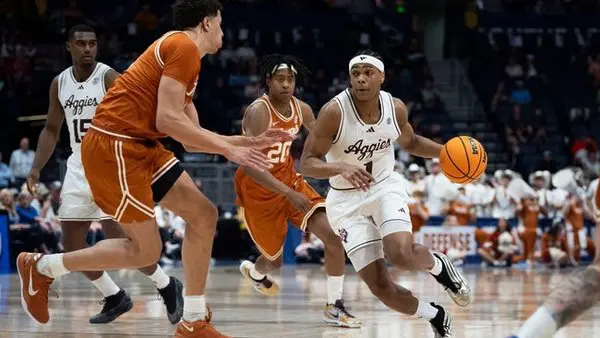
Bash is looking past Kentucky’s recent struggles to highlight a situational spot where the Wildcats’ balanced roster creates a massive edge against an inflated home line.
The Setup: Kentucky at Texas A&M
Texas A&M is laying 2 points at home against Kentucky on Tuesday night at Reed Arena, and if you’re expecting a typical SEC defensive grinder, you haven’t been paying attention. Both teams sitting at 19-10, both ranked in the top 25, but when you dig into the collegebasketballdata.com efficiency numbers, this matchup tells a completely different story than the spread suggests. Kentucky brings a +22.3 net rating (#27 nationally) into College Station to face an Aggies squad sitting at +16.6 (#43). That’s a 5.7-point gap in adjusted efficiency, yet the Wildcats are getting points on the road. The market is essentially giving Kentucky nearly 8 points of value when you factor in the typical home court edge. Either the books know something about these teams that the efficiency metrics don’t capture, or we’re looking at a legitimate opportunity to back the better team getting spotted points.
The #25 Wildcats have been inconsistent lately—three losses in their last five—but their underlying metrics remain elite on both ends. The Aggies counter with the #15 offensive rating in the country at 123.9, but their defensive numbers (#271 at 111.5) are borderline catastrophic for a team with NCAA Tournament aspirations. This sets up as an offensive showcase that the market might be undervaluing.
Game Info & Betting Lines
Game: Kentucky @ Texas A&M
Date: Tuesday, March 3, 2026
Time: 7:00 PM ET
Venue: Reed Arena, College Station, TX
Bovada:
Spread: Texas A&M -2
Total: 159
Moneyline: Texas A&M -130, Kentucky +110
DraftKings:
Spread: Texas A&M -2.5
Total: 159.5
Why This Number Makes Sense (or Doesn’t)
The spread makes sense if you’re buying into recent results over season-long efficiency. Kentucky has dropped three of five, and home court in the SEC is legitimately worth 2-3 points. But here’s what doesn’t add up: Kentucky ranks #36 in adjusted offensive efficiency and #26 in adjusted defense. Texas A&M sits at #46 and #61 respectively. When the better team on both ends of the floor is getting points, you need a compelling reason beyond “they lost a few games recently.”
The total at 159 is where things get really interesting. Both teams play at nearly identical pace—69.0 for Kentucky, 68.8 for A&M—projecting roughly 69 possessions. But look at the efficiency matchup: Kentucky’s offense (#36) against A&M’s defense (#61) projects extremely well, while A&M’s elite offense (#15) faces a legitimately good Kentucky defense (#26). The model projects this game landing around 152 points, a full 7 points under the market number. That’s not a small gap—that’s the market potentially overreacting to both teams’ offensive reputations without properly weighing the defensive side.
The KenPom prediction has this at Kentucky 78, Texas A&M 79 with a 54% home win probability. That’s essentially a pick’em with home court factored in, yet Kentucky is getting 2-2.5 points. The numbers are screaming value on the visitors.
Kentucky Breakdown: The Analytical Edge
The Wildcats’ efficiency profile is exactly what you want in a road underdog: balanced excellence on both ends. That 121.1 adjusted offensive rating ranks 36th nationally, built on solid shooting fundamentals—53.7% eFG%, 57.8% true shooting. They’re not spectacular from three (35.0%, #125), but they make up for it with quality two-point shooting at 54.5% and a strong offensive rebounding rate of 31.9%.
Defensively, this is where Kentucky separates itself. Holding opponents to 41.9% from the field (#58) and just 31.2% from three (#45), they’ve got the defensive chops to slow down even elite offenses. With 4.4 blocks per game (#43) and a defensive rating that ranks 26th nationally in adjusted metrics, they’re built to handle A&M’s perimeter-heavy attack.
Otega Oweh leads at 13.7 PPG, but this is a balanced attack with five players averaging double figures. Denzel Aberdeen (12.9 PPG, 3.3 APG) and Collin Chandler (11.7 PPG) provide backcourt scoring, while Malachi Moreno (7.1 RPG) anchors the glass. The only injury concern is Jayden Quaintance (questionable, knee), but he’s not among the top statistical contributors.
Texas A&M Breakdown: The Counterpoint
The Aggies’ offense is legitimately elite—88.1 PPG (#11) and that #15 offensive rating isn’t a mirage. They shoot 36.5% from three (#48), 54.8% eFG%, and most importantly, they move the ball beautifully with 18.7 assists per game (#8 nationally). This is a connected, unselfish offense that creates quality looks.
But here’s the problem: they give up 78.9 PPG (#311) and rank #271 in defensive rating. That 44.0% opponent field goal percentage (#163) and 32.0% from three (#76) are mediocre at best. When you’re facing Kentucky’s balanced offensive attack and efficient shooting, those defensive holes become exploitable.
Rubén Dominguez (14.5 PPG) and Marcus Hill (12.1 PPG) lead the backcourt, while Samet Yigitoglu (12.0 PPG, 8.0 RPG) and Rashaun Agee (11.8 PPG, 8.2 RPG) provide interior presence. The loss of Mackenzie Mgbako (out for season, foot) has been significant—he was a key contributor before going down. Rylan Griffen (10.6 PPG, 3.5 APG) rounds out a deep rotation, but the defensive issues are systemic, not personnel-based.
The Matchup: Where This Gets Decided
This game comes down to whether Texas A&M’s elite offense can overcome their defensive liabilities against a Kentucky team that does everything well without being spectacular anywhere. The pace matchup is neutral—both teams in the high 60s—so we’re looking at a half-court game decided by execution and efficiency.
Kentucky’s #26 adjusted defense against A&M’s #15 offense is the marquee matchup. The Aggies’ ball movement (18.7 APG) will test Kentucky’s perimeter rotations, but the Wildcats’ ability to contest threes (31.2% opponent 3P%) could neutralize A&M’s primary weapon. On the flip side, when Kentucky has the ball against that #271 defensive rating, they should generate quality looks consistently.
The rebounding battle slightly favors Kentucky (38.1 RPG vs 37.5), and both teams protect the ball equally well (turnover ratio of 0.1 for both). Free throw shooting could matter late—Kentucky at 72.6% (#180) versus A&M at 74.5% (#100)—but neither team gets to the line at an elite rate.
The KenPom four factors tell the story: Kentucky’s defensive eFG% allowed (48.3%, #50) should limit A&M’s efficiency, while A&M’s defensive eFG% allowed (50.6%, #134) gives Kentucky plenty of room to operate. In a game projected for 70 possessions, those percentage-point differences add up quickly.
Bash’s Best Bet
Kentucky +2.5 (-110)
I’m backing the better team getting points. Kentucky’s 5.7-point net rating advantage isn’t some minor statistical quirk—it represents genuine superiority on both ends of the floor. The Wildcats rank 27th nationally in adjusted net efficiency; Texas A&M sits 43rd. When you’re getting 2.5 points with the team that’s better offensively (by adjusted metrics) and significantly better defensively, you take it.
Yes, Kentucky has lost three of five. Yes, Reed Arena is a legitimate home court advantage. But this spread is asking me to believe that recent results and venue are worth 8 points of value (5.7 efficiency gap plus 2.5 points). That’s too much. The market is overvaluing A&M’s offensive firepower and undervaluing Kentucky’s defensive ability to limit it.
I also like Under 159 as a lean. The model projects 152, and while I’m not laying heavy juice on a 7-point gap, the defensive matchup—Kentucky’s #26 adjusted defense against an A&M offense that’s elite but not unstoppable—suggests a game in the low-to-mid 150s. If you’re playing the under, I’d wait for 159.5 or better.
Final Pick: Kentucky +2.5 | Confidence: 57%