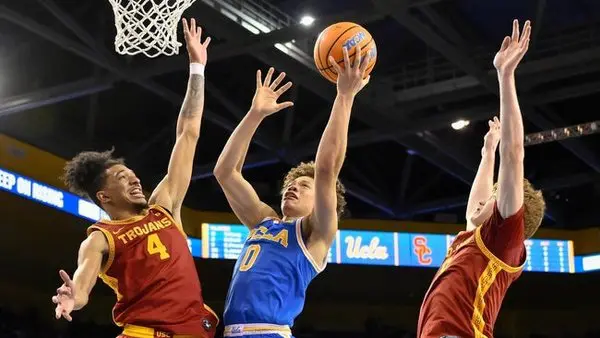
After evaluating the 11-point chasm in adjusted defensive efficiency, the strategic value in this Big Ten showdown lies in whether UCLA’s top-tier home offense can crack Nebraska’s “no-middle” shell.
The Setup: Nebraska at UCLA
UCLA’s laying a point and a half at Pauley Pavilion against ninth-ranked Nebraska on Tuesday night, and if you’re squinting at this number wondering why it’s not bigger, you’re not alone. The Bruins are 16-1 at home this season. Nebraska’s playing elite defense. And yet here we are with a pick’em spread in what should be a fascinating Big Ten clash between teams heading in opposite directions.
Here’s the thing: when you dig into the collegebasketballdata.com efficiency numbers, this line isn’t just defensible—it’s telling you exactly what the market thinks about UCLA’s glaring defensive issues. Nebraska ranks #8 in adjusted defensive efficiency nationally at 92.6, while UCLA sits at #69 at 103.6. That’s an 11-point chasm in defensive quality, and it’s the primary reason this spread isn’t UCLA -6 or -7 despite the home court advantage.
The Cornhuskers bring a +27.0 net rating (#12 nationally) into Pauley, compared to UCLA’s +17.8 (#41). Nebraska’s 25-4 record isn’t a mirage—they’re legitimately one of the best teams in college basketball, and they’ve been money on the road at 11-3 ATS in their last 14 away games. This number respects that reality.
Game Info & Betting Lines
Game: Nebraska Cornhuskers (25-4, #9 AP) at UCLA Bruins (19-10, #25 AP)
Date: Tuesday, March 3, 2026
Time: 11:00 PM ET
Location: Pauley Pavilion, Los Angeles, CA
Conference: Big Ten
Spread: UCLA -1 to -1.5
Total: 143.5
Moneyline: UCLA -110 / Nebraska -110
Why This Number Makes Sense (or Doesn’t)
The market landed on essentially a pick’em, and the efficiency model backs that up—projecting Nebraska by less than a point after factoring in home court. Let’s break down why.
Nebraska’s defensive infrastructure is suffocating. They hold opponents to 39.8% from the field (#17 nationally) and just 29.4% from three (#11). Their adjusted defensive rating of 92.6 ranks fifth in KenPom’s system. When you’re that elite defensively, you travel well—and Nebraska’s 7-2 road record in conference play proves it.
UCLA’s offense is legitimately good—#32 in adjusted offensive efficiency at 121.4—but they’re going to struggle to generate clean looks against this Nebraska defense. The Bruins rank #103 in effective field goal percentage at 53.5%, which is solid but not elite. Against a defense that forces you into contested jumpers and protects the rim, that efficiency number gets squeezed.
The pace projection of 65 possessions tells you everything about how this game will play out. Neither team wants to run—Nebraska ranks #202 in tempo at 66.5 possessions per game, UCLA #317 at 64.0. This becomes a half-court grind, and in those games, the team with the elite defense typically controls the outcome. The total of 143.5 reflects that reality, and it’s probably about right given both teams have gone under consistently—Nebraska’s hit the under in 20 of 29 games overall.
Nebraska Breakdown: The Analytical Edge
Fred Hoiberg’s built something special in Lincoln, and it starts with that suffocating defense. The Cornhuskers force opponents into difficult shots, protect the defensive glass at an elite level (27.2% defensive rebounding rate, #50 nationally), and rarely foul—opponents shoot just 25.1% of their attempts at the free throw line (#7 in the nation).
Offensively, Nebraska’s efficient without being explosive. Rienk Mast leads the way at 18.1 points per game, while Pryce Sandfort adds 15.8. The Cornhuskers rank #13 nationally in assists per game at 18.2, showcasing excellent ball movement, and they protect the basketball with just 9.6 turnovers per game (#25). That assist-to-turnover ratio of 1.91 is elite.
The one concern? Nebraska’s offensive rebounding is abysmal—#344 nationally at 24.9%. They’re not generating second-chance points, which could be problematic against a UCLA team that ranks #165 in offensive rebounding rate at 31.1%. But when you’re this good defensively, you don’t need offensive boards to win games.
UCLA Breakdown: The Counterpoint
The Bruins are 16-1 at Pauley Pavilion, and that home court advantage is real. They’ve won 13 straight at home according to the betting trends, and Mick Cronin’s teams always defend their building. The question is whether that’s enough against a Nebraska team that simply doesn’t lose on the road.
Donovan Dent is the engine—12.0 points per game but more importantly 6.4 assists per game, #13 nationally. Tyler Bilodeau provides scoring at 15.6 points, while Skyy Clark adds 12.7. The Bruins can score—#32 in adjusted offensive efficiency—but they’re going to have to earn every basket against Nebraska’s defense.
The defensive numbers are concerning. UCLA allows 43.6% from the field (#136) and 31.6% from three (#61). Their adjusted defensive efficiency of 103.6 ranks just 69th nationally. In their last 10 games, they’re allowing 76.0 points per game—that’s a massive jump from their season average. The road losses to Michigan (56-86) and Michigan State (59-82) exposed just how vulnerable this defense can be against quality opponents.
The Matchup: Where This Gets Decided
This comes down to whether UCLA’s offense can solve Nebraska’s defensive puzzle. The model projects UCLA scoring 69.8 points on 107.0 points per 100 possessions—well below their season average. That projection assumes Nebraska’s defense does what it’s done all season: force tough shots, limit transition opportunities, and control the defensive glass.
UCLA’s one legitimate advantage is offensive rebounding. That 6.2 percentage point edge in offensive rebounding rate could generate 4-6 extra possessions, which in a 65-possession game is massive. If the Bruins can turn those second chances into 8-10 points, they’ve got a real path to covering.
The other factor is free throw volume. UCLA gets to the line more frequently—33.9% FT rate compared to Nebraska’s 26.6%. In a game projected to finish in the 69-72 range, an extra 4-6 free throw attempts could swing the outcome. But Nebraska rarely fouls, so generating that volume will require UCLA to attack the rim aggressively.
The head-to-head history is limited but telling. These teams split two games last season, both going under the total. Nebraska won 66-58 at home, UCLA shot just 36.2% from the field across both games. That’s what happens when you face elite defense.
Bash’s Best Bet
I’m laying the points with UCLA at -1.5, and I’m taking the under 143.5. Here’s why.
The home court edge at Pauley Pavilion is real—16-1 straight up, 13-1 in their last 14 at home. Nebraska’s defense travels, but UCLA’s offense is good enough to generate 70-72 points in this environment. The Bruins have covered 9 of their last 17 home games, and against a team they match up reasonably well with offensively, I trust Cronin to get this done.
More importantly, I love the under. Both teams rank outside the top 200 in tempo. Nebraska’s gone under in 20 of 29 games, including 5 of their last 6 on the road. UCLA’s hit the over in just 4 of their last 5 at home, but that includes a 95-94 shootout with Illinois that skews the data. The model projects 142.6 total points, and in a game where Nebraska’s elite defense will dictate pace and shot quality, I’m betting on a final score in the 68-70 range for both teams.
The Pick: UCLA -1.5 and Under 143.5