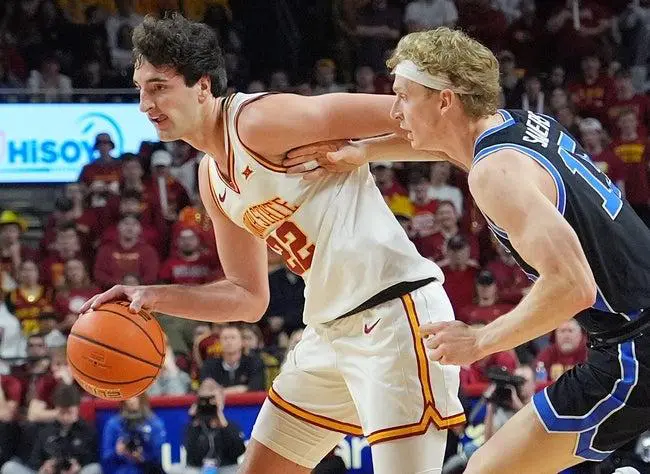
It is a daunting task for Pacific at the Marriott Center. The Tigers must find a way to score against a top-35 defense while trying to slow down AJ Dybantsa and a BYU offense that ranks 9th nationally in rating. Can Pacific’s methodical pace shorten the game enough to stay within the point spread, or will the Cougars’ efficiency turn this into a rout?
The Setup: Pacific at BYU
BYU’s laying 23.5 points at home against Pacific on Monday night, and I can already hear the skepticism: That’s a massive number for a WCC conference game. Look, I get it. Pacific’s got a respectable 7-3 record and ranks 29th nationally in opponent points allowed. But here’s the thing – when you dig into the collegebasketballdata.com efficiency numbers, this isn’t your typical mid-major conference matchup. We’re looking at a talent and system gap that’s borderline obscene.
BYU sits at 14th nationally in adjusted net efficiency with a rating of 21.6, while Pacific checks in at 94th with a 7.8 mark. That’s a 13.8-point efficiency gap, and when you’re playing at the Marriott Center – one of the toughest home courts in college basketball – against a Cougars squad that ranks 21st in adjusted offensive efficiency at 120.0, you’re asking Pacific to do something they simply aren’t built to do. Let me walk you through why this number not only makes sense but might actually have value on BYU.
Game Info & Betting Lines
Matchup: Pacific @ BYU
Date: December 16, 2025
Time: 9:00 PM ET
Venue: Marriott Center, Provo, UT
Spread: BYU -23.5 (DraftKings) / BYU -23 (Bovada)
Total: 147.5 (DraftKings) / 147 (Bovada)
Why This Number Makes Sense
The efficiency disparity here is the foundation of everything. BYU’s offensive rating of 139.8 ranks 9th nationally according to collegebasketballdata.com, while Pacific sits at 111.5, good for 174th. That’s a 28.3-point gap in offensive efficiency. Now, Pacific does have a solid defensive rating at 98.5 (69th nationally), but here’s where it gets interesting – they’ve achieved that against a schedule that hasn’t featured anyone remotely close to BYU’s offensive firepower.
BYU’s effective field goal percentage of 57.0% ranks 42nd nationally, while Pacific allows opponents to shoot 39.8% from the field (54th). That’s not just good defense – it’s why Pacific has stayed competitive in most games. But the Cougars shoot 37.4% from three-point range (46th nationally) compared to Pacific’s defensive three-point percentage of 30.1% (83rd). That matchup advantage is real, and when you factor in BYU’s ability to take care of the ball – just 9.6 turnovers per game, ranking 22nd nationally – you’re looking at a team that’s going to get quality shots possession after possession.
Here’s the math that matters: BYU plays at a 60.9 pace (340th nationally), which is glacial. Pacific plays slightly faster at 66.1 (265th). Let’s split the difference and call it around 63-64 possessions. Do that math over 64 possessions, and a 28-point offensive efficiency gap translates to roughly 17-18 points. Add in home court advantage – worth 3-4 points in college basketball – and you’re already at 20-22 points before we even talk about the talent disparity.
Pacific’s Situation
Pacific brings a 7-3 record into Provo, but let’s add some context to those numbers. Their best win came against Air Force on the road, and they just lost to California 67-61. That California loss is actually instructive – the Golden Bears aren’t an offensive juggernaut, and Pacific still couldn’t crack 62 points.
Elias Ralph leads the Tigers at 17.1 points per game (132nd nationally), and he’s a legitimate scorer. TJ Wainwright adds 12.2 per game, and point guard Jaden Clayton dishes out 5.6 assists (42nd nationally). That’s solid production. The problem is what happens when Pacific faces elite offensive efficiency. Their adjusted offensive efficiency of 109.5 ranks just 140th, and their 32.7% three-point shooting (217th) becomes a massive liability against a team that can score like BYU.
The Tigers’ offensive rebounding percentage of 28.4% ranks 280th nationally, which means second-chance opportunities will be scarce. When you’re playing a slower-paced game and can’t generate extra possessions, every trip down the floor becomes critical. Pacific simply doesn’t have the offensive firepower to trade baskets with the Cougars.
BYU’s Situation
The Cougars are 7-1 with their only loss coming in what had to be a scheduling quirk early in the season. They just went on the road and beat Miami 72-62, then knocked off Dayton 83-79. Those are legitimate road wins against quality competition, and they’re doing it with one of the most balanced offensive attacks in the country.
AJ Dybantsa leads the way at 19.4 points per game (49th nationally), but the depth is what makes BYU dangerous. Richie Saunders adds 19.1 per game (53rd), and Robert Wright III chips in 17.0 points with 6.1 assists per game (19th nationally). That’s three legitimate scoring threats, and all three can create for others. Kennard Davis Jr. provides another double-digit scorer at 10.4 per game.
BYU’s adjusted defensive efficiency of 98.4 ranks 31st nationally, which means they’re not just an offensive team – they can get stops when needed. The Cougars force 9.6 turnovers per game while committing just 9.6 themselves, and that ball security combined with their 49.5% field goal percentage (47th) creates a nightmare scenario for opponents trying to keep pace.
The Matchup: Where This Gets Decided
This game lives and dies on BYU’s ability to exploit Pacific’s offensive limitations. The Cougars rank 9th in offensive rating at 139.8, while Pacific’s defensive rating sits at 98.5. That’s a 41.3-point gap, and while that number won’t translate directly to the scoreboard, it illustrates the chasm in quality.
Here’s the matchup that seals it for me: Pacific’s three-point shooting versus BYU’s three-point defense. The Tigers shoot just 32.7% from deep (217th), while BYU allows 31.6% (135th). Pacific needs to shoot above their season average from three to have any chance of staying within this number, and that’s asking them to do something they haven’t done consistently all season. Meanwhile, BYU’s 37.4% from three-point range (46th) against Pacific’s 30.1% three-point defense (83rd) creates a massive advantage for the home team.
The pace factor also favors BYU. At 60.9 possessions per game (340th), the Cougars control tempo and limit the number of opportunities for opponents to make runs. Pacific would prefer a slightly faster game at 66.1 (265th), but they’re not going to dictate pace on the road at the Marriott Center. Fewer possessions means each one matters more, and BYU’s superior efficiency on both ends becomes magnified.
I keep coming back to those turnover numbers because they’re just too extreme to ignore. BYU commits just 9.6 turnovers per game (22nd nationally) while Pacific forces only 5.5 steals per game (315th). The Tigers aren’t going to create extra possessions through defense, which means they need to execute perfectly in halfcourt sets against a top-35 adjusted defense. That’s not happening with enough consistency to cover 23.5 points.
My Play
The Pick: BYU -23.5 for 2 units
I’m laying the points with BYU at home. The efficiency gap is too massive, the talent disparity is real, and Pacific doesn’t have the offensive weapons to keep pace in a slower game. I’m projecting BYU 82, Pacific 55, which covers the 23.5-point spread comfortably.
The main risk here is if BYU gets comfortable and takes their foot off the gas in the second half. Kevin Young’s squad is still establishing its identity this season, and blowout management can be tricky. But I’ve considered all of that, and the 13.8-point adjusted net efficiency gap is still too massive to ignore. When you’re getting 120.0 adjusted offensive efficiency (21st) at home against 101.7 adjusted defensive efficiency (57th), you’re looking at a mismatch that should produce a comfortable double-digit win.
BYU covers the 23.5, and this one probably isn’t as close as the final score indicates.