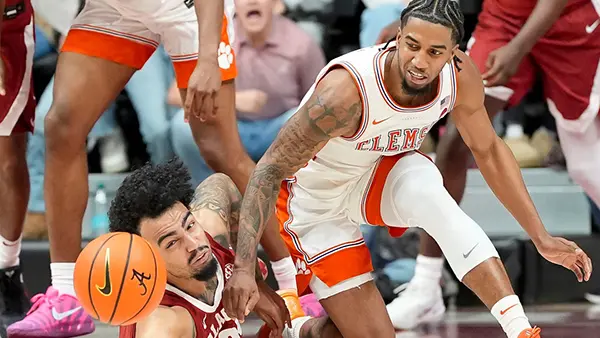
It is rivalry night at Littlejohn Coliseum. The South Carolina Gamecocks will look to slow the tempo and make this a rock fight, but can they hang with Clemson’s physical frontcourt? With the Tigers dominating the paint scoring by a wide margin this season, we analyze if the visitors have enough firepower to stay within the spread or if this turns into a rout.
The Setup: South Carolina at Clemson
Clemson’s laying 12.5 points at home against South Carolina, and this in-state rivalry is bringing some serious separation in the betting market. Here’s the thing – when you dig into the collegebasketballdata.com efficiency numbers, this isn’t just about rivalry intensity. We’re looking at a massive gap between two programs heading in different directions this season. The Tigers sit at #16 nationally in adjusted net efficiency (20.0), while the Gamecocks check in at #92 (7.9). That’s not just a rankings difference – it’s a chasm that tells us Clemson is performing at an elite level while South Carolina is solidly mediocre when you adjust for competition.
Clemson’s 7-2 start includes quality wins, and they’re doing it with the 18th-ranked adjusted offense in the country (121.0) paired with a top-50 defense (101.0 adjusted defensive rating, #49). South Carolina? They’re 95th offensively (112.4) and 107th defensively (104.4). Let me walk you through why this double-digit spread isn’t just rivalry hype – it’s backed by fundamental basketball advantages that should show up on the scoreboard.
Why This Number Makes Sense
The efficiency gap here is what seals it for me. Clemson’s offensive rating of 123.9 (#51) compared to South Carolina’s 115.7 (#124) represents a significant advantage, but it’s the defensive side where this game gets decided. The Tigers are holding opponents to a 98.2 defensive rating (#63), while the Gamecocks sit at 100.6 (#101). That might seem close, but here’s why these numbers matter: Clemson defends without fouling and forces tough shots.
Look at the opponent field goal percentage – Clemson holds teams to 39.1% (#38 nationally), while South Carolina allows 42.4% (#134). That’s a three-percentage-point gap that translates directly to points. Do that math over 65 possessions at a similar pace, and you’re looking at an extra 6-8 points just from field goal defense alone. Add in Clemson’s rebounding dominance – 42.4 boards per game (#23) versus South Carolina’s 35.8 (#230) – and you’ve got second-chance opportunities tilting heavily toward the home team.
The turnover battle is fascinating because both teams take care of the ball exceptionally well. South Carolina turns it over just 9.7 times per game (#23), while Clemson is even better at 8.8 (#5). Both rank in the top 20 in turnover ratio. But here’s the difference: Clemson converts those turnovers into 128 points this season compared to South Carolina’s 101. The Tigers are more efficient in transition, averaging 88 fast break points to the Gamecocks’ 71.
South Carolina’s Situation
The Gamecocks come in at 6-3, but those three losses tell a story. They dropped games to Virginia Tech (83-86), at Northwestern (77-79), and those were competitive but revealed South Carolina’s ceiling against quality opponents. Meechie Johnson leads the way at 15.1 points per game, but this offense lacks a true go-to scorer who can create when things get tight.
South Carolina’s biggest weakness is on the glass. That 26.7% offensive rebounding rate ranks 324th nationally – that’s bottom-tier stuff. Against a Clemson team that ranks 23rd in total rebounding, the Gamecocks are going to get one-and-done possessions all night. You can’t overcome a talent gap when you’re giving the opponent multiple cracks at baskets.
The one area where South Carolina excels is defending the three-point line – they hold opponents to 27.6% (#25). That’s elite perimeter defense. But here’s the thing: Clemson isn’t a volume three-point shooting team. They’re shooting just 32.8% from deep (#213), so taking away the three isn’t going to neutralize what the Tigers do best, which is dominate inside with 342 points in the paint already this season.
The pace factor matters too. South Carolina plays at 64.3 possessions per game (#309), which is glacial. They want to slow this down and keep it ugly. Problem is, Clemson plays at a similar tempo (65.5, #281) and executes better in the halfcourt.
Clemson’s Situation
The Tigers are 7-2 with losses at BYU (64-67) and at Alabama (84-90) – both quality road games where they competed. That 97-94 win at Georgia shows they can win shootouts in hostile environments. At home in Littlejohn Coliseum, Clemson should be even more comfortable controlling tempo and physicality.
RJ Godfrey leads a balanced attack at 12.1 points per game, but what makes Clemson dangerous is the depth. Five players average between 8-12 points, making them impossible to game-plan against with a single defensive focus. Carter Welling (10.6 PPG, 6.2 RPG) and Jake Wahlin (8.0 PPG, 4.9 RPG) provide frontcourt size that South Carolina can’t match.
The Tigers’ ball security is elite – that 8.8 turnovers per game ranks 5th nationally. Brad Brownell has this team playing disciplined, mistake-free basketball. When you combine that with the 31.7% offensive rebounding rate (#156), Clemson is getting 10-12 more shot attempts per game than South Carolina. Over a full game, that’s massive.
Clemson’s defense is the calling card. That 39.1% opponent field goal percentage is top-40 nationally, and they’re holding teams to 27.9% from three (#31). They defend both levels effectively, which is why their 98.2 defensive rating is so impressive. They don’t gamble for steals (5.6 per game, #311) or blocks (2.9, #259) – they just make you earn everything in the halfcourt.
The Matchup: Where This Gets Decided
This game lives and dies on the rebounding battle and interior scoring. Clemson has 342 points in the paint compared to South Carolina’s 276. That’s a 66-point gap over nine games – more than seven points per game. Against South Carolina’s poor rebounding (#230 overall, #324 in offensive rebounding percentage), Clemson should feast on second chances and easy putbacks.
The three-point shooting matchup is a wash – both teams shoot around 33% and defend it well. This isn’t going to be a perimeter shootout. It’s going to be won in the trenches, and Clemson has the size and physicality advantage with Godfrey, Welling, and Wahlin controlling the paint.
Here’s the matchup that seals it for me: Clemson’s offensive efficiency (121.0 adjusted, #18) against South Carolina’s defensive efficiency (104.4 adjusted, #107). That’s a 16.6-point gap in adjusted metrics. Even accounting for home court (typically worth 3-4 points in college basketball), we’re looking at a 12-13 point true talent gap. The line is 12.5. This isn’t an overreaction – it’s properly priced.
The pace will favor whoever executes better in the halfcourt. Both teams play slow (Clemson 281st, South Carolina 309th in tempo), so we’re looking at around 64-66 possessions. Clemson’s offensive rating advantage means they should score 8-10 more points over that span, and their defensive advantage adds another 4-6 points of value.
My Play
I’m backing Clemson -12.5 with confidence. I’m putting 2.5 units on the Tigers to cover at home.
The main risk here is if South Carolina’s elite three-point defense (27.6% allowed, #25) forces Clemson into an off-shooting night and the Gamecocks keep it close with their ball security (9.7 turnovers per game, #23). But I’ve considered all of that, and the rebounding gap is still too massive to ignore. Clemson is going to get 8-10 more shot attempts, and that’s the difference between winning by 8 and winning by 15.
I’m projecting Clemson 82, South Carolina 67. The Tigers control the glass, dominate the paint, and pull away in the second half when South Carolina’s lack of offensive firepower becomes critical. This rivalry game stays competitive for 25 minutes before Clemson’s superior depth and execution take over.
Clemson -12.5. Lock it in.