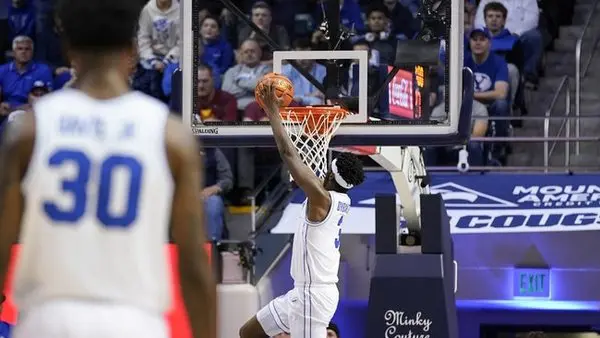
BYU hosts UCF as double-digit favorites in a spot where the Cougars’ top-10 offense faces a Knights defense that has recently struggled to contain elite Big 12 guard play.
The Setup: UCF at BYU
BYU’s laying 11.5 at home against UCF on Tuesday night, and this line is screaming efficiency mismatch. The Cougars check in at #9 in adjusted offensive efficiency and #40 defensively according to collegebasketballdata.com, while the Knights sit at #45 offensively and #136 on defense. That’s a 11.3-point net rating gap favoring the home side, and when you factor in BYU’s elite 124.9 adjusted offensive rating attacking UCF’s porous 107.3 defensive rating, you’ve got a recipe for the Cougars to put up points in bunches. The market’s giving us 11.5, but the efficiency math suggests this should be closer to a two-touchdown spread. Here’s why that gap matters—and where the value actually lives.
Game Info & Betting Lines
Matchup: #25 UCF (19-7) at #19 BYU (20-7)
When: Tuesday, February 24, 2026, 9:00 PM ET
Where: Jon M. Huntsman Center, Provo, UT
Conference: Big 12
DraftKings Spread: BYU -11.5
Total: 163.5
Why This Number Makes Sense (or Doesn’t)
Let’s talk about why this line landed at 11.5 instead of the 16-plus that the raw efficiency numbers suggest. UCF’s been scrappy on the road in conference play—they just grabbed a 73-71 win at Utah in their last outing, showing they can hang in hostile Big 12 environments. But here’s the thing: BYU’s 125.6 offensive rating ranks #9 nationally, and they’re averaging 85.5 points per game while shooting 55.5% effective field goal percentage. When you run an offense that efficient against a defense allowing 110.7 points per 100 possessions (UCF’s defensive rating, ranked #248), you’re looking at a significant talent gap.
The pace factor matters here too. BYU operates at 67.2 possessions per game while UCF pushes it slightly faster at 69.8. The blended pace projects around 68.5 possessions, which means we’re not getting a track meet—but we’re getting enough possessions for BYU’s offensive firepower to separate. The market’s respecting UCF’s 19-7 record and their ability to shoot 37.4% from three (ranked #30 nationally), but the underlying numbers suggest the Knights are overvalued here.
UCF Breakdown: The Analytical Edge
UCF’s offensive profile is legitimately dangerous when they’re clicking. Riley Kugel leads the way at 14.4 points per game, while Themus Fulks runs the show with 7.4 assists per game (ranked #4 nationally). That’s elite playmaking, and when you pair it with Jamichael Stillwell’s 8.6 rebounds per game on the glass, you’ve got the pieces to compete.
The problem? That #136 defensive efficiency isn’t a fluke. UCF allows 46.0% shooting from the field (ranked #283) and generates just 5.7 steals per game (ranked #296). They don’t force turnovers—10.7 per game for opponents—and they don’t protect the rim consistently with only 2.9 blocks per game. Against BYU’s balanced attack, those defensive weaknesses get exploited.
One major concern: Kugel is listed as questionable with an undisclosed injury. If their leading scorer can’t go, UCF’s already-challenged defense has to somehow outscore an elite BYU offense without their top weapon.
BYU Breakdown: The Counterpoint
BYU’s offensive efficiency isn’t an accident—it’s built on two legitimate stars. AJ Dybantsa is putting up 19.4 points and 6.2 rebounds per game, while Richie Saunders was matching him at 19.1 points per game before a season-ending knee injury. Wait—that’s a massive loss, right? Here’s the thing: BYU’s adjusted numbers already account for recent performance, and they just dropped 79 points on Iowa State in their last home game without Saunders.
Robert Wright III steps into an expanded role with 17.0 points and 6.1 assists per game, giving BYU a secondary creator who can exploit UCF’s perimeter defense. The Cougars shoot 59.4% true shooting percentage (ranked #41) and get to the line consistently. They’re also #34 in total rebounding at 39.3 boards per game, which should neutralize UCF’s 33.3% offensive rebounding rate.
Defensively, BYU’s 100.9 adjusted defensive rating ranks #40 nationally. They hold opponents to 43.4% shooting and block 4.7 shots per game (ranked #29). That rim protection matters against a UCF team that scores 980 points in the paint this season.
The Matchup: Where This Gets Decided
This game comes down to whether UCF can survive BYU’s offensive onslaught long enough to keep it within the number. The Knights have the shooting to hang around—they’re #30 in three-point percentage—but BYU’s #9 offensive efficiency suggests they’ll get quality looks possession after possession.
The head-to-head history tells a story: BYU won 81-75 at UCF earlier this season and has taken three of the last four meetings. The Cougars know how to attack UCF’s defensive weaknesses, and playing at the Jon M. Huntsman Center with 20-7 record momentum behind them amplifies that advantage.
Here’s the X-factor: UCF’s 11.4 turnovers per game against BYU’s 7.6 steals per game. If the Cougars force live-ball turnovers and convert them into fast break points (they average 370 on the season), this game gets ugly fast. The projected total of 167.8 points based on efficiency models suggests both teams should score, but BYU’s defensive edge gives them the runway to cover.
Bash’s Best Bet
I’m laying the 11.5 with BYU. The efficiency gap is too wide, and UCF’s defensive limitations get exposed against elite offenses. BYU’s #9 adjusted offensive rating attacking the Knights’ #248 defensive rating is a mismatch the market isn’t fully pricing in. Add in the Kugel injury uncertainty, and you’re looking at a UCF team that might be without its leading scorer trying to keep pace with Dybantsa and Wright.
The Cougars have covered in similar spots this season, and their 24.0 adjusted net rating compared to UCF’s 12.7 tells you everything you need to know about the talent gap. Give me BYU to win this by 14-plus and send UCF home with another Big 12 road loss.
The Pick: BYU -11.5