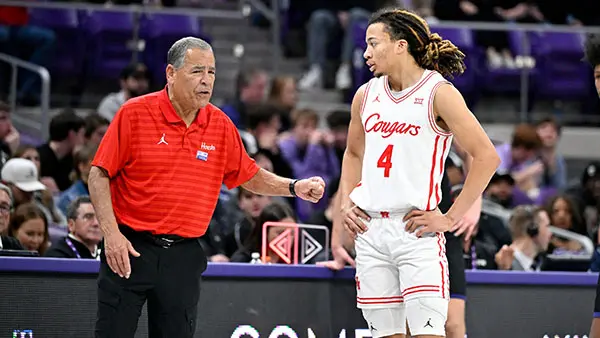
Will Houston’s glacial pace be enough to neutralize UCF’s offensive connectivity? Bash dives into the tactical matchup and the 148.5 total to find the sharpest prediction for tonight’s Big 12 showdown.
The Setup: UCF at Houston
Houston’s laying 14.5 points at Fertitta Center against UCF, and on paper, this looks like a classic style clash. You’ve got the Knights rolling in at 8-1, averaging 88 points per game and ranking 28th nationally in adjusted offensive efficiency according to collegebasketballdata.com. Meanwhile, Houston sits at 8-1 with the sixth-ranked adjusted defense in the country, surrendering just 60 points per game. The Cougars are giving up two full touchdowns here, and my immediate reaction is that this number respects UCF’s offensive firepower while banking on Houston’s suffocating defense to impose its will at home. The question isn’t whether Houston can slow down the Knights—it’s whether they can pull away enough to cover a substantial number against a team that can score in bunches.
Game Info & Betting Lines
Matchup: UCF @ Houston
Date: February 4, 2026
Time: 7:00 PM ET
Venue: Fertitta Center, Houston, TX
Spread: Houston -14.5
Total: 148.5
Why This Number Makes Sense (or Doesn’t)
Let’s start with the efficiency gap. Houston’s adjusted net efficiency sits at plus-18.4, ranking 26th nationally. UCF checks in at plus-11.7, good for 61st. That’s a seven-point difference in adjusted metrics, and when you factor in home court advantage—typically worth 3-4 points in college basketball—you’re looking at a projected spread somewhere in the 10-13 range. So why 14.5?
The market is clearly respecting Houston’s defensive identity. The Cougars rank sixth in adjusted defensive efficiency at 94.1, and they’re holding opponents to just 37.8% from the field and an absurd 25.9% from three-point range, seventh-best in the nation. When you can defend like that at home, you earn the right to lay premium numbers. But here’s the wrinkle: UCF isn’t some plodding Big 12 offense. They rank 49th in offensive rating at 124.3 and shoot 50% from the field overall, 35th nationally. They’ve got legitimate juice.
The total of 148.5 tells you everything about how the oddsmakers expect this to play. Houston’s pace ranks 315th nationally at just 63.8 possessions per game. UCF plays faster at 70.5, but not dramatically so. When these two teams meet, we’re looking at maybe 66-67 possessions. If Houston controls tempo and holds UCF to their defensive average of 60 points, the Cougars would need to score 89 to cover. That’s asking a lot from a team averaging 75.7 per game with an offensive rating that ranks just 149th nationally.
UCF Breakdown: The Analytical Edge
The Knights are a legitimate offensive outfit, and the numbers back it up. That 118.9 adjusted offensive efficiency ranks 28th in the country, and they’ve got multiple ways to hurt you. Riley Kugel leads the way at 14.4 points per game, but the real engine here is Themus Fulks, who’s dishing out 7.4 assists per game—fourth nationally. When your point guard ranks that high in the assist charts, you’re running an offense with purpose and connectivity.
UCF’s shooting splits are impressive: 50% from the field, 38.7% from three (29th nationally), and a true shooting percentage of 60.4%. They’re efficient scorers who don’t beat themselves. The turnover rate is manageable at 12.1 per game, and they rank 35th in offensive rebounding percentage at 35.9%. They create second chances and convert them.
The concern? Defense. That 107.2 adjusted defensive efficiency ranks just 158th nationally, and they’re allowing 75.1 points per game. They don’t force turnovers—just 4.7 steals per game ranks 352nd—and they don’t protect the rim particularly well with only three blocks per contest. When you can’t get stops consistently, you’re asking your offense to carry a heavy load on the road in a hostile environment.
Houston Breakdown: The Counterpoint
Houston does one thing at an elite level: they defend. That 94.1 adjusted defensive efficiency is top-10 material, and the Cougars have the personnel to make life miserable for UCF’s perimeter-oriented attack. They rank 17th in opponent field goal percentage and seventh in opponent three-point percentage. When you defend the arc that well, you force teams to beat you in the half-court, and that’s exactly where Houston wants you.
Emanuel Sharp leads the scoring at 17.6 points per game, and Kingston Flemings adds 15.9 while facilitating at 5.0 assists per contest. Milos Uzan provides another playmaking option at 4.7 assists per game. The Cougars don’t turn the ball over—just 9.8 per game ranks 25th nationally—and they take care of possessions.
The problem is simple: Houston doesn’t score enough to comfortably cover big numbers. That 112.4 adjusted offensive efficiency ranks just 95th nationally, and they shoot only 43.9% from the field overall. Their true shooting percentage of 54.0% ranks 262nd. They’re not built to run teams out of the gym. They win by grinding you down, forcing bad shots, and winning the possession battle. Against a team that can score like UCF, asking Houston to win by 15 feels like a tall order.
The Matchup: Where This Gets Decided
This game comes down to whether Houston’s defense can disrupt UCF’s offensive rhythm enough to create a blowout. The Cougars will slow the pace—that’s non-negotiable. UCF wants to play in the high 60s possession-wise; Houston will drag it into the low 60s. Every possession matters in a game like this.
UCF’s perimeter shooting is the X-factor. If the Knights can knock down threes at their season average of 38.7%, they’ll stay within striking distance even if Houston controls tempo. But if the Cougars’ perimeter defense—which has held opponents to 25.9% from deep—shows up, UCF could struggle to crack 70 points. And if you’re UCF and you’re scoring in the 60s, you’re not covering this number.
The other battleground is offensive rebounding. Both teams rank in the top 40 nationally in offensive rebounding percentage, which means second-chance points could swing this game. Houston’s ability to limit those opportunities while creating their own will be critical. The Cougars also generate more points off turnovers (154 to 133), and with UCF’s lack of defensive pressure, Houston should get clean looks in transition.
Recent history favors Houston, who’s won four of the last five meetings. But those games were tight—69-68 last year, 67-59 two years ago. This isn’t a matchup where Houston historically blows UCF off the floor.
Bash’s Best Bet
I’m taking UCF +14.5. Look, I respect what Houston does defensively, and Fertitta Center is a tough place to play. But 14.5 points is a massive number against a UCF team that ranks 28th in adjusted offensive efficiency and shoots the ball this well. The Knights have the offensive firepower to stay within two possessions, even in a grind-it-out game.
Houston’s offense isn’t built to create separation against competent competition. They score 75.7 per game and rank 95th in adjusted offensive efficiency. Even if they hold UCF to 68-70 points, that means the Cougars need to score in the mid-80s to cover. I don’t see it. This feels like a 72-64 type of game where Houston wins but UCF hangs around because they can shoot. Give me the points with the Knights.