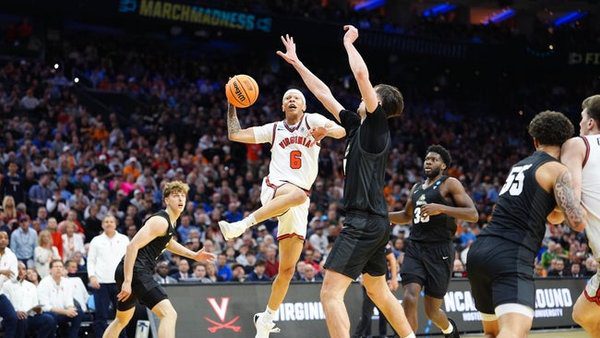
Bash is treating this as a coin-flip matchup disguised as a spread, with Tennessee’s elite defensive metrics and rebounding dominance offsetting Virginia’s shooting efficiency in a neutral-site NCAA tournament grinder.
No. 6 Tennessee is getting 1.5 points against No. 3 Virginia at the Xfinity Mobile Arena on March 22, 2026, and the market is telling you this NCAA tournament game is essentially a pick’em. I’m not arguing. When you dig into the collegebasketballdata.com numbers, this is two nearly identical teams—Tennessee ranked #13 in adjusted net rating (+27.6), Virginia #17 (+27.3)—separated by three-tenths of a point in efficiency. The Vols bring the #12 adjusted defense in the country (94.0) and the #2 offensive rebounding rate (37.5%). The Cavaliers counter with the #26 adjusted offense (123.4) and a 58.4% true shooting mark that ranks #63 nationally. This is a classic NCAA tournament meat grinder: two slow-tempo, defense-first programs with elite metrics meeting on a neutral floor where margin of error evaporates. The spread reflects that reality perfectly.
Why the Market Landed on Tennessee +1.5
Virginia entered this tournament as the No. 3 seed with a 30-5 record and an RPI of #11, while Tennessee limped in at 23-11 with an RPI of #28. The seeding gap explains the slight lean toward the Cavaliers, but the efficiency data doesn’t support a larger number. Tennessee’s strength of schedule (#17) is significantly tougher than Virginia’s (#44), and the Vols went 7-9 in Quadrant 1 games compared to Virginia’s 9-4 mark. That’s not a massive gap when you consider Tennessee played more elite opponents. KenPom projects this game at Tennessee 70, Virginia 69—a one-point edge for the Vols—with a 49% win probability for Virginia. The market is essentially pricing in the seed differential and Virginia’s superior overall record while acknowledging that Tennessee’s defensive metrics and rebounding edge make this a genuine toss-up. The total of 137.5 sits well below both teams’ season averages (Tennessee 79.4 PPG, Virginia 80.7 PPG) because this is a neutral-site NCAA game between two teams ranked in the top-50 defensively with a projected pace of 64 possessions. The market expects a grind.
Tennessee’s Rebounding Edge and Defensive Identity
Tennessee’s calling card is suffocating defense and second-chance dominance. The Vols rank #12 nationally in adjusted defensive efficiency (94.0) and hold opponents to just 40.8% from the field (#27) and 30.3% from three (#22). But the real separator is on the glass: Tennessee’s 37.5% offensive rebounding rate ranks #2 in the country, while Virginia sits at 32.6% (#94). That’s a 4.9-percentage-point edge in offensive rebounding, which translates to additional possessions in a low-possession game. Nate Ament (16.3 PPG, 7.1 RPG) and Jaylen Carey (8.4 PPG, 6.4 RPG) give the Vols size and physicality on the boards, and in a game projected for 65 possessions, those extra looks matter. I also like Tennessee’s experience in tight games—they went 7-9 in Q1 matchups, meaning they’ve been battle-tested against elite competition all season. Virginia’s 9-4 Q1 record is better, but the Vols have seen this level of intensity before. The concern? Tennessee’s 69.4% free throw shooting (#278) is abysmal, and in a one-possession NCAA game, that’s a legitimate liability. Virginia shoots 73.1% from the line (#161), which isn’t elite but is competent enough to close.
Virginia’s Shooting Precision vs. Tennessee’s Grit
Virginia’s advantage is shooting efficiency. The Cavaliers post a 54.9% effective field goal percentage (#54) compared to Tennessee’s 51.8% (#183), and their 36.3% three-point shooting (#46) dwarfs Tennessee’s 33.8% (#191). Thijs De Ridder (16.4 PPG) and Malik Thomas (12.1 PPG) provide scoring balance, and Virginia’s 58.4% true shooting percentage (#63) means they maximize their possessions. The Cavaliers also lead the nation in blocks per game (6.4), which could neutralize Tennessee’s offensive rebounding advantage by contesting second-chance attempts at the rim. But here’s the rub: Virginia’s adjusted defensive efficiency (#16, 96.0) is good but not elite, and Tennessee’s adjusted offense (#38, 121.6) is efficient enough to exploit it. The Vols also force fewer turnovers (16.4% forced turnover rate, #199) than Virginia (15.5%, #256), meaning both teams will protect the ball and grind this out in the halfcourt. Virginia’s 30-5 record is impressive, but their non-conference schedule was soft (NC SOS #217), and they haven’t faced the same level of physicality that Tennessee endured in SEC play.
Matchup Metrics: Adjusted Efficiency and Style Clash
| Metric | Tennessee | Virginia |
|---|---|---|
| KenPom Rank | #15 | #16 |
| RPI Rank | #28 | #11 |
| Strength of Schedule | #17 | #44 |
| Q1 Record | 7-9 | 9-4 |
| Adj. Offensive Efficiency | 121.6 (#38) | 123.4 (#26) |
| Adj. Defensive Efficiency | 94.0 (#12) | 96.0 (#16) |
| Offensive Rebounding Rate | 37.5% (#2) | 32.6% (#94) |
| True Shooting % | 55.7% (#196) | 58.4% (#63) |
This is a 65-possession slugfest between two teams that rank in the bottom third nationally in tempo (Tennessee #220, Virginia #247). The pace blend projects to 65.5 possessions, meaning every possession is magnified. Tennessee’s offensive rebounding edge could generate 3-4 additional scoring opportunities, but Virginia’s shooting efficiency could neutralize that advantage by converting at a higher rate. The model projects Tennessee to score 71.3 points and Virginia 71.2 points—a one-point margin that screams overtime or final-possession game. The total of 137.5 implies a combined 137-138 points, but the model projects 142.6, suggesting the market is undervaluing the offensive firepower slightly. Both teams are capable of scoring in the mid-70s, and in a neutral-site NCAA game with no home-court advantage, I expect both offenses to find rhythm.
Bash’s Best Bet
I’m taking Tennessee +1.5 for 1.5 units. The efficiency gap is negligible, Tennessee’s defensive metrics and rebounding edge give them a legitimate path to victory, and the Vols have been battle-tested all season in a tougher conference schedule. Virginia is the better seed and has the better record, but this is a neutral-site game where Tennessee’s physicality and second-chance points can control the tempo. The risk is Tennessee’s free throw shooting—if this comes down to the final minute and the Vols are at the line, I’ll be sweating. But at +1.5, I’m getting a team that KenPom projects to win outright, and in a game this tight, I’ll take the points and the superior defensive metrics. If you prefer the total, the model suggests value on the over 137.5, but I’m riding with the Vols to keep this within a possession.