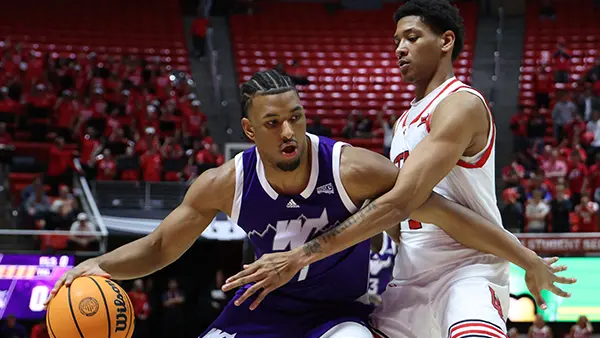
Don’t let the double-digit spread scare you off. The sharps are backing Utah Valley because Weber State’s defense ranks 232nd in the country and cannot stop high-efficiency offenses. Bash explains why the Wolverines will control the tempo at home and why the true line should be closer to 18 points in this handicapping breakdown.
The Setup: Weber State at Utah Valley
Utah Valley’s getting 13.5 to 14 points at home against Weber State, and I can already hear the skeptics: That’s a lot of chalk in a mid-major matchup between two teams that can score. Look, I get the hesitation. But when you dig into the collegebasketballdata.com efficiency numbers, this isn’t just about who scores more – it’s about how they score, how often they score, and what happens when they don’t have the ball.
Here’s my thesis: Utah Valley wins this game by 18-plus, and the spread is actually undervaluing the efficiency gap between these two programs. The Wolverines rank 52nd nationally in adjusted net efficiency at +13.1, while Weber State sits at 171st with a -0.2 mark. That’s a 13-point gap in adjusted efficiency, and we’re only laying 13.5. Let me walk you through why this number makes perfect sense – and why it’s actually on the low side.
Game Info & Betting Lines
Game: Weber State (4-5) at Utah Valley (6-3)
Date: December 17, 2025
Time: 8:00 PM ET
Venue: UCCU Center, Orem, UT
Spread: Utah Valley -13.5 to -14
Total: 150-150.5
Moneyline: Utah Valley -675, Weber State +490
Why This Number Makes Sense
The efficiency gap here is massive, but it’s not just the net number – it’s how these teams get there. Utah Valley ranks 85th in adjusted offensive efficiency at 113.5, while Weber State checks in at 135th with a 109.9 mark. That’s a 3.6-point advantage per 100 possessions for the Wolverines on offense alone. But here’s where this gets really interesting: Utah Valley’s adjusted defensive efficiency ranks 42nd nationally at 100.4, while Weber State sits at 232nd with a 110.1 mark. That’s nearly a 10-point swing on the defensive end.
Do that math over a full game, and you’re looking at a double-digit margin just from the efficiency baseline. But let’s get more specific about what those numbers actually mean on the court. Utah Valley’s raw offensive rating of 132.6 ranks 18th nationally – that’s elite territory. They’re shooting 52.4% from the field (10th nationally) and posting a 59.0% effective field goal percentage that ranks 17th in the country. That’s not just good shooting – it’s why they score 83.2 points per game while playing at the 327th-fastest pace in college basketball at just 62.7 possessions per game.
Weber State, meanwhile, is playing at a much faster tempo – 71.7 possessions per game, ranking 82nd nationally. Here’s the thing: when a slow, efficient team hosts a faster, less efficient team, the slower team controls the game. Utah Valley will dictate pace, limit possessions, and maximize each trip down the floor. Weber State wants to run and create 75 possessions. They’re getting maybe 65, and those 65 are coming against the 42nd-best adjusted defense in America.
Weber State’s Situation
The Wildcats can score – 85.0 points per game ranks 68th nationally – but they do it by playing fast and hoping their shooting holds up. That 34.4% three-point percentage (153rd) is mediocre, and their 71.1% free throw shooting (194th) means they’re leaving points at the line. Guard Jace Whiting leads them at 14.3 points per game, with Trevor Hennig adding 13.9, but neither is efficient enough to carry this offense against an elite defense.
The real problem is on the other end. Weber State’s adjusted defensive efficiency ranks 232nd nationally at 110.1. Yes, they’re holding opponents to 24.4% from three (4th nationally), which is impressive. But that opponent three-point defense is masking serious issues. They’re 309th in blocks per game at just 2.4, and 213th in steals at 6.9 per game. They don’t create havoc, they don’t protect the rim, and they’re about to face a team that shoots 52.4% from the field.
Weber State’s recent form shows the inconsistency: they beat Kansas City twice and Oral Roberts, but they got throttled 88-65 at St. Thomas-Minnesota. When they face quality competition, the defensive issues get exposed.
Utah Valley’s Situation
The Wolverines are 6-3 with their only losses coming to San Diego State on the road (77-66) and two other games not listed in their recent form. What stands out immediately is that defensive rating: 104.3 raw, 100.4 adjusted (42nd nationally). They’re holding opponents to 65.3 points per game (34th nationally), 37.8% shooting (17th), and 27.7% from three (28th). They rank 14th nationally in blocks per game at 5.7 and 26th in steals at 9.9. This is a defense that creates chaos.
Offensively, Jackson Holcombe leads at 16.0 points per game, but the real engine is Trevan Leonhardt, who’s dishing 6.4 assists per game (12th nationally). That assist rate is why Utah Valley ranks 9th nationally at 20.0 assists per game – they share the ball, find the best shot, and convert at elite rates. That 59.0% effective field goal percentage isn’t luck; it’s systematic ball movement against defenses that can’t keep up.
At home in the UCCU Center, Utah Valley controls everything: pace, shot selection, and defensive intensity. They’re coming off an 89-45 demolition of Samford and a 68-53 win over UC Santa Barbara. They’re rolling, and they’re about to face a defense ranked 232nd in adjusted efficiency.
The Matchup: Where This Gets Decided
This game lives and dies on pace and shooting efficiency. Weber State wants 72 possessions and a track meet. Utah Valley wants 63 possessions and a halfcourt grind. At home, Utah Valley gets what it wants. When the Wolverines slow this game down to their preferred pace, Weber State’s offensive rating drops because they’re not built to execute in the halfcourt against elite defenses.
Here’s the matchup that seals it for me: Utah Valley’s 52.4% field goal shooting and 59.0% effective field goal percentage against Weber State’s 232nd-ranked adjusted defense. The Wildcats can’t stop teams from getting quality looks, and the Wolverines are one of the best shooting teams in America. That’s a 15-point swing right there over the course of a full game.
On the other end, Weber State’s 34.4% three-point shooting faces a defense that ranks 28th nationally in opponent three-point percentage at 27.7%. The Wildcats aren’t good enough shooters to overcome that defensive pressure. They’ll force shots, turn it over (they’re 323rd in turnovers per game at 14.7 for Utah Valley, but Weber State isn’t much better at 230th), and watch Utah Valley convert those mistakes into points.
I keep coming back to those efficiency numbers because they’re just too extreme to ignore. A 13-point adjusted net efficiency gap should produce a 13-point margin, and we’re getting 13.5. But when you factor in home court (worth 3-4 points), pace control, and matchup advantages, this should be closer to 17-18.
My Play
The Pick: Utah Valley -13.5 (-110) for 2 units
I’m laying the points with Utah Valley at home. The efficiency gap is real, the matchup favors them in every phase, and they control pace. Weber State’s defense is too porous to slow down a team shooting 52.4% from the field, and their offense isn’t efficient enough to keep up when Utah Valley limits possessions.
The main risk here is if Weber State gets hot from three early and forces Utah Valley to speed up. But I’ve considered all of that, and the defensive gap is still too massive to ignore. Utah Valley ranks 42nd in adjusted defensive efficiency; Weber State ranks 232nd. That’s the game.
Score Prediction: Utah Valley 79, Weber State 61
Utah Valley wins this by 18, covers comfortably, and reminds everyone why efficiency matters more than pace. Take the Wolverines and sleep easy.