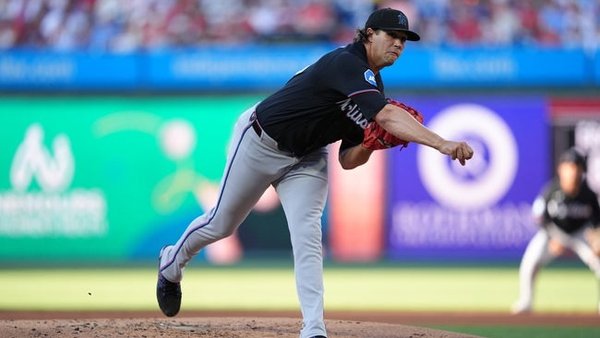
Tyler Phillips carries a 3.53 ERA and nearly 90 innings of legitimacy into loanDepot park — George Klassen brings 4.2 innings, an 11.57 ERA, and 10 walks. The total is set at 9, with the Under priced at -108 against an Over at -112, and a run projection that barely clears the number by 0.3. The market has not fully closed the gap between a real starter and an emergency option in a run-suppressing dome.
Angels at Marlins Betting Preview: Take the Under With Phillips Anchoring the Dome
The headline here is the starter disparity, and it’s one of the sharpest you’ll find on any MLB board this week. Miami’s Tyler Phillips brings a 3.53 ERA and 89.1 innings pitched into loanDepot park — a legitimate mid-rotation arm with a full-season sample that holds up under scrutiny. The Angels counter with George Klassen, who has logged all of 4.2 innings on the season with an 11.57 ERA and 3.64 WHIP. That’s not a struggling pitcher — that’s essentially an emergency option being handed a major league lineup in a dome park.
The market has set the total at 9, with the Under priced at -108 and the Over at -112. That slight pricing asymmetry matters. The numbers project 9.3 combined runs — fractionally over the number — but the juice differential tips the value toward the Under. When you combine Phillips anchoring one half of the total in a run-suppressing environment with the Angels’ weak offensive profile, the case for staying under builds quickly.
The Angels are arriving from Baltimore having just beaten the Orioles 4-1 Thursday, while Miami is coming off an 11-3 demolition at Atlanta’s hands. Neither team’s recent form screams runs in this particular matchup, and the dome park only tightens the ceiling further.
Game Info & Betting Lines
- Date/Time: Friday, August 7, 2026 | 7:10 PM ET
- Venue: loanDepot park (Dome) | Park Factor: 0.95 (run-suppressing)
- Probable Starters: George Klassen (LAA) vs. Tyler Phillips (MIA)
- Moneyline: Los Angeles Angels +136 / Miami Marlins -162
- Run Line: Miami Marlins -1.5 (+128) / Los Angeles Angels +1.5 (-154)
- Total: 9 (Over -112 / Under -108)
Why This Number Is Close — But Slightly Off
The market’s logic for setting the total at 9 isn’t wrong on its face. Klassen’s volatility is real — 10 walks in 4.2 innings screams command issues that can spiral fast — and the Marlins’ lineup, while not elite, has legitimate pieces. Otto Lopez is hitting .320 with an .830 OPS, and Griffin Conine carries an .863 OPS. The market is essentially pricing in the possibility that Klassen gets rocked early and the Marlins pile on before the bullpen takes over.
But here’s the problem with that framing: Miami’s lineup profiles as a .728 OPS unit, not a blowout-capable offense. Their contact-heavy approach — 931 team strikeouts against the Angels’ 1,083 — doesn’t scream “tee off on a struggling right-hander.” Phillips’ side of the total, meanwhile, is anchored by a pitcher who has kept hitters in check across nearly 90 innings, in a dome that historically suppresses run scoring by about 5%.
A 9.3 combined run projection is thin — barely clearing the number — but the juice imbalance does the rest of the work. Paying -108 on the Under versus -112 on the Over for a projection that barely edges over isn’t a coin flip. It’s a pricing edge, small but real, and that’s enough to act on at moderate conviction.
What Separates the Pitching
The gap between these two starters is not a matter of degree — it’s categorical. Tyler Phillips operates with a five-pitch mix built around deception rather than velocity. His sweeper (23.7% usage, 84.3 mph) generates a 33.6% whiff rate and .268 xwOBA against — genuinely elite suppression for a secondary offering. His split-finger (22.9% usage) is nearly as punishing, holding hitters to a .266 xwOBA with a 31.1% whiff rate. The crown jewel is his curveball at 17.6% usage: 45.7% whiff rate. What Phillips lacks in swing-and-miss volume — his 6.65 K/9 is modest — he compensates for with a ground-ball oriented sinker (25.5% usage, 95.7 mph) that creates weak contact and keeps the ball in the park. Eleven home runs allowed across 89.1 innings is manageable.
Against the Angels’ lineup, Phillips has room to work. Mike Trout is the obvious danger — an xwOBA of .487 against right-handed pitching and a 7.4% barrel rate demand respect — but the middle and bottom of the order is vulnerable. Nolan Schanuel’s 1.4% barrel rate and .353 xwOBA against righties won’t punish weak stuff. Denzer Guzman posts a .330 xwOBA against right-handed pitching. This isn’t a lineup that punishes command pitchers.
George Klassen is the inverse. His four-seam fastball sits at 97.3 mph with a 22.2% whiff rate, and his slider generates a 40.9% whiff rate — the raw stuff isn’t the problem. The problem is the .554 xwOBA against his changeup and the .698 xwOBA against his sinker, which suggests hitters are doing serious damage when they do make contact. Ten walks in 4.2 innings points to command instability that elevates his floor on a bad night considerably. The Marlins’ lineup doesn’t need to be great to exploit that — they just need to be patient, which their contact-oriented approach suggests they can be.
The Pushback
I’m not pretending this is a lock. The scenario that burns the Under is pretty easy to sketch: Klassen walks the first two batters he faces, Heriberto Hernández — who posts a .404 xwOBA against right-handed pitching — gets into a hitter’s count and goes deep, and suddenly we’re looking at a 3-0 game in the first inning. Klassen’s .698 sinker xwOBA and 10 walks in 4.2 IP make that a realistic path, not a tail risk. If the Angels pull him early, Miami’s bullpen is dealing with its own depletion issues — Andrew Nardi, Anthony Bender, and William Kempner are all on the injured list — so the Angels could theoretically tack on runs against an overextended relief corps.
There’s also the thin margin of the projection itself. When your edge is 0.3 runs on a 9-run total, you’re one bad inning away from the Over cashing, and bad innings are exactly what Klassen specializes in. I take that seriously.
What I’m betting against is the blowup being large enough. A 3-run Marlins inning off Klassen followed by four innings of Phillips holding the Angels to one run still gets us to somewhere around 8-9 total runs, depending on late-game bullpen action. The Under doesn’t need a pitching duel — it just needs the game to stay within normal parameters of volatility.
I also looked hard at the moneyline. Miami at -162 is a strong edge situation on paper, but that’s past my juice ceiling for a moderate-confidence play. I’m not laying $162 to win $100 when the pitching matchup has genuine uncertainty baked in on one side. The Under at -108 gives me exposure to the same core thesis — Phillips outpitching Klassen leads to a low-scoring game — at a price I can live with.
Run Environment & Game Shape
loanDepot park’s 0.95 park factor is doing real work in this projection. A 5% run suppression effect in a dome environment — no wind, no weather variables, controlled conditions — means the physical space itself is arguing for the Under. When you’re already projecting 9.3 combined runs and the venue shaves 5% off that expectation, the effective run environment pushes the projection closer to 8.8 or 8.9 in practical terms. That’s a number that makes the Under at 9 look less like a coin flip and more like a structurally sound bet. The dome doesn’t care that Klassen has command issues. It doesn’t care that Miami has some pop in the middle of the order. It just keeps the ball in play and suppresses the kind of weather-aided carry that inflates run totals in open-air parks. When a game is projected this close to the total and the park is actively working against the Over, that’s not a push — that’s a lean with teeth.
The Play
Under 9 (-108) | 2 Units | Moderate Confidence
Phillips is the anchor here — nearly 90 innings of 3.53 ERA ball in a dome that cuts 5% off the run environment makes his half of the total reliable enough to build a case around. Klassen’s volatility is genuine, but it’s already baked into where the number is set; the market has priced in a rough outing, and the juice asymmetry — paying -108 on the Under versus -112 on the Over for a projection that barely clears 9.3 — tips the value clearly toward the Under. With a run-suppressing dome park compressing an already-thin projected total, this is a clean spot to take the cheaper side of the number.
Bet: Under 9 (-108) — 2 units