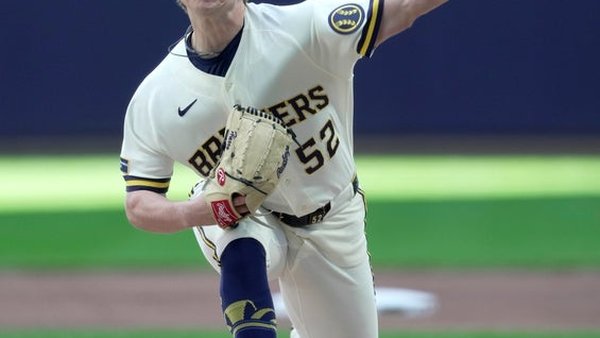
Kyle Harrison’s 10.93 K/9 and elite contact-suppression profile meet a Cincinnati offense hitting .229/.308/.398 — a bottom-tier unit that is exactly what a high-strikeout lefty exploits. The total at 9.0 is treating both starters as a wash; the pitching gap between Harrison and Singer says otherwise.
Kyle Harrison vs. Brady Singer: Milwaukee Brewers at Cincinnati Reds Betting Preview
After yesterday’s 5-3 Cincinnati win that featured three home runs and a rain delay, this series finale flips the pitching matchup entirely. Where the Brewers sent Dustin May to the mound on Saturday, today they counter with Kyle Harrison — a left-hander posting a 3.45 ERA and 10.93 K/9 across 107 innings. The gap between these two starters is what drives everything.
The market has set the total at 9.0, a number that reflects a hitter-friendly park and a volatile Cincinnati arm in Brady Singer. Great American Ball Park plays 10% above league average for runs — that inflation is real and already priced in. But the market may not be fully weighting how dominant Harrison is in suppressing exactly the kind of offense Cincinnati sends to the plate.
The Brewers’ moneyline at -163 is a non-starter regardless of the matchup quality. That’s where the analysis has to go somewhere else — and the total at 9.0 is where the actual edge lives.
Game Info & Betting Lines
- Date/Time: Sunday, September 6, 2026 | 12:10 PM ET
- Venue: Great American Ball Park | Park Factor: 1.10 (hitter-friendly)
- Probable Starters: Kyle Harrison (MIL, 10-4, 3.45 ERA) vs. Brady Singer (CIN, 5-13, 4.83 ERA)
- Moneyline: Milwaukee Brewers -163 / Cincinnati Reds +135
- Run Line: Milwaukee Brewers -1.5 (+100) / Cincinnati Reds +1.5 (-120)
- Total: 9.0 (Over -103 / Under -117)
Why This Number Is Close — But Slightly Off
The market’s logic is sound on the surface. Great American Ball Park inflates run scoring, Singer is a 4.83 ERA arm who has surrendered 26 home runs in 141.2 innings, and the Brewers’ lineup — when clicking — averages 5.02 runs per game on the season. The case for the over writes itself if you’re looking at Singer’s side of the ledger in isolation.
But here’s the problem: the total is a two-sided equation. Harrison’s side of this game is the counterweight the market is undervaluing. The Reds are hitting .229/.308/.398 (OPS .706) as a team — a bottom-tier offensive unit that is precisely the kind of lineup a high-strikeout lefty feasts on. Harrison has fanned batters at 10.93 per nine while walking just 29 in 107 innings. He doesn’t miss barrels, and he doesn’t give out free passes.
The numbers project a combined 10.0 total — technically over 9.0 — but a coin-flip projection that barely clears the number at 10.0 means the under at -117 carries real value. The juice isn’t onerous, the pitching asymmetry is significant, and the Reds’ offense is simply too weak on paper to be trusted to capitalize on the park factor against an arm this sharp. The market is balanced on Singer’s volatility; it’s underweighting Harrison’s dominance.
What Separates the Pitching
This comparison isn’t close. Kyle Harrison is working with a four-seam fastball sitting at 94.8 mph that he deploys on 56.7% of pitches, generating a 26.0% whiff rate and holding hitters to just a .304 xwOBA. His slurve — thrown 30.1% of the time — is arguably his best weapon, with a 30.4% whiff rate and an elite .233 xwOBA against. Against a Cincinnati lineup that whiffs at high rates up and down the order, that slurve is going to be a problem all afternoon.
Elly De La Cruz carries the highest ceiling in the Reds’ lineup — a .468 xwOBA and 8.4% barrel rate make him the one hitter Harrison cannot afford to be careless with. But the BvP history in a small sample (9 PA, .125 BA, 2K) suggests Harrison has handled him. Sal Stewart (.413 xwOBA, 31 HR on the season) and Tyler Stephenson (.423 xwOBA) are legitimate threats, but Stephenson’s .340 xwOBA against left-handed pitching specifically is a meaningful split — he’s far less dangerous in this matchup than his overall line suggests.
Brady Singer is a different story entirely. His primary pitch is a 91.3 mph sinker thrown nearly half the time — a pitch that generates only a 14.3% whiff rate and allows a .357 xwOBA. His slider (27.2% usage, 28.5% whiff rate, .316 xwOBA) is his most-used secondary offering and a serviceable pitch, but his sweeper (14.0% usage, 37.4% whiff, .286 xwOBA) is where he generates his best swing-and-miss. His cutter and four-seamer are liabilities, posting xwOBAs of .443 and .474 respectively. Garrett Mitchell’s .486 xwOBA against right-handed pitching and Jake Bauers’ .448 xwOBA are the Milwaukee hitters best positioned to punish Singer’s flat offerings. The gap between these two starters in terms of quality contact suppression is substantial — Harrison creates soft contact and strikeouts; Singer creates traffic.
The Pushback
The strongest argument against the under is the projected total itself. The numbers show a combined 10.0 runs — technically leaning over the number, not under it. That’s not a projection you dismiss casually. The park factor at Great American Ball Park is real, and it doesn’t discriminate based on which pitcher is on the mound. Even a dominant lefty is pitching in an environment that systematically inflates run scoring.
Singer’s volatility is the other concern. A 4.83 ERA arm with 26 home runs allowed in 141.2 innings has proven he can get shelled, and Milwaukee’s lineup — last in the big leagues with 132 home runs but featuring legitimate contact hitters at the top — is capable of a crooked-number inning against him.
The Bottom Line
The case for the under comes down to one thing: Harrison’s ability to neutralize a weak Reds offense is being underpriced relative to Singer’s volatility. Cincinnati’s .229/.308/.398 slash line is a bottom-tier offensive profile, and that’s the number that matters most when a high-strikeout lefty is on the mound. The park factor is already baked into the 9.0 line — this isn’t a secret — but what the market may be leaving on the table is how thoroughly Harrison suppresses exactly this type of lineup. A 10.0 projected total that just barely clears the bar is not a strong signal to fade the under; it’s a reason to grab it at -117 before anything changes.
Bet: Under 9.0 (-117) — 2 Units — Moderate Confidence