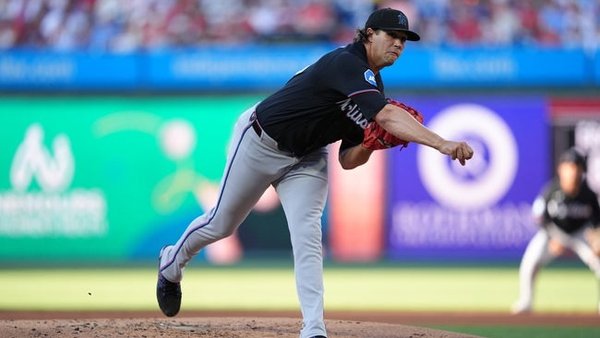
Clay Holmes carries a 2.09 ERA and a sinker-heavy profile built to suppress contact — yet the market is pricing the Over at -114 while the Under sits at a cheaper -105. loanDepot park’s 0.95 park factor tightens the run environment further, and the pitching gap between Holmes and Phillips is wide enough to shift how both halves of this ledger get shaped.
Clay Holmes vs. Tyler Phillips: Chicago Cubs at Miami Marlins Betting Preview
Yesterday’s 6-5 Cubs win at loanDepot park was a grind — thirteen hits, late momentum swings, and two Marlins home runs that kept it close until the final out. But that game featured Javier Assad walking five batters, a bullpen scramble, and Ryan Rolison bailing out the seventh inning. Today’s pitching context is completely different, and the market hasn’t fully priced that gap.
Clay Holmes enters this start as one of the more underrated arms in the National League this season. His 2.09 ERA and 1.07 WHIP in 81.2 innings aren’t flukes — they’re backed by an elite ground-ball profile and a near-total absence of home run damage. Against a Marlins lineup that carries a team OPS of .723 and pitches in a dome that suppresses run scoring, Holmes is exactly the kind of arm that can hold a game under the number even when the offense has been clicking.
The Under at -105 is the cleanest expression of this edge. The market is slightly off — leaning Over at -114 while the arm on the mound argues the opposite direction. That’s a small but real pricing inefficiency worth exploiting.
Game Info & Betting Lines
- Date/Time: Sunday, September 6, 2026 | 1:40 PM ET
- Venue: loanDepot park (Dome) | Park Factor: 0.95 — pitcher-friendly
- Probable Starters: Clay Holmes (CHC) vs. Tyler Phillips (MIA)
- Moneyline: Cubs -149 / Marlins +123
- Run Line: Cubs -1.5 (+113) / Marlins +1.5 (-136)
- Total: 8.0 (Over -114 / Under -105)
Why This Number Is Slightly Off
The market’s lean toward the Over makes some surface-level sense. The Cubs have scored six runs in each of their last two games against this Marlins staff. Both offenses are operating from a recent baseline of production in this series, and Tyler Phillips’s 1.33 WHIP and 47 walks in 110.1 innings suggests a pitcher who puts traffic on the bases. The Over at 8.0 feels like a reasonable number when one starter is vulnerable and an offense is running hot.
But here’s the problem: the Over is priced at -114 while the Under sits at -105. The market is asking you to pay more juice to bet on the side that requires Holmes to have an off night AND Phillips to underperform his ERA in the same game. That’s a double condition. The Under only needs one of those arms — the better one — to do its job.
The numbers point to a combined total in the 8.8-run range, which is marginally above the posted 8.0. But that figure is built on season-long offensive baselines. Holmes’s true suppression profile — built on a sinker-heavy approach that generates weak contact and limits home runs — argues the Cubs’ half of that estimate should skew lower. With the park knocking another 5% off the run environment, the actual expected total is closer to the number than the Over juice reflects.
What Separates the Pitching
The gap between these two starters is substantial, and it matters for how each half-inning gets shaped.
Holmes leans heavily on a sinker that comprises 49.0% of his pitches at 93.3 mph — generating a 10.5% whiff rate and, more importantly, keeping the ball on the ground and out of the seats. His sweeper (18.9% usage) holds hitters to a .210 xwOBA with a 24.5% whiff rate, and his changeup sits at a .224 xwOBA with a 32.4% whiff rate. These are put-away weapons, not just setup pitches. The Marlins lineup’s top threats — Griffin Conine (.490 xwOBA) and Kyle Stowers (.453 xwOBA) — carry high barrel rates in general, but Conine is 4-for-8 in limited BvP looks and Stowers is 1-for-5 with a strikeout. Heriberto Hernández is 0-for-5 with two strikeouts against Holmes’s profile. Holmes creates soft-contact innings that don’t snowball.
Phillips is a different kind of arm — he generates a 96.1 mph four-seamer and a sweeper sitting at 84.2 mph with a 33.3% whiff rate. The split-finger at 34.4% whiff is his best weapon. But his sinker generates a .398 xwOBA and his four-seamer comes in at .405 — those are hittable fastballs. Pete Crow-Armstrong carries a .485 xwOBA against right-handed pitching and Ian Happ checks in at .415. Seiya Suzuki (.384 vsRHP) is the one right-handed bat who might be cooler against Phillips, but this Cubs lineup has the power upside — 39 homers for PCA, 24 each for Bregman and Suzuki — to do damage against a pitcher with a 1.14 HR/9 rate.
The pitching gap is real: Holmes suppresses, Phillips allows contact. But the question for the total isn’t which team scores more — it’s whether the combined output clears 8.0. Holmes’s half of the ledger is the anchor that keeps it under.
The Pushback
The strongest case against this Under is the Cubs’ own recent form. They dropped six runs in each of the last two games in this ballpark. Pete Crow-Armstrong is in a legitimate NL MVP race with 39 homers. Alex Bregman extended his hitting streak to eight games on Friday. This is not a cold offense stumbling into a dome — these are hot bats that have been eating Miami pitching all weekend.
Phillips’s 47 walks in 110.1 innings is a legitimate concern. A pitcher who struggles with command is always a threat to turn a two-run inning into a four-run inning on a single mistake. The Cubs have the lineup construction — PCA’s .485 xwOBA against right-handers, Happ’s .415 vsRHP — to punish every base-on-balls Phillips issues.
And then there’s the Cubs bullpen situation, which deserves honest treatment. Porter Hodge, Ben Brown, Riley Martin, Hunter Harvey, Phil Maton, and Gavin Hollowell are all unavailable — that’s six relievers either on the IL or day-to-day. If Holmes exits before the seventh inning, Chicago is running a thin relief corps into the late innings. That’s where the Under can leak runs, and it’s a real risk. But the shape of that risk matters: a depleted bullpen tends to give up a run or two in a blown-save situation, not a five-run inning. It changes the floor of the Under, not the ceiling. Holmes would have to exit early AND the bullpen would have to implode for this game to push comfortably past 8.0.
Run Environment: loanDepot Park Does the Rest
loanDepot park is a dome with a 0.95 park factor — it suppresses run scoring by about 5% relative to a neutral venue. That’s not a massive number, but in a game projected this close to the total, it’s meaningful. The difference between a 9-run environment and an 8.5-run environment is exactly the margin we’re working with here.
Miami’s team OPS sits at .723. Their lineup features Stowers (.453 xwOBA, 31.1% strikeout rate), Hernández (.447 xwOBA, 27.3% K rate), and Conine (.490 xwOBA, 35.0% whiff rate) — dangerous hitters, but all three carry elevated whiff numbers that Holmes’s sweeper and changeup are built to exploit. Against a right-handed sinker-first starter, the xwOBA splits bear this out: Stowers is .487 vsRHP but only .348 vsLHP, which cuts both ways — Holmes is right-handed, so Stowers gets his preferred look. That’s the honest read. But the BvP data (1-for-5, one strikeout) suggests Holmes has handled him, and the soft-contact profile of his sinker limits the damage even when hitters put the ball in play.
The combined picture — Holmes anchoring the Cubs’ half, a pitcher-friendly dome, and a Marlins offense that whiffs enough to keep innings short — puts the under-8.0 scenario in play without needing a perfect game from anyone.
The Play
I’m on the Under 8.0 (-105) for 2 units. This is a moderate-confidence play built on a clear pitching edge, a suppressive park environment, and a market that’s pricing the Over at an unjustified premium. The Cubs bullpen depth is a real risk I’m not dismissing — but it’s a risk that shapes the margins, not one that blows up the Under thesis entirely. Holmes has to be Holmes, and everything we know about his 2026 season says that’s a reasonable expectation.
Bet: Under 8.0 (-105) | 2 Units