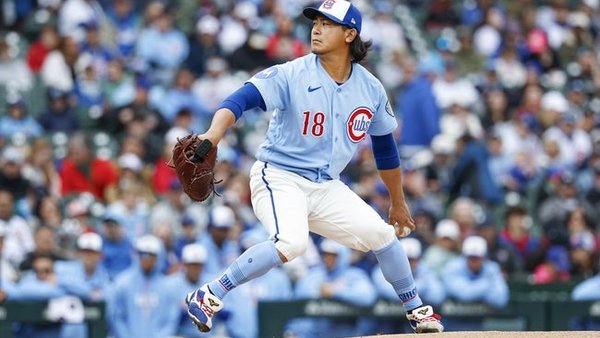
Yesterday’s 10-4 scoreline has the market focused on run production — the real story is Wednesday’s pitching mismatch. Imanaga’s elite command walks into Citizens Bank Park against a starter who has already surrendered 2 home runs in 17 innings.
Shota Imanaga vs Jesus Luzardo: Chicago Cubs at Philadelphia Phillies Betting Preview
The market is still digesting yesterday’s offensive fireworks, where the Cubs torched Philadelphia 10-4 in a game that featured 23 combined hits. But while the public focuses on run production, the sharp money should be zeroing in on Wednesday’s pitching matchup — and it’s not even close. Shota Imanaga brings elite control and strikeout ability into Citizens Bank Park, while Jesus Luzardo continues to struggle with command and home run suppression.
The Cubs are getting plus money at +113 despite holding a significant pitching advantage, creating a classic market overreaction scenario. Philadelphia’s home field bump and yesterday’s defensive miscues are baking extra value into this line that doesn’t reflect the fundamental gap between these starters.
Game Info & Betting Lines
- Date/Time: Wednesday, April 15, 2026 | 6:40 PM ET
- Venue: Citizens Bank Park (Park Factor: 1.02)
- Probable Starters: Shota Imanaga vs Jesus Luzardo
- Moneyline: Chicago Cubs +113 / Philadelphia Phillies -136
- Run Line: Philadelphia Phillies -1.5 (+141) / Chicago Cubs +1.5 (-171)
- Total: 8.5 (Over -115 / Under -105)
Why This Number Is Too Wide
The market is pricing Philadelphia as a moderate favorite at -136, largely due to home field advantage and recency bias from the Phillies’ 13-7 win on Monday. The legitimate case for Philadelphia centers on Kyle Schwarber’s 1.027 OPS and the fact that this lineup just proved it can score against Cubs pitching. Bryce Harper (.900 OPS) provides additional middle-of-the-order thump, and Citizens Bank Park’s 1.02 park factor offers a slight environmental edge.
But the market is overweighting offensive volatility while undervaluing pitching consistency. Yesterday’s 10-4 Cubs victory wasn’t about sustained offensive production — it was about Philadelphia’s bullpen imploding in the sixth inning after a defensive error opened the floodgates. The underlying pitching matchup tells a completely different story, one where Imanaga’s 2.81 ERA and elite 11.25 K/9 rate create a sustainable advantage over Luzardo’s 6.23 ERA and concerning home run rate.
This line already accounts for most of Philadelphia’s legitimate edges, but it’s not properly pricing the gap between these starters. Getting plus money on the better pitcher in a coin-flip run environment represents genuine value.
What Separates the Pitching
The contrast between these starters is stark, and the Statcast data reveals why. Imanaga’s arsenal is built for sustained success — his 44.3% four-seam fastball at 92.2 mph pairs perfectly with a devastating 32.4% split-finger at 83.6 mph that generates a 39.3% whiff rate and holds hitters to just .213 xwOBA. His 14.1% sweeper usage adds another elite secondary option with a 40.0% whiff rate and .139 xwOBA against.
Most importantly, Imanaga’s command profile is elite. He’s walked just 4 batters in 16 innings while striking out 20, creating the kind of efficient innings that neutralize opposing lineups. His .8125 WHIP reflects this precision, keeping baserunners to a minimum and avoiding the big innings that sink starters.
Luzardo presents a completely different risk profile. While his 13.5 K/9 rate looks impressive, the underlying metrics tell a troubling story. His 6.23 ERA is supported by concerning peripheral numbers — he’s already allowed 2 home runs in just 17.1 innings, suggesting his signature sweeper (34.3% usage, 50.0% whiff rate) isn’t effectively complementing his high-velocity arsenal. His 96.7 mph four-seam fastball shows plus velocity, but his .318 xwOBA against on sinkers and .257 on four-seamers indicates hitters are making quality contact when they connect.
The gap becomes even more pronounced when examining how these arsenals match up against opposing lineups. Imanaga’s split-finger creates problems for power hitters like Schwarber, whose 13.9% barrel rate comes primarily against fastballs and breaking balls — not the tumbling action of elite split-fingers.
The Pushback
The concern is Chicago’s offensive inconsistency cutting into this pitching edge. The Cubs are hitting just .229 as a team with a .687 OPS, ranking near the bottom of the National League in run production outside of yesterday’s explosion. Alex Bregman (.620 OPS) and Dansby Swanson (.688 OPS) have been particular disappointments, and there’s no guarantee they can replicate yesterday’s clutch hitting against a different pitcher.
Philadelphia’s power threats also create legitimate volatility concerns. Schwarber’s .592 xwOBA this season indicates he’s hitting the ball harder than his numbers suggest, and Harper’s track record against left-handed pitching (though Imanaga is a lefty with unusual arsenal characteristics) means one mistake pitch could flip the game’s complexion entirely.
That said, what works in Chicago’s favor is that even modest run support should be sufficient given the pitching gap. The Cubs don’t need to score 10 runs again — they just need to scratch across 3-4 runs against a struggling Luzardo, something yesterday’s performance suggests is entirely achievable.
Run Environment & Game Shape
The total sits at 8.5, reflecting the market’s expectation of a moderate-scoring game despite yesterday’s offensive outburst. Citizens Bank Park’s 1.02 park factor provides only minimal offensive enhancement, and both bullpens figure to be available after Tuesday’s blowout didn’t require extensive relief usage.
This environment actually amplifies the pitching edge rather than diminishing it. In lower-scoring games, the difference between a 2.81 ERA starter and a 6.23 ERA starter becomes magnified. Imanaga’s ability to work deep into games with minimal baserunners creates more predictable game flow, while Luzardo’s tendency toward big innings means Philadelphia will need to outscore problems rather than prevent them.
The likely scoring range falls between 7-9 runs total, making this a game where starting pitcher quality drives the outcome more than offensive explosion potential.
Joe Jensen’s Pick
JENSEN’S PICK: Chicago Cubs Moneyline (+113) — 2 Units
Projected Score: Chicago Cubs 5, Philadelphia Phillies 4
I looked at the run line here, but this environment feels too tight for multi-run separation. The Cubs’ offense remains inconsistent outside of yesterday’s performance, and Philadelphia’s power threats like Schwarber and Harper can keep games close even when trailing. The moneyline provides the cleanest path to value without requiring margin assumptions.
The fundamental thesis is simple: Imanaga’s elite control and arsenal depth creates a significant advantage over Luzardo’s home run and command concerns, while yesterday’s 10-4 victory proves the Cubs can score against this Philadelphia pitching staff. Getting plus money on the superior starter in what projects as a tight contest represents clear value.
I’m confident enough in the pitching edge to back it with 2 units, but not going heavier given the Cubs’ offensive inconsistency and early-season variance. This bet wins if Imanaga performs to his established level while Luzardo continues struggling with command and long balls.