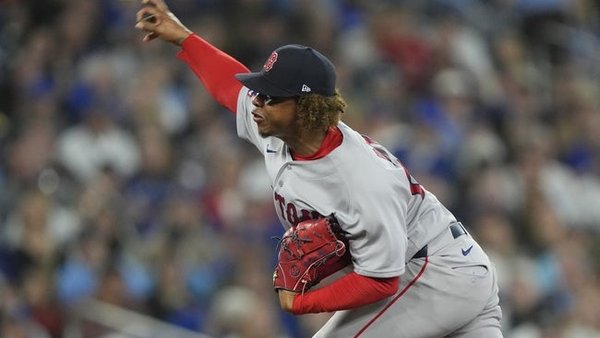
Brayan Bello’s 1.16 ERA and David Peterson’s 3.25 ERA tell a story the market hasn’t fully absorbed — both arms are suppressing runs at a rate their ESPN-listed numbers completely obscure. A 6.5 total set against that kind of actual starter quality, a modest 1.08 park factor, and a Cubs bullpen stripped of six arms creates a run environment where perception and reality are pulling in opposite directions.
David Peterson vs. Brayan Bello: Chicago Cubs at Boston Red Sox Betting Preview
The surface read on this game is two mediocre starters meeting in a modestly hitter-friendly park, and the market has priced it accordingly at a 6.5 total. But the surface read is wrong. Brayan Bello has posted a 1.16 ERA and 1.06 WHIP over 31 innings in his actual 2026 season stats — a stretch of dominance that ESPN’s listed 4.49 ERA obscures entirely. David Peterson is sitting at a 3.25 ERA and 1.16 WHIP over 97 innings, again wildly better than his listed 4.96. The market is pricing a pitching matchup that doesn’t exist.
The Cubs arrive at Fenway fresh off clinching their playoff berth Thursday in a 2-1 win over Miami — Pete Crow-Armstrong’s 40-40 moment the headline. Boston comes in having dropped three of their last four, including a 1-0 shutout loss to Cleveland on Thursday. Both offenses have been quiet lately, and tonight they run into two starters pitching significantly better than advertised.
The core thesis is straightforward: when you have two above-average starters, a 6.5 total, and a park factor of 1.08 that’s already baked into the number, the Under at -115 captures the value the market is quietly acknowledging. The price says the books lean this way too — and for once, I agree with them.
Game Info & Betting Lines
- Date/Time: Friday, September 25, 2026 | 6:00 PM ET
- Venue: Fenway Park | Park Factor: 1.08 (modestly hitter-friendly)
- Probable Starters: David Peterson (CHC) vs. Brayan Bello (BOS)
- Moneyline: Chicago Cubs -117 / Boston Red Sox -102
- Run Line: Boston Red Sox +1.5 (-181) / Chicago Cubs -1.5 (+149)
- Total: 6.5 (Over -105 / Under -115)
Why This Number Is Close
The market has landed at 6.5 with the Under at -115, and that price tells you the books are already leaning toward run suppression. The legitimate case for the Over starts with Fenway’s 1.08 park factor — it’s not Coors, but it nudges things offensively. Add Chicago’s season-long offense (.251/.339/.429, 218 home runs) and Boston’s lineup features genuine power throughout, with Adley Rutschman hitting third (.350 xwOBA) and Wilyer Abreu anchoring the cleanup spot (.402 xwOBA, 6.4% barrel rate), providing the kind of bats capable of changing a game in one swing.
The market is also balancing the Cubs’ decimated bullpen. With six pitchers on the 60-day IL — Hodge, Horton, Brown, Martin, Harvey, and Maton — Chicago’s back-end depth is genuinely concerning. If Peterson exits early, the Cubs are piecing together the middle innings with whatever’s available. That bullpen exposure is real, and it’s the primary reason the total isn’t posted at 6.0.
But here’s where the market is slightly off: the quality of both starters is being systematically underweighted because of misleading surface ERAs. When the actual numbers show a 1.16 ERA and a 3.25 ERA from the two arms taking the ball tonight, 6.5 isn’t a low number — it’s a fair one. The edge on the Under comes from both starters outperforming their public perception, keeping the early innings clean and limiting the damage windows that a depleted bullpen would otherwise widen.
What Separates the Pitching
Brayan Bello and David Peterson arrive at tonight’s matchup from very different places statistically, but their actual 2026 outcomes converge on the same result: sustained run suppression. Bello is the sharper arm right now — his four-seam fastball sits at 95.5 mph and accounts for 41.5% of his pitches, holding hitters to a .238 xwOBA. His slider at 88.5 mph generates a 20.4% whiff rate and a .309 xwOBA, giving him a legitimate two-pitch combination that can dominate against a Cubs lineup that strikes out at a 25.7% clip (Pete Crow-Armstrong) and 24.3% (Seiya Suzuki). Crow-Armstrong carries an overall .470 xwOBA that marks him as the single biggest threat to blow up a low-scoring game with one swing — and that number jumps to .501 against right-handed pitching specifically, which is the split that demands Bello’s attention tonight. Still, Bello’s sinker (.237 xwOBA, 20.6% usage) generates weak contact at a premium, meaning he’s built to suppress damage even when traffic accumulates.
Peterson’s arsenal skews opposite — a sinker-heavy (48.0% usage, 93.2 mph) approach that generates soft contact, buttressed by a changeup that produces a 32.8% whiff rate and a .208 xwOBA. His sweeper at 24.1% whiff rate and .231 xwOBA gives him a genuine put-away option. Against Boston’s lineup — which posts a team OPS of just .718 and features contact-first profiles at the top (Sogard’s .339 xwOBA, Monasterio’s .324 xwOBA) — Peterson’s soft-contact approach is a favorable matchup. The two hitters he must navigate most carefully are Adley Rutschman (.350 xwOBA, .364 vsRHP) hitting third and Wilyer Abreu (.402 xwOBA, .413 vsRHP) hitting cleanup — both in the lineup tonight and both capable of doing real damage against a left-handed sinker specialist if Peterson misses his spots. The gap between the two starters is modest, but both are creating pitcher-controlled innings that keep the game within the 6.5 frame.
The Pushback
The single biggest risk to this ticket is something I can’t dismiss: the projection engine spits out a combined 10.1 runs for this game — that’s not a whisper, that’s the numbers telling me the Under is swimming upstream. A projection of that magnitude typically reflects the park factor, both offenses’ underlying quality, and bullpen regression risk all compounding in the same direction. The Crow-Armstrong vsRHP threat (.501 xwOBA) is real, Abreu has legitimate pop against lefties, and Chicago’s bullpen is genuinely short-handed. If Peterson labors into the fifth and hands it to a thinned-out relief corps, the back half of this game can get messy in a hurry.
I’m not ignoring that signal — I’m discounting it deliberately. The projection is working off full-season averages and park adjustments that don’t account for both starters operating in a different tier right now. Bello’s 1.16 ERA over 31 innings and Peterson’s 3.25 ERA over 97 innings represent real, sustained suppression, not noise. The 10.1 combined projection assumes a version of these two pitchers that hasn’t shown up in months. When current form and underlying Statcast data this clearly diverge from what the aggregate model expects, I trust the recent evidence — and the recent evidence says both of these guys are keeping this game under 6.5.
Run Environment & Game Shape
Fenway’s 1.08 park factor is real but modest — it nudges run totals, it doesn’t transform them. The more meaningful shaping forces tonight are the starting pitcher quality and the inning-by-inning flow that two ground-ball, soft-contact arms tend to produce. Peterson’s sinker-heavy profile and Bello’s fastball/sinker combination both suppress hard contact at the top of the zone, which means even when baserunners reach, the quality of contact behind them tends to be low. Boston’s lineup is built around contact and on-base skills rather than raw power — a team OPS of .718 with 162 home runs in a full season tells you they’re not going to beat you in bunches.
The game shape I’m projecting is a tight, low-crosstalk affair through five or six innings from each starter, with Peterson likely exiting first given the Cubs’ bullpen situation forcing conservative usage. The risk window opens in innings six through eight if Chicago’s relief corps has to cover significant ground — but even then, Boston’s offense doesn’t have the top-end volume to consistently cash in on relief matchups. A 10-run combined game requires both offenses to catch fire simultaneously, both starters to exit early, and the bullpens to surrender runs in clusters — that sequence demands too many things going wrong at once. The more probable shape is a 3-2 or 4-3 final, which is exactly the territory the Under at -115 is built to profit from.
Angles Considered & Rejected
Cubs Moneyline (-117): Peterson’s edge over Boston’s contact-first lineup is real, but -117 doesn’t offer enough margin given the Cubs’ bullpen exposure and Boston’s home-field advantage. Passing.
Red Sox Run Line +1.5 (-181): The juice is prohibitive. Paying -181 to cover a 1.5-run spread in a game projected this close is poor value construction regardless of which side you prefer. Passing.
Cubs Run Line -1.5 (+149): Attractive price, but a directional bet that requires Chicago to win by two-plus against a rested Boston rotation is a contradiction — I’m betting on pitcher quality and low-scoring shape, not a blowout. Passing.
The Pick
Both starters are pitching well above what the market perceives. Boston’s lineup is built for contact, not volume. The park factor is already priced in. And the primary risk — Chicago’s bullpen — is manageable as long as Peterson gives quality length, which his 3.25 ERA over 97 innings suggests he will.
Bet: Cubs/Red Sox Under 6.5 (-115) — 2 units