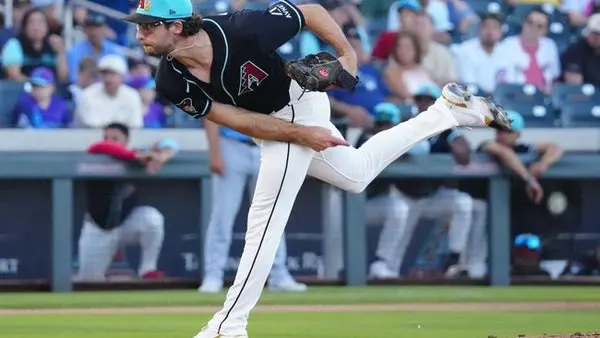
The Dodgers are priced like the 2025 champions they are, but I keep coming back to a pitching mismatch that feels more decisive than this -259 suggests — especially when Gallen’s 4.83 ERA meets Yamamoto’s championship form.
Zac Gallen vs Yoshinobu Yamamoto: Arizona Diamondbacks at Los Angeles Dodgers Betting Preview
Opening Day often brings inflated prices and public money chasing last season’s storylines. The Dodgers are steep favorites coming off their 2025 championship, and Arizona enters with significant roster upgrades including Nolan Arenado. But strip away the noise and focus on what drives outcomes in baseball — the starting pitching matchup.
Yamamoto’s elite 2.49 ERA and championship-winning performance creates a meaningful edge against Gallen’s concerning 4.83 ERA from last season. That’s a 2.34 ERA gap, which translates to real run prevention value. The market is balancing Arizona’s offseason improvements against LA’s championship pedigree, but the mound disparity feels underpriced even at this number.
Game Info & Betting Lines
- Date/Time: March 27, 2026, 8:30 PM ET
- Venue: Dodger Stadium (Park Factor: 0.98 – pitcher-friendly)
- Probable Starters: Gallen (13-15, 4.83 ERA) vs Yamamoto (12-8, 2.49 ERA)
- Moneyline: Arizona +209 / Los Angeles -259
- Run Line: Los Angeles -1.5 (-126) / Arizona +1.5 (+104)
- Total: 9 (Over -102 / Under -118)
Why This Number Is Steep But Justified
The market is pricing LA’s championship experience, home field advantage, and Kyle Tucker’s addition to a lineup already featuring Shohei Ohtani’s 55-homer production. Arizona counters with Arenado’s veteran presence and Ketel Marte’s elite .893 OPS when healthy.
But the -259 price reflects more than roster construction — it’s accounting for pitching reliability. Yamamoto posted a 10.42 K/9 rate with just 14 home runs allowed across 173.2 innings, while Gallen’s 4.83 ERA came with 31 homers surrendered in 192 innings. That’s not small sample variance; that’s a fundamental difference in run prevention ability.
The line feels high until you consider Arizona’s pitching depth was decimated by injuries, with seven arms on the IL including key rotation pieces. When your starter carries that much uncertainty and your depth is compromised, paying for elite pitching makes sense.
What Separates the Pitching
This isn’t close. Yamamoto dominated with a 0.99 WHIP and strong command, creating efficient innings that minimize damage. His 10.42 K/9 rate means he can work through trouble with strikeouts, while his home run suppression (0.73 HR/9) plays perfectly in pitcher-friendly Dodger Stadium.
Gallen presents the opposite profile — a 4.83 ERA supported by concerning peripherals. His 1.26 WHIP suggests command issues, and 31 homers allowed in 192 innings shows vulnerability to big swings. The 8.20 K/9 rate isn’t awful, but it’s not dominant enough to overcome his other weaknesses.
The gap becomes starker when you consider game script. Yamamoto creates quick, low-stress innings that preserve his pitch count and keep him deep in games. Gallen’s higher walk rate and homer tendency leads to pitch-heavy innings and earlier exits. In a sport where bullpen management matters, starting with a five-inning pitcher versus a seven-inning ace creates cascading advantages.
Despite questions about Gallen’s roster status after being listed among Arizona’s key departures, he remains with the team for 2026. His presence gives Arizona starting pitching depth, but his 2025 struggles raise concerns about his current effectiveness level.
The Pushback
The price demands scrutiny. At -259, you’re betting nearly three units to win one, requiring a 72% win probability just to break even. That’s championship-level confidence in what’s still an Opening Day matchup with inherent volatility.
Gallen showed ace potential in previous seasons, and Opening Day often brings peak motivation and preparation. Arizona’s lineup additions are real — Arenado brings postseason experience and clutch hitting, while Carroll and Marte provide dynamic offensive weapons when healthy. The Diamondbacks aren’t pushovers; they reached the World Series in 2023 with similar core pieces.
But the pitching mismatch remains the deciding factor. Even if Gallen delivers his best effort, Yamamoto’s floor is higher and his ceiling is championship-proven. The risk-reward calculation tilts toward paying for elite pitching, especially when Arizona’s depth concerns could magnify any early struggles.
Run Environment & Game Shape
Dodger Stadium’s 0.98 park factor slightly suppresses offense, creating an environment where pitching edges become amplified. The posted total of 9 suggests the market expects moderate scoring, which favors the team with superior mound work.
Yamamoto thrives in tight, low-scoring games where every run matters. His precision approach and home run suppression should keep Arizona’s power threats contained. Gallen’s homer vulnerability becomes more costly in a park where runs are harder to manufacture through small ball.
This projects as a 5-4 or 6-3 type game rather than a slugfest, meaning starting pitching performance drives the outcome more than lineup depth or late-inning strategy.
Joe Jensen’s Pick
JENSEN’S PICK: Los Angeles Dodgers -259
The price hurts, but the pitching mismatch is too significant to ignore. Yamamoto’s elite stuff and championship pedigree create a meaningful edge over Gallen’s homer-prone profile. I’m paying for pitching certainty in what should be a relatively low-scoring affair where every run matters. The Dodgers’ offensive depth provides multiple ways to push across runs, while their pitching staff gives them the better chance to limit damage.
This isn’t a bet I love making at -259, but it’s one where the underlying matchup supports the market price. Sometimes you have to eat chalk when the fundamentals point in one clear direction.