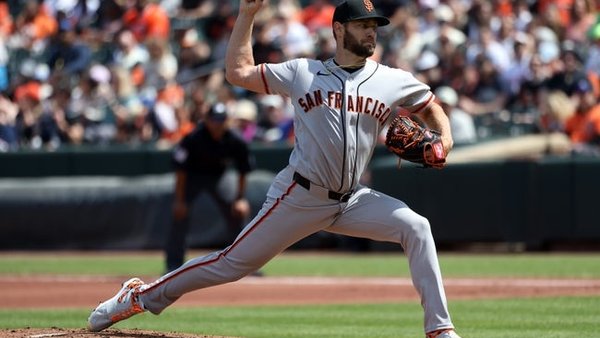
Yesterday’s Giants explosion suggests momentum — but Washington’s 89-point OPS advantage and patient approach against Houser’s sinker-heavy profile creates a different calculation than the -102 price implies.
Adrian Houser vs Cade Cavalli: San Francisco Giants at Washington Nationals Betting Preview
This matchup presents a classic case of two struggling rotations where the market might be undervaluing the superior offensive environment. After yesterday’s 10-5 slugfest that saw 15 hits from San Francisco, both teams return with pitchers carrying troubling peripherals. Adrian Houser brings a 5.06 ERA and 1.56 WHIP to the mound for the Giants, while Cade Cavalli counters with a 4.60 ERA and an even more concerning 1.72 WHIP for Washington.
The market has installed Washington as a slight home favorite at -102, which acknowledges their superior offensive profile this season – a .749 OPS compared to San Francisco’s league-worst .660 mark. But what caught my attention is how this line seems to discount just how poor Houser has been relative to even Cavalli’s struggles, creating a narrow edge despite both teams’ pitching concerns.
Game Info & Betting Lines
- Date/Time: Saturday, April 18, 2026 | 4:05 PM ET
- Venue: Nationals Park (Park Factor: 0.98 – slightly pitcher-friendly)
- Probable Starters: Adrian Houser (0-2, 5.06) vs Cade Cavalli (0-1, 4.60)
- Moneyline: San Francisco Giants -118 / Washington Nationals -102
- Run Line: Washington Nationals +1.5 (-163) / San Francisco Giants -1.5 (+135)
- Total: 9.5 (Over -115 / Under -105)
Why This Number Is Close
The market is balancing several legitimate factors here. San Francisco just exploded for 15 hits and 10 runs yesterday, showing they can break out of their offensive malaise against weak pitching. Both teams sit at identical 5-5 records over their last 10 games, and neither has established clear superiority this season. The Giants also get the slight road favorite treatment, which typically reflects market confidence.
What’s working in San Francisco’s favor is recency bias from yesterday’s offensive explosion and the fact that Cavalli’s 1.72 WHIP suggests he’s been fortunate to limit damage despite poor command. The market sees two struggling starters and defaults to the road team that just showed offensive life.
But I think this line undervalues the significant gap in offensive baselines. Washington’s .749 team OPS represents a substantial 89-point advantage over San Francisco’s .660 mark. The Giants’ 3.4 runs per game ranks dead last in baseball, while Washington averages 5.6 runs per game despite their recent cold stretch. The market is pricing yesterday’s outlier performance too heavily while ignoring the season-long offensive disparity.
What Separates the Pitching
Both starters bring concerning profiles, but Houser’s underlying metrics are notably worse. His sinker sits at 44.2% usage but generates just a 7.6% whiff rate while allowing a .407 xwOBA – those are bottom-tier numbers for a primary pitch. The 94.6 mph velocity isn’t overpowering, and when hitters make contact, they’re finding success. His slider provides some relief at 24.2% whiff rate, but he’s essentially a two-pitch pitcher without a reliable third offering.
Cavalli presents a different set of problems but with more upside potential. His 96.2 mph four-seam fastball represents legitimate velocity, though the 12.0% whiff rate and .428 xwOBA suggest command issues are undermining the stuff. His knuckle curve at 34.5% whiff rate gives him a genuine swing-and-miss weapon, and the changeup shows promise with a .076 xwOBA in limited usage.
The critical difference lies in stuff quality versus execution. Cavalli has better raw weapons but struggles with location, evidenced by 12 walks in just 15.2 innings. Houser shows better control with only 5 walks in 16 innings, but his stuff lacks the quality to miss bats consistently. Against Washington’s patient lineup – they’ve drawn 68 walks this season compared to San Francisco’s 41 – Cavalli’s command issues could be exploited. But CJ Abrams (.371 average, 1.190 OPS) and James Wood (.902 OPS) have shown they can capitalize on mistakes from both pitcher types.
The Pushback
Here’s what keeps me from making this a stronger play: Washington’s offense has been ice cold recently, failing to reach their season averages in their last few games before yesterday’s loss. Both Abrams and Wood represent relatively small samples of excellence that could regress. Cavalli’s 12 walks in 15.2 innings is genuinely concerning – if he can’t find the zone early, this game could get away from Washington quickly.
The Giants also just demonstrated they can score runs in bunches when facing poor pitching, and Cavalli certainly qualifies. Yesterday’s 15-hit performance suggests their hitters might be finding timing and confidence that could carry over. Matt Chapman had three hits and three RBIs, showing the type of production that could make Houser’s struggles irrelevant if the Giants’ bats stay hot.
That said, I keep coming back to the baseline offensive gap and Houser’s consistently poor peripherals. One offensive explosion doesn’t erase 20 games of struggle for San Francisco, and Washington’s lineup depth provides multiple ways to score runs even if their stars have an off day.
Run Environment & Game Shape
Nationals Park’s 0.98 park factor provides a slight pitcher-friendly environment, but the 9.5 total suggests the market expects both starters to struggle. This run environment should favor the team with better offensive depth and patience, which clearly points to Washington. Both bullpens have shown vulnerability this season, so the game likely comes down to which starter can navigate their lineup turns more effectively.
The projected scoring range sits in the 8-11 run territory, creating an environment where offensive edges get amplified. Washington’s ability to draw walks becomes more valuable against a pitcher like Houser who has shown control issues in the past. The relatively tight park factor means extra-base hits and timely hitting become premium skills – both areas where Washington holds advantages.
Joe Jensen’s Pick
JENSEN’S PICK: Washington Nationals Moneyline -102 — 1 Unit
Washington Nationals 5, San Francisco Giants 4. I looked at the run line here, but both starting pitchers carry enough risk to keep this game within a run either direction. The offensive gap between these teams is too significant to ignore, even after yesterday’s Giants explosion. Houser’s sinker-heavy approach against Washington’s patient hitters creates multiple opportunities for crooked numbers.
This isn’t a confident standalone bet given both teams’ inconsistencies, but Washington’s superior offensive baseline and home environment provide enough edge to justify the lean. The -102 price offers fair value on a team that should score more consistently than their recent results suggest.