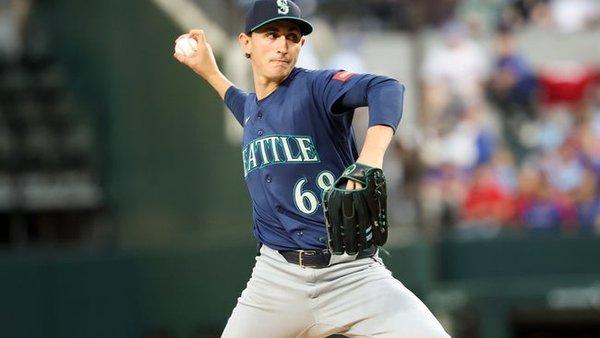
Seattle rides momentum from last night’s 7-1 victory, but Bradley’s 9.79 K/9 against Kirby’s 6.64 creates a pitching mismatch the market hasn’t priced. The Twins are catching plus money with the superior arm — that disconnect matters.
Taj Bradley vs George Kirby: Seattle Mariners at Minnesota Twins Betting Preview
The Twins are catching plus money at Target Field despite rolling out a starter with superior strikeout upside and nearly identical run prevention. While Seattle rides into Minneapolis off a dominant 7-1 victory last night, the market appears to be overweighting that result and undervaluing the pitching edge that favors the home side.
Both Taj Bradley (2.91 ERA) and George Kirby (2.97 ERA) bring sub-3.00 earned run averages to the mound, but Bradley’s 9.79 K/9 compared to Kirby’s 6.64 creates the separation that makes this price attractive. Getting plus money with comparable arms typically signals market inefficiency — and that’s exactly what we’re seeing at Target Field.
Game Info & Betting Lines
- Date/Time: Wednesday, April 29, 2026 | 1:40 PM ET
- Venue: Target Field (Park Factor: 1.00)
- Probable Starters: George Kirby (4-2, 2.97) vs Taj Bradley (3-1, 2.91)
- Moneyline: Seattle Mariners -132 / Minnesota Twins +112
- Run Line: Minnesota Twins +1.5 (-160) / Seattle Mariners -1.5 (+132)
- Total: 8 (Over +100 / Under -122)
The market is balancing legitimate concerns about Minnesota’s recent form — they’ve dropped eight of their last ten games — against Seattle’s momentum coming off consecutive quality starts from their rotation. The Mariners also boast superior team pitching numbers across the board, with a 3.69 ERA compared to Minnesota’s 4.40 mark. But this line is driven by individual starter quality rather than bullpen depth, and that’s where the market might be missing the nuance.
Bradley’s 1.15 WAR compared to Kirby’s 0.97 suggests the southpaw has been the more valuable pitcher this season, despite nearly identical surface numbers. When you’re getting +112 on a starter with better underlying metrics, the market is essentially asking you to fade recent team results rather than evaluate the actual pitching matchup — and I think that creates opportunity.
What Separates the Pitching
The strikeout gap tells the story here. Bradley’s 37 strikeouts in 34 innings compared to Kirby’s 29 in 39.1 innings points to different approaches that could matter significantly in a tight game. Bradley’s arsenal centers around a 96.5 mph four-seamer that he throws nearly half the time, but it’s his secondary offerings that create the swing-and-miss upside.
His cutter sits at 88.9 mph with a 35.1% whiff rate and generates a stellar .246 xwOBA against. The split-finger at 90.6 mph produces a 33.3% whiff rate with a .200 xwOBA — those are elite putaway numbers that suggest Bradley can work deeper into games without relying on his bullpen.
Kirby operates differently, leaning on location and command rather than swing-and-miss stuff. His slider generates a 29.1% whiff rate, but his four-seamer and sinker both allow .291 xwOBA against — significantly higher contact quality than Bradley’s offerings. In a game projected around eight runs, the pitcher who can limit traffic and extend his outing typically provides more value, and Bradley’s arsenal suggests he’s better equipped for that role.
The matchup data reinforces this edge. Seattle’s top hitters have shown vulnerability to Bradley’s pitch mix in limited sample sizes, with key guys like Josh Naylor (.111 average in 11 plate appearances) and Julio Rodriguez posting just .333 with one homer in nine trips. Meanwhile, Minnesota’s Josh Bell has absolutely raked against Kirby (.571 average with two homers in seven PAs), suggesting the Twins’ middle order could break through earlier in this game.
Here’s what gives me pause: Minnesota’s recent offensive struggles have been brutal. They’ve managed just one run in their last two games and have been shut down by quality pitching throughout this losing streak. Seattle’s lineup gets healthier every day, while the Twins are dealing with injury concerns that have disrupted any rhythm they might have built.
There’s also the psychological momentum factor. When a team scores seven runs and gets quality pitching like Seattle did last night, confidence carries over. The Mariners have been the better team over the last ten games, going 7-3 compared to Minnesota’s 2-8 record. Sometimes recent form trumps theoretical edges, and Seattle clearly has all the momentum.
But Monday’s 11-4 explosion reminded everyone what Minnesota’s ceiling looks like against quality pitching. When they connect, they can score in bunches, and getting plus money on a team that just proved they can push across double-digit runs feels like the market overreacting to one poor offensive showing.
Target Field’s 1.00 park factor creates a neutral run environment that should favor the better pitcher, and Bradley’s strikeout upside gives him the edge in tight, low-scoring games. The total sits at 8, suggesting the market expects this to play under, which amplifies starting pitching quality. Both teams carry identical .706 OPS marks this season, so offensive advantages are minimal — making Bradley’s K/9 differential the key separator here.
Joe Jensen’s Pick
JENSEN’S PICK: Minnesota Twins Moneyline +112 — 1 Unit
I looked at the run line here, but it’s very pricey, and getting plus money straight up with the better starting pitcher feels like the cleaner play. Bradley’s strikeout upside and proven ability to limit hard contact should keep this game close enough for Minnesota’s offense to steal a win. In a matchup this tight, I’ll take the home underdog with the superior arm and let the Twins’ offensive ceiling do the rest.