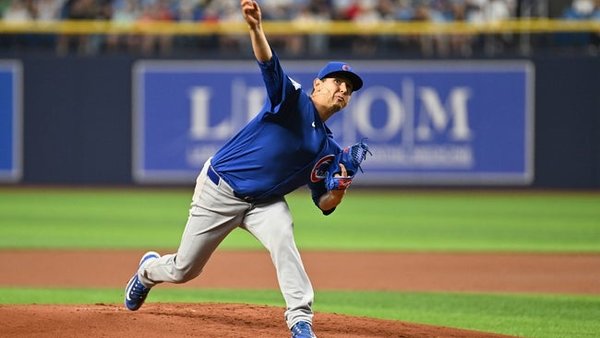
Assad’s 8.10 ERA and 1.60 WHIP show genuine command problems, but the Cubs moneyline at -136 treats this like a coin flip. Myers’ precision arsenal should exploit these control gaps.
Tobias Myers vs Javier Assad: New York Mets at Chicago Cubs Betting Preview
The market is pricing this Sunday afternoon matchup at Wrigley like it’s a coin flip, but the starting pitcher divide tells a different story. Tobias Myers brings a crisp 3.46 ERA and 0.77 WHIP to the mound for the Mets, while Javier Assad is sporting an ugly 8.10 ERA through his first 10 innings. That’s not small-sample noise — it’s a control problem manifesting in hard contact.
The Cubs are riding a four-game winning streak and just handed the Mets their 10th consecutive loss yesterday, but that momentum narrative is already baked into this -136 number. What isn’t properly reflected is how Myers’ precision arsenal should exploit Assad’s command issues in a tight run environment. The total sits at 8.5, suggesting the market expects a pitcher-friendly game, which amplifies the value of backing the superior arm at a reasonable price.
Game Info & Betting Lines
- Date/Time: Sunday, April 19, 2026, 2:20 PM ET
- Venue: Wrigley Field (Park Factor: 1.02 — slightly hitter-friendly)
- Probable Starters: Tobias Myers (3.46 ERA) vs Javier Assad (8.10 ERA)
- Moneyline: New York Mets +113 / Chicago Cubs -136
- Run Line: Chicago Cubs -1.5 (+159) / New York Mets +1.5 (-194)
- Total: 8.5 (Over -105 / Under -115)
Why This Number Is Close But Not Right
The market is balancing Chicago’s home momentum and recent offensive surge against New York’s pitching advantage, and on the surface, -136 feels about right for a Cubs team that’s won four straight and just dismantled the Mets yesterday. The Cubs have outscored opponents by 29 runs this season compared to New York’s -24 differential, and Carson Kelly’s pinch-hit three-run homer in yesterday’s 4-2 victory exemplifies the type of clutch hitting that’s been driving their success.
But the line is giving too much weight to situational factors and not enough to the fundamental pitching mismatch. Assad’s 8.10 ERA isn’t just bad luck — his 1.60 WHIP shows genuine command problems, walking four batters in just 10 innings while surrendering two home runs. Meanwhile, Myers has been surgical with a 0.77 WHIP and only one walk issued all season. The Cubs offense has been productive, averaging 5.5 runs per game, but they’ve struggled to capitalize consistently when their offense is needed most.
I’m getting a Cubs team that should be favored by more given the pitching gap, but the market is keeping this close because of surface-level momentum reads. That creates value on the Mets moneyline.
What Separates the Pitching
This is where the betting edge reveals itself — Myers versus Assad isn’t close. Myers’ arsenal centers around a 92.4 mph four-seam fastball that comprises 42.1% of his offerings, holding opponents to a .340 xwOBA. His out pitch is a devastating split-finger that generates a 36.4% whiff rate and microscopic .064 xwOBA against. When Myers needs a strikeout, that splitter becomes unhittable, producing a 32% put-away rate.
Assad’s approach is fundamentally different and far less effective. His 93.2 mph sinker sits at 41% usage but hemorrhages contact with a .371 xwOBA against and pedestrian 11.1% whiff rate. His secondary offerings lack the bite to miss bats — the cutter generates only 13% whiffs while allowing a .380 xwOBA. Assad does possess a sweeper that shows promise with 37.5% whiffs, but at just 9% usage, it’s not frequent enough to anchor his arsenal.
The Cubs lineup features quality hitters like Nico Hoerner (.927 OPS) and Carson Kelly (.970 OPS), but Myers’ splitter should neutralize middle-of-the-order threats. Conversely, the Mets’ patient approach could exploit Assad’s control issues — Francisco Alvarez (.894 OPS) and Luis Robert Jr. (.751 OPS) have shown the ability to work counts and capitalize on mistakes. Assad’s 4:1 walk-to-strikeout ratio this season signals a pitcher struggling to command the zone consistently.
Run Line Analysis: Why I’m Passing
While my model shows strong value on Chicago covering the -1.5 run line at +159, I’m staying away from this angle despite the appealing price. The concern isn’t the Cubs’ ability to win — it’s their ability to win big against a Mets team that, despite their struggles, still possesses enough individual talent to keep games competitive.
New York’s offensive numbers (.632 OPS) look pathetic, but that includes contributions from players who are now injured or relegated to bench roles. The current lineup features legitimate threats in Alvarez (.894 OPS) and Robert (.751 OPS) who can change the complexion of any inning. More importantly, the Mets’ bullpen has actually been functional during this losing streak — it’s been their inability to score runs that’s killed them, not necessarily their ability to prevent big innings.
Assad’s control issues make him a candidate for early removal, which could bring the Cubs bullpen into play earlier than ideal. In a game where I’m already concerned about run-scoring environment, asking Chicago to win by multiple runs feels like pushing my edge too far. The moneyline captures the pitching advantage without requiring a blowout scenario.
The Pushback
Here’s what makes me pause: Assad’s sample size. Ten innings is microscopic in baseball terms, and his career numbers suggest he’s capable of better than this 8.10 disaster. Regression could come at any moment, especially at home where he’s historically been more comfortable. The Cubs offense, despite recent inconsistencies, still ranks significantly higher in team OPS (.745 vs .632) and has scored 39 more runs than the Mets this season.
The bigger concern is New York’s historic collapse. This team has been outscored 60-18 during their 10-game losing streak — that’s not just bad luck, it’s systematic failure. Key injuries to Juan Soto and Jorge Polanco have depleted their lineup, and there’s legitimate question whether they can score enough runs even against Assad’s struggles. Road favorites in baseball can be dangerous when the visiting team is this broken mentally.
But I keep coming back to the pitching fundamentals. Myers’ splitter gives him a weapon Assad simply doesn’t possess, and in a tight game environment, that differential becomes magnified. The Cubs may be riding momentum, but momentum doesn’t hit 92 mph fastballs or swing through split-fingers in the dirt.
Run Environment & Game Shape
The total at 8.5 suggests the market expects a pitcher-friendly affair, which aligns perfectly with Myers’ profile. Wrigley’s 1.02 park factor is nearly neutral, meaning run scoring will depend primarily on execution rather than environmental factors. This setup favors the pitcher with better command and more reliable secondary weapons — that’s clearly Myers.
I’m projecting a game script where both starters work deeper into the contest than their season averages suggest. Myers should cruise through middle innings with his splitter keeping Cubs hitters off balance, while Assad — despite his struggles — has enough stuff to navigate through a depleted Mets lineup if he can locate his sinker. The first team to break through likely wins, and I trust Myers to maintain his edge longer.
THE PICK: New York Mets +113 (1 unit)
I’m taking the better pitcher at plus money. Assad’s early-season struggles represent genuine control issues, not small-sample variance, and Myers’ splitter gives him a legitimate out pitch that should play up in this environment. The Cubs may have momentum, but in a sport where individual matchups matter more than team narratives, I’m backing the superior arm.