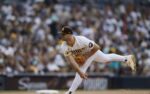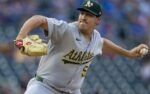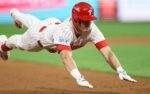
I’m staring at a Phillies home favorite priced like they should win by two runs, but Foster Griffin’s complete statistical void makes this exactly the type of spot where the house edge actually works in the sportsbook’s favor.
Foster Griffin vs Taijuan Walker: Washington Nationals at Philadelphia Phillies Betting Preview
Opening week presents the classic trap of wanting action on every game, but this Nationals-Phillies matchup exemplifies why patience pays in baseball betting. Philadelphia sits as a -175 home favorite despite a woeful 1-2 start and -4 run differential, while Washington arrives with momentum from taking two of three in Chicago. The market appears to be pricing in Citizens Bank Park’s slight offensive boost and Walker’s known commodity against Griffin’s complete unknown.
The fundamental problem isn’t that this line looks particularly wrong—it’s that we’re operating with half the information needed to make an informed decision. When Foster Griffin takes the mound for Washington, we’re essentially betting blind against Walker’s documented 2025 struggles (4.08 ERA, 1.407 WHIP). This information asymmetry creates the exact scenario where the sportsbook’s built-in advantage becomes insurmountable.
Game Info & Betting Lines
- Date/Time: Monday, March 30, 2026 at 6:40 PM ET
- Venue: Citizens Bank Park (Park Factor: 1.02 – slightly hitter-friendly)
- Probable Starters: Foster Griffin (WAS) vs. Taijuan Walker (PHI)
- Moneyline: Washington Nationals +144 / Philadelphia Phillies -175
- Run Line: Philadelphia Phillies -1.5 (+119) / Washington Nationals +1.5 (-143)
- Total: 9 runs (Over -115 / Under -105)
Why This Number Creates False Confidence
The market is balancing several legitimate factors that make Philadelphia the rightful favorite. Walker, despite his mediocre 2025 numbers, provides a known quantity with 123.2 innings of documented performance. Citizens Bank Park’s 1.02 park factor genuinely favors run production, and home field advantage, while minimal in baseball, still exists. The Phillies also carry the perception of being the superior organization with better depth.
However, this same market logic reveals the betting trap. The -175 price suggests Philadelphia wins this game roughly 64% of the time, but that confidence assumes we can properly evaluate both starting pitchers. When one half of the equation is completely missing—Griffin’s statistical profile—we’re essentially guessing on the most critical factor that determines MLB outcomes. The line isn’t necessarily wrong; we just lack the data to prove it either way.
What Separates the Pitching
Taijuan Walker’s 2025 season tells the story of a pitcher who kept his team in games without dominating. His 4.08 ERA and 1.407 WHIP reflected consistent mediocrity, allowing 1.53 home runs per nine innings—a concerning number in any park that favors hitters. Walker’s 6.26 K/9 rate paired with 3.06 BB/9 suggests limited margin for error against even average lineups.
The complete absence of data on Foster Griffin creates an impossible handicapping scenario. Without knowing his velocity, command, repertoire changes, or even basic rate stats, we’re reduced to speculation about how he’ll handle a Phillies lineup that showed flashes but struggled with consistency in their opening series. Walker’s homer-prone tendencies provide a theoretical edge for Washington’s power hitters, but Griffin’s ability to prevent runs remains a complete mystery.
This pitching gap—or lack thereof—represents the core problem with this game. Walker’s documented struggles should create opportunity for the visiting side, but Griffin’s unknown performance ceiling makes it impossible to quantify that edge. We’re essentially betting on which question mark proves more problematic.
The Pushback
The strongest case for action centers on Walker’s demonstrable weaknesses and Philadelphia’s early-season struggles. A -4 run differential through three games suggests real problems, not just bad luck. Walker’s home run rate from 2025 (1.53 HR/9) in a hitter-friendly park creates obvious vulnerability, especially if Washington’s power hitters like Joey Wiemer—who homered twice in the Cubs series—find their timing.
Philadelphia’s bullpen injuries to Max Lazar and Orion Kerkering limit late-game options, potentially forcing longer outings from Walker or reliance on lesser arms. The Nationals showed offensive life in Chicago, scoring 18 runs across three games, suggesting their lineup might exploit Walker’s documented control issues. But here’s the problem: all of this analysis assumes Griffin can hold up his end, and we have zero evidence either way. The bet ultimately hinges on complete speculation about 50% of the primary matchup.
Run Environment & Game Shape
Citizens Bank Park’s 1.02 park factor suggests a slight offensive environment, supporting the posted total of 9 runs. The market expects a moderate-scoring game where both offenses can produce against potentially vulnerable pitching. This environment theoretically amplifies Walker’s home run problems while potentially masking Griffin’s unknown limitations through offensive support.
However, this run environment cuts both ways when handicapping becomes pure guesswork. Higher-scoring games create more variance, meaning Griffin’s mystery performance could swing the outcome dramatically in either direction. The park factor that should help clarify the betting picture instead adds another layer of uncertainty to an already problematic information gap.
Joe Jensen’s Pick
JENSEN’S PICK: PASS — 0 Units
I looked at the moneyline on Washington, thinking Walker’s struggles and Philadelphia’s poor start created value with the underdog. The price at +144 appears reasonable for a visiting team that just took a series in Chicago. But that edge evaporates when half the pitching equation is completely unknown. I considered the total under, figuring two potentially struggling starters might get pulled early, but Griffin’s mystery performance could just as easily explode in a hitter-friendly park.
The run line presented similar problems—any statistical advantage dissolves when we can’t evaluate the primary factor that determines game outcomes. This represents a classic early-season spot where the market’s efficiency stems from shared information limitations rather than sharp analysis. Sometimes the best bet is no bet, and three games into the season with missing data on a starting pitcher exemplifies exactly that scenario.