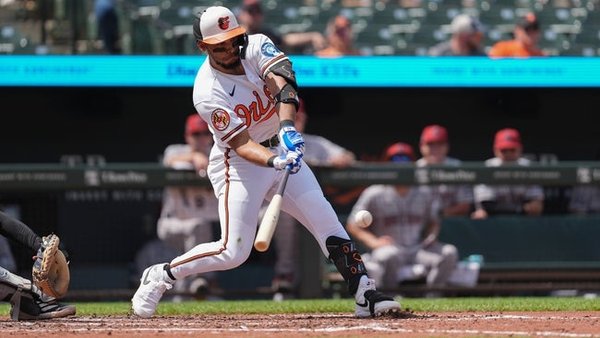
Williams’ 2.38 ERA creates clear pitching separation, but the market hasn’t fully adjusted for Cleveland’s bullpen meltdown — six runs surrendered to this exact Baltimore offense just 24 hours ago.
Dean Kremer vs Gavin Williams: Baltimore at Cleveland Betting Preview
The market is pricing this game around Gavin Williams‘ excellence and Cleveland’s home field advantage, installing the Guardians as -143 favorites despite Baltimore’s superior offensive metrics and fresh evidence of Cleveland’s relief vulnerability. Williams has been outstanding with a 2.38 ERA and 0.83 WAR through 22.2 innings, creating legitimate hesitation about backing the road team.
But the market isn’t fully accounting for what Baltimore’s offense accomplished against this exact Cleveland bullpen last night — six runs in the eighth inning after trailing 4-0. That explosion exposed critical weaknesses in Cleveland’s relief corps that Dean Kremer doesn’t need to be dominant to exploit. At +119, Baltimore offers value despite the pitching mismatch.
Game Info & Betting Lines
- Date/Time: Saturday, April 18, 2026 | 6:10 PM ET
- Venue: Progressive Field (Park Factor: 0.98)
- Probable Starters: Dean Kremer vs Gavin Williams
- Moneyline: Baltimore +119 / Cleveland -143
- Run Line: Cleveland -1.5 (+159) / Baltimore +1.5 (-194)
- Total: 7.5 (O -102 / U -118)
Why This Number Is Tight
The market is balancing Williams’ clear pitching superiority against Baltimore’s offensive advantages and recent momentum. Williams has been everything Cleveland hoped — 11.5 K/9 with a 1.147 WHIP that suggests legitimate dominance. His 96.2 mph four-seam fastball pairs with a devastating sweeper at 51.4% whiff rate that has carved up opposing lineups.
Cleveland’s case gets stronger when you consider home field advantage and comparable team records (11-10 vs 10-10). The Guardians also match Baltimore’s power output with 21 home runs to the Orioles’ 18, suggesting offensive parity that favors the better pitcher.
But the line doesn’t fully reflect Baltimore’s .709 OPS advantage over Cleveland’s .697 mark — a gap that becomes more meaningful when combined with better plate discipline (83 walks vs 80 despite fewer strikeouts). More critically, it underweights what happened in the eighth inning Friday when Baltimore torched Cleveland’s bullpen for six runs, exposing the exact relief corps that will need to protect any Williams advantage.
What Separates the Pitching
Williams dominates this matchup on paper, but the gap isn’t as wide as the surface numbers suggest. His 2.38 ERA comes with solid peripherals — the 96.2 mph velocity and 51.4% whiff rate on his sweeper create a legitimate swing-and-miss profile that should challenge Baltimore’s lineup. Williams has allowed just three home runs in 22.2 innings, showing the kind of power suppression that can neutralize Baltimore’s lineup depth.
Kremer presents a completely different profile with his small sample creating both opportunity and risk. His 16.2 K/9 suggests dominant stuff, but that comes in just five innings with three home runs allowed. The underlying metrics show a pitcher with swing-and-miss potential — his split-finger sits at 46.2% whiff rate — but also significant homer vulnerability that Cleveland’s power hitters could exploit.
The critical difference isn’t just the starters — it’s what happens when they exit. Cleveland’s bullpen just surrendered six runs in one inning to this exact Baltimore offense, with Scott Armstrong unable to record an out and Erik Sabrowski melting down in high leverage. Williams might give Cleveland five or six quality innings, but Baltimore has already proven they can attack what comes next.
The Pushback
The concern is obvious — Williams represents a significant step up in competition from what Baltimore has faced recently. His combination of velocity and breaking ball quality gives him multiple ways to attack Baltimore’s lineup, and Kremer’s tiny sample makes him completely unpredictable. Those three home runs in five innings suggest a pitcher who could get ambushed by Cleveland’s power.
Cleveland also gets the benefit of home field advantage and recent success against Baltimore’s pitching. The Guardians have scored four runs in consecutive games against Baltimore, suggesting they’ve found ways to generate offense even in tight games. José Ramírez (.776 OPS) and Chase DeLauter (.896 OPS) provide the kind of middle-order threat that can exploit Kremer’s homer issues.
But the bullpen evidence from 24 hours ago weighs too heavily to ignore. Baltimore didn’t just score six runs — they did it against the same relievers who will need to bridge Williams to the closer. That kind of fresh intelligence on Cleveland’s relief vulnerability creates an edge that persists regardless of the starting pitching gap.
Run Environment & Game Shape
Progressive Field’s 0.98 park factor creates a neutral run environment that should favor the better offensive team over time. The total at 7.5 reflects market expectations of a pitcher-driven game, but that total assumes Cleveland’s bullpen can maintain Williams’ effectiveness.
This projects as a game decided in the sixth through eighth innings, when Baltimore’s proven ability to attack Cleveland’s relief corps becomes the determining factor. The likely scoring range of 3-5 runs per side makes this a margin game where Baltimore’s offensive depth and plate discipline create multiple scoring opportunities against a Cleveland bullpen that just showed critical vulnerability.
Joe Jensen’s Pick
JENSEN’S PICK: Baltimore Orioles ML (+119) — 2 Units
I looked at the run line here, but this environment is too tight for multi-run separation. Both offenses are modest (.709 vs .697 OPS) and Williams is quality enough to keep Cleveland competitive. The moneyline captures the edge without requiring margin.
Baltimore’s .709 OPS and superior plate discipline create value at plus money, especially after proving they can exploit Cleveland’s bullpen depth. Jeremiah Jackson’s .923 OPS and Taylor Ward’s .811 OPS provide elite top-of-order production that Cleveland cannot match. The model projects Baltimore 4, Cleveland 3 — a narrow edge that pays at these odds. Two units reflects moderate confidence in the offensive gap overcoming the pitching disadvantage.