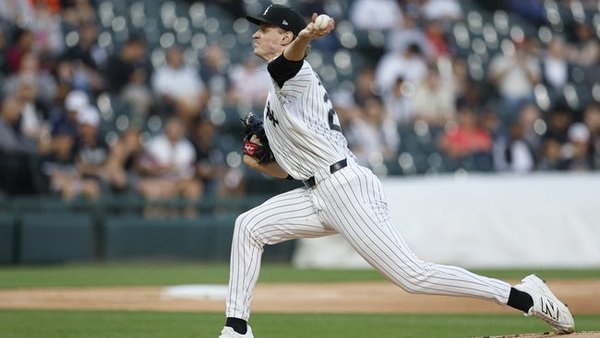
Springs’ 1.46 ERA against Schultz’s 6.23 ERA creates a clear pitching advantage — the -156 moneyline makes you pay premium juice for what should be a more decisive edge.
Jeffrey Springs vs Noah Schultz: Chicago White Sox at Athletics Betting Preview
The Athletics host the White Sox in the finale of a wild series that’s seen 22 total runs scored across two games, but Sunday’s pitching matchup suggests a dramatically different environment. Jeffrey Springs takes the mound for Oakland carrying a pristine 1.46 ERA and 0.77 WHIP through 24.2 innings of work, while Chicago counters with Noah Schultz, who’s struggled to a 6.23 ERA and 1.62 WHIP in just 4.1 innings pitched.
The market is pricing the Athletics at -156, creating juice that’s right at the threshold of what I consider playable for a starting pitching edge this pronounced. While the White Sox showed they can score — 15 hits in Friday’s 9-2 win, six more runs in Saturday’s 7-6 loss — that offensive production came against different arms entirely. Springs represents a completely different caliber of opponent.
Game Info & Betting Lines
- Date/Time: Sunday, April 19, 2026 | 4:05 PM ET
- Venue: Sutter Health Park (0.93 park factor)
- Probable Starters: Noah Schultz vs Jeffrey Springs
- Moneyline: White Sox +129 / Athletics -156
- Run Line: Athletics -1.5 (+129) / White Sox +1.5 (-156)
- Total: 9.5 (Over +100 / Under -120)
Why This Number Is Too Conservative
The market is respecting Chicago’s recent offensive surge — 15 hits on Friday, another six runs on Saturday — but it’s not fully accounting for the dramatic shift in pitching quality they’re about to face. Springs has been everything Chicago’s rotation hasn’t: consistent, efficient, and nearly unhittable when executing his gameplan.
The -156 price suggests the sportsbooks are building in some concern about Springs’ workload or Schultz’s small sample size potentially being misleading. There’s legitimate reasoning here — Schultz has thrown just 4.1 innings, making any statistical evaluation inherently noisy. The concern is that we’re paying significant juice for what could be a coin flip if Schultz settles in early.
But here’s where I lean back toward the pitching gap: Springs hasn’t just been good, he’s been dominant across a meaningful sample. His 0.77 WHIP and ability to limit walks (just 4 in 24.2 innings) suggests sustainable control, not early-season luck. Meanwhile, Schultz’s struggles include both poor results and poor process — 4 walks allowed in 4.1 innings indicates command issues that won’t magically resolve against a lineup that’s shown recent life.
What Separates the Pitching
This matchup presents a textbook contrast between established excellence and early-season volatility. Springs relies heavily on his four-seam fastball (45.5% usage) at 91.3 mph, generating a microscopic 0.236 xwOBA against with excellent command. His changeup (20.5% usage) has been particularly devastating, posting a 41.5% whiff rate and 0.202 xwOBA, giving him a legitimate out pitch against both righties and lefties.
Schultz brings a harder arsenal with his four-seam sitting at 96.7 mph (25.2% usage), but the execution has been problematic. His sinker (27.1% usage at 96.1 mph) has yielded a concerning 0.305 xwOBA, while his cutter (21.5% usage) has been hammered for a 0.417 xwOBA. The velocity is impressive, but the location and sequencing haven’t clicked yet — evidenced by those 4 walks in limited action.
The telling difference lies in their put-away capabilities. Springs’ changeup produces a 21.6% put-away rate when ahead in the count, while his slider clocks in at 27.3%. Schultz’s slider manages a 33.3% put-away rate, but he’s struggled to get to favorable counts consistently enough to deploy it effectively. Springs creates weak contact through deception; Schultz relies more on overpowering hitters but hasn’t commanded the zone well enough to maximize his stuff.
The Pushback
The strongest case against backing Oakland comes directly from this weekend’s evidence. Chicago’s offense just hung 15 hits on the Athletics on Friday and followed with 6 runs on Saturday — clear proof they can break through even at pitcher-friendly Sutter Health Park. Colson Montgomery has shown pop with a 0.354 xwOBA, while Andrew Benintendi carries a .455 xwOBA that could spell trouble if Springs loses command early.
The sample size concern with Schultz is legitimate — 4.1 innings simply isn’t enough data to confidently project continued struggles. Young pitchers can make rapid adjustments, and his velocity suggests the raw stuff is there. If he finds the strike zone early and works ahead in counts, that 96+ mph fastball could neutralize Oakland’s contact-oriented approach.
There’s also the bullpen question looming. Oakland’s relief corps hasn’t been significantly better than Chicago’s (4.71 team ERA vs 4.87), so if this game stays close into the later innings, the pitching advantage could evaporate quickly. The Athletics have to actually build and maintain a lead for this starter edge to matter.
Run Environment & Game Shape
Sutter Health Park’s 0.93 park factor creates a pitcher-friendly environment that should amplify Springs’ effectiveness while potentially exposing Schultz’s command issues further. The market total of 9.5 suggests expectations for a moderate-scoring affair, but that number feels influenced by the offensive fireworks we’ve seen in games one and two of this series.
If Springs executes his usual gameplan — pound the strike zone with the four-seamer and changeup while mixing in breaking balls for strikeouts — we’re looking at a game where Oakland takes a lead and protects it rather than engaging in a shootout. The Athletics’ offense has been solid if unspectacular (.676 OPS), but they’ve shown enough against inconsistent pitching to build a working margin.
The projected scoring environment favors the team with the better starter, plain and simple. In a park that suppresses runs with a pitcher who’s allowed just one earned run per nine innings, the margin for error shrinks considerably for Chicago’s hitters.
Joe Jensen’s Pick
JENSEN’S PICK: Athletics Moneyline — 0 Units
I like this side but not at this price. The pitching advantage is real and substantial — Springs’ 1.46 ERA and 0.77 WHIP against Schultz’s 6.23 ERA and 1.62 WHIP creates a clear edge that should favor Oakland in this run environment. But -156 is too much juice for me to recommend as a standalone play.
I considered the run line, but Chicago’s recent offensive showing (21 runs in two games) suggests they won’t go quietly even against superior pitching. The gap between these offenses isn’t wide enough to confidently lay 1.5 runs at a reasonable price.
This is beer money territory or better suited as a parlay leg where the juice doesn’t sting as much. The underlying logic is sound — back the proven arm over the struggling newcomer in a pitcher’s park — but the price prevents me from making it a confident standalone recommendation. Sometimes the right read meets the wrong number.