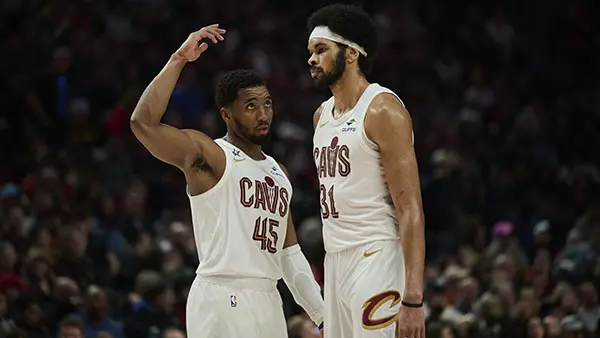
The public is rushing to lay the touchdown with the first-place Pistons, but Bryan Bash is smelling a trap and taking the +6.0 with a Cleveland squad that’s been a cash cow for underdog bettors.
The Pistons are laying 6 points at home against a Cavaliers squad that’s missing two of its top three scorers. Detroit’s sitting at the top of the East at 43-14, Cleveland’s banged up at 37-23, and the market’s asking you to lay a touchdown with the better team. But once you run the efficiency math and account for pace, this line doesn’t add up the way the surface numbers suggest.
The projection has Detroit by 3.8 points—more than two full points shy of the 6 they’re asking you to lay. Cleveland’s offense still rates at 117.6 per 100 possessions even without Donovan Mitchell, and that creates a mismatch problem when you pair it against Detroit’s 108.5 defensive rating. The Cavaliers’ offense versus the Pistons’ defense projects to a +9.1 advantage per 100 possessions, and in a game expecting 100.9 possessions, that’s not something you can just brush aside because Cleveland’s missing bodies. I’m taking the points all day long.
Game Info & Betting Lines
When: Friday, February 27, 2026, 7:00 ET
Where: Little Caesars Arena
Watch: ESPN
Current Spread: Detroit Pistons -6.0 (-115) | Cleveland Cavaliers +6.0 (-105)
Total: 227.5 (Over -110 / Under -110)
Moneyline: Pistons -250 | Cavaliers +210
Why This Line Exists
Detroit’s net rating sits at +8.1 compared to Cleveland’s +4.4, giving the Pistons a 3.7-point efficiency edge per 100 possessions. That’s the foundation for why this spread exists—the market’s pricing in Detroit’s season-long dominance and the fact they’re playing at home where they’re 22-7. The Pistons have been the best team in the East all season, and Cade Cunningham’s running one of the most efficient offenses in basketball at 116.6 per 100.
But here’s where the possessions math tells a different story. The pace blend comes in at 100.9 possessions—Cleveland runs at 101.3, Detroit at 100.5, so we’re looking at a slightly faster game than Detroit’s typical grind. Over those 100.9 possessions, Cleveland’s 117.6 offensive rating creates real problems for Detroit’s defense. The Cavaliers are still shooting 59.0% true shooting and 55.6% effective field goal percentage even with Mitchell sidelined, because Jarrett Allen just put up 27 and 11 in Milwaukee, and Dennis Schroder dropped 26 in his ninth game since the Sacramento trade.
The market’s giving Detroit credit for their 116.6 offensive rating against Cleveland’s 113.1 defensive rating—that’s a +3.5 mismatch in Detroit’s favor. But that’s not enough to overcome the +9.1 edge Cleveland’s offense holds against this Pistons defense when you’re asking me to lay six. My model projects a 3.8-point margin, and that 2.2-point gap between projection and spread is exactly the spot where the home favorite burns you.
Cleveland Cavaliers Breakdown: What You Need to Know
Cleveland’s dealing with significant injury issues—Donovan Mitchell is out with a strained right groin for the second straight game, and James Harden’s questionable with a fractured right thumb after sitting Wednesday in Milwaukee. Dennis Schroder, Keon Ellis, and Dean Wade are all questionable as well, which means the Cavaliers could be running out a seriously depleted backcourt.
But here’s what the numbers tell you: even in that Milwaukee loss, this offense still functioned. Schroder had 26 points, Allen dominated inside with 27 and 11, and Jaylon Tyson continues to shoot 50.3% from the field and 45.6% from three. The Cavaliers’ 117.6 offensive rating isn’t a fluke—it’s built on 65.4% assist rate, 59.0% true shooting, and the ability to generate quality looks even when the top options are compromised.
Cleveland’s clutch record sits at 14-16 with a +0.3 net rating in close games, which tells you they’ve been competitive but haven’t closed consistently. That’s a concern if this game comes down to the final possessions, especially on the road where they’re 17-12. But over a full 48 minutes, this offense has the shooting quality and rim pressure to stay within a touchdown against anyone.
Detroit Pistons Breakdown: The Other Side
Detroit’s 43-14 record is legitimate—this isn’t a mirage. Cade Cunningham’s averaging 25.4 points and 9.8 assists, Jalen Duren just dropped 29 and 15 against a depleted Oklahoma City squad, and Duncan Robinson’s shooting 40.0% from three as a floor-spacing weapon. The Pistons’ 116.6 offensive rating paired with a 108.5 defensive rating creates that +8.1 net rating that’s carried them to the top of the conference.
The defense is where Detroit separates itself—108.5 defensive rating, 10.5 steals per game, 6.4 blocks per game. They force 15.3 turnovers and control the glass with a 30.7% offensive rebounding rate, which is 3.2 percentage points better than Cleveland’s 27.5%. That rebounding edge matters in a game expecting 100.9 possessions, because it translates to roughly three extra possessions for Detroit over the course of the game.
Detroit’s clutch performance is elite—24-9 record in close games with a +1.9 net rating when it’s within five in the final five minutes. They execute down the stretch, and at home where they’re 22-7, they’ve been nearly impossible to beat in tight finishes. Isaiah Stewart’s suspended, but Paul Reed can absorb those backup center minutes without much drop-off behind Duren.
The Matchup: Where This Game Gets Decided
This game gets decided by whether Detroit’s defense can slow down Cleveland’s offensive efficiency enough to justify a six-point spread. The efficiency gap is too wide to ignore here—Cleveland’s 117.6 offensive rating against Detroit’s 108.5 defensive rating creates a +9.1 mismatch per 100 possessions. Over 100.9 possessions, that’s roughly 9.2 points of expected advantage for Cleveland’s offense.
Detroit holds a +3.5 offensive mismatch going the other way, but that’s not nearly the same magnitude. The Pistons’ offensive rebounding edge of 3.2 percentage points will generate some extra possessions, and their ability to protect the ball (13.1% turnover rate versus Cleveland’s 12.4%) keeps possessions alive. But Cleveland’s shooting quality—59.0% true shooting versus Detroit’s 57.7%—means the Cavaliers are converting at a slightly higher rate when they do get clean looks.
The pace blend of 100.9 possessions favors neither team significantly, but it does create enough scoring opportunities that Cleveland’s offensive firepower can keep this competitive even without Mitchell. Schroder’s proven he can run the offense, Allen’s a mismatch problem for Duren in the post, and Tyson’s shooting 45.6% from three on decent volume. The writing’s on the wall with this matchup—Detroit’s the better team, but not by six points when Cleveland’s offense still has this much juice.
Bash’s Best Bet & The Play
The market’s disrespecting Cleveland here. Yes, they’re missing Mitchell. Yes, Harden’s questionable. Yes, they’re on the road against the East’s best team. But a 3.8-point projection versus a 6-point spread is a 2.2-point edge, and that’s too much value to pass up when Cleveland’s offense still rates at 117.6 per 100 possessions.
Detroit’s going to win this game more often than not—the Pistons are the better team, they’re at home, and their clutch execution is elite. But the question isn’t who wins, it’s whether Detroit covers six. And when Cleveland’s offense creates a +9.1 mismatch against this Detroit defense, I don’t see how the Pistons pull away enough to cover that number. The efficiency math says this should be a one-possession game through three quarters, and even if Detroit closes strong, six is too many points.
The main risk is Cleveland’s backcourt depth. If both Harden and Schroder can’t go, the Cavaliers are running out Craig Porter and Sam Merrill as primary ball-handlers, and that’s a different conversation. But assuming Schroder plays, this offense has enough weapons to stay within striking distance all night.
BASH’S BEST BET: Cleveland Cavaliers +6.0 for 2 units.