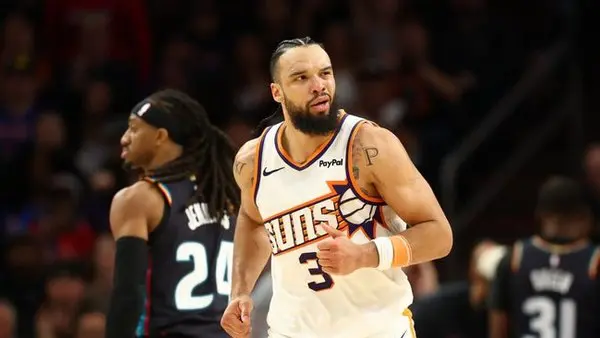
Professional handicappers are looking past Phoenix’s recent survival against Detroit and focusing on the roster reality: the Suns lack a lead guard. Cleveland’s ability to control pace and pound the glass makes them a dangerous road favorite tonight.
The Setup: Cleveland Cavaliers at Phoenix Suns
Cleveland lays 5 points in the desert Friday night, and the market’s telling you something important: both rosters are compromised, but Phoenix is bleeding more talent. The Cavaliers arrive at 29-20 without Darius Garland, who’s averaging 18.0 points and 6.9 assists this season. That’s a significant absence. But the Suns counter without Devin Booker, their 25.4-point lead guard who orchestrates everything offensively. When you lose your primary creator in a pace-and-space system, the efficiency math changes fast. Cleveland’s still got Donovan Mitchell dropping 29.4 per game, and Mitchell just torched the Lakers for 25 in a 30-point beatdown. Phoenix meanwhile needed Dillon Brooks’ career-high 40 points to survive Detroit at home. That’s not sustainable production—that’s variance saving a short-handed roster. The Cavaliers are getting respect as road favorites because the talent gap widens when you account for who’s actually available.
Game Info & Betting Lines
Game Time: January 30, 2026, 9:00 ET
Location: Mortgage Matchup Center
TV: Home: Arizona’s Family 3TV, Suns Live | Away: FanDuel SN OH, NBA League Pass
Current Betting Lines (Bovada):
Spread: Cleveland Cavaliers -5.0 (-110) | Phoenix Suns +5.0 (-110)
Moneyline: Cavaliers -200 | Suns +170
Total: Over/Under 223.5 (-110)
Why This Line Exists
Phoenix sits at 29-19, identical to Cleveland’s win total, but they’re 16-6 at home compared to the Cavaliers’ 12-9 road mark. That home-court advantage typically commands 2.5 to 3 points in the spread. So why is Cleveland favored by 5? The injury context flips the script entirely. Garland’s absence hurts Cleveland’s secondary creation, but Mitchell remains the alpha. Phoenix loses Booker and also plays without Jalen Green, who’s been sidelined since training camp. That’s two rotation guards unavailable, forcing Grayson Allen and Jordan Goodwin into expanded roles they’re not built to sustain over 36-40 minutes. Allen’s averaging 16.6 points and 3.8 assists—solid complementary numbers, not lead-guard production. Brooks just exploded for 40 against Detroit, but he’s a 21.0-point scorer on the season. Expecting him to repeat that output is chasing recency bias. The market’s pricing in Cleveland’s superior top-end talent and Phoenix’s inability to generate consistent offense without their primary ball-handler. That 5-point spread reflects the Cavaliers’ capacity to control pace and execution even on the road when the opponent’s missing their offensive engine.
Cleveland Cavaliers Breakdown: What You Need to Know
Mitchell’s 29.4 points per game anchors everything offensively, and he’s complemented by Evan Mobley’s 17.9 points and 8.8 rebounds. That’s a legitimate two-man core capable of dictating terms against compromised defenses. Jarrett Allen added 17 points and nine boards against the Lakers, giving Cleveland interior presence that Phoenix struggles to match without a traditional rim protector. The Cavaliers just dismantled Los Angeles 129-99, and that third-quarter surge wasn’t about the Lakers’ incompetence—it was about Cleveland’s ability to execute in transition and half-court sets when Mitchell has the ball. Jaylon Tyson contributed 20 in that game, and he’s filling minutes with Garland sidelined. The concern is depth. Max Strus remains out recovering from offseason foot surgery, and Garland’s toe sprain eliminates their second-best playmaker. That compresses the rotation and increases Mitchell’s usage, which can lead to efficiency dips late in games. But against a Phoenix team missing its best offensive player, Mitchell’s volume becomes an advantage rather than a liability. Cleveland’s 12-9 road record isn’t dominant, but context matters—they’re facing a Suns squad that can’t replicate its 16-6 home success without Booker running the offense.
Phoenix Suns Breakdown: The Other Side
Brooks’ 40-point eruption against Detroit bought Phoenix a win, but that performance sits 19 points above his season average. Regression is inevitable. Allen’s 16.6 points and 3.8 assists provide secondary scoring, but he’s not a primary creator. Without Booker’s 25.4 points and 6.2 assists, the Suns lose their most efficient shot generator and the player who makes everyone else’s job easier. Green’s continued absence further depletes the backcourt, forcing Phoenix to lean on Jordan Goodwin and Collin Gillespie—rotation players being asked to execute starter responsibilities. The Suns are 10 games above .500 and won five of their last seven, but those wins came with Booker available for most of that stretch. Their 13-13 road split tells you they’re vulnerable away from home, and while they’re hosting Cleveland, the talent deficit matters more than venue. Phoenix’s offensive efficiency depends on spacing and ball movement, and both collapse when you remove the player averaging 6.2 assists. Brooks and Allen can score in bunches, but neither creates for others consistently. That limits Phoenix’s ability to sustain offensive runs when Cleveland tightens defensively.
The Matchup: Where This Game Gets Decided
This game hinges on creation versus compromise. Cleveland’s offense flows through Mitchell, who’s proven he can carry the scoring load without Garland. Phoenix’s offense, by contrast, fragments without Booker. The Cavaliers can generate quality looks through Mitchell’s penetration and Mobley’s mid-range game. The Suns rely on Allen and Brooks hunting their own shots, which produces variance rather than consistency. Defensively, Cleveland has the personnel to contain Brooks and Allen by forcing them into contested looks. Phoenix lacks the perimeter defenders to slow Mitchell, especially when he’s operating as the sole primary option. The pace component matters here too. Cleveland prefers a controlled tempo that maximizes Mitchell’s touches and limits transition opportunities. Phoenix thrives in up-tempo environments where Booker can push in transition and create early offense. Without Booker, the Suns lose that pace advantage and get dragged into the half-court grind where Cleveland’s talent superiority becomes obvious. Over 48 minutes and roughly 95-100 possessions, the Cavaliers’ ability to execute through Mitchell and Mobley should create a margin that exceeds 5 points. Phoenix needs multiple players to exceed their season averages just to stay competitive, and that’s not a sustainable betting thesis.
Bash’s Best Bet & The Play
BASH’S BEST BET: Cleveland Cavaliers -5.0 for 2 units.
The talent gap is real, and Phoenix can’t bridge it without Booker. Brooks’ 40-point game against Detroit was spectacular, but it’s not repeatable—he’s a 21-point scorer being asked to do 30-point work. Cleveland’s got Mitchell operating as a true alpha, Mobley providing interior scoring, and Allen controlling the glass. The Cavaliers just destroyed the Lakers by 30, and while Phoenix is better than Los Angeles, they’re not better without their best player. The 5-point spread accounts for home court and Cleveland’s road record, but it undervalues the execution gap when you compare Mitchell’s shot creation to what Allen and Brooks can generate without a primary facilitator. The risk is variance—if Brooks gets hot again or Allen catches fire from three, Phoenix can hang around. But betting on back-to-back outlier performances from a role player is how you lose money long-term. Cleveland controls this game through superior talent and execution, and 5 points feels light given the circumstances. Lay the number with the Cavaliers and trust Mitchell to do what he does best: dominate when the ball’s in his hands.