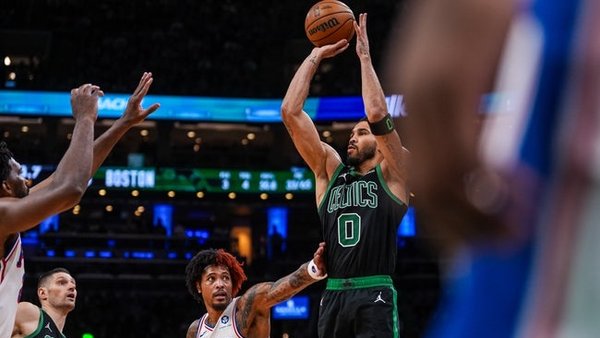
Bash sees a playoff elimination game where the market may be undervaluing Boston’s efficiency edge, but Philadelphia’s desperation and home-court energy create a trickier betting decision than the spread suggests.
The Setup: Celtics at 76ers
The Celtics head to Philadelphia on Thursday night as 6-point road favorites with the total sitting at 212.5. Boston leads this first-round playoff series and has the chance to close it out, but the 76ers just bought themselves life with a dominant Game 5 performance behind Joel Embiid’s 33-point explosion. The market is giving Philly six points at home in an elimination spot, and my initial read says that number feels a touch generous given the efficiency gap between these teams.
Boston sits at 56-26 with a net rating of +8.3, while Philadelphia checks in at 45-37 with a net rating that’s essentially break-even at -0.1. That’s an 8.4-point gap per 100 possessions, and it’s the foundation of why the Celtics have been the better team all season. The question is whether desperation, home court, and Embiid’s recent form can overcome that fundamental difference.
The projection has Boston winning this game by around two points when you factor in a standard home-court bump for Philly. That creates a meaningful gap between where the line sits and where the matchup math points. We’re looking at roughly four points of potential value, which is enough to warrant serious attention.
Game Info & Betting Lines
Game Time: 7:30 PM ET, Thursday, April 30, 2026
Location: TBD
TV: NBCSN, Peacock
Current Odds (MyBookie.ag):
- Spread: Celtics -6.0 (-110) | 76ers +6.0 (-110)
- Total: Over 212.5 (-110) | Under 212.5 (-110)
- Moneyline: Celtics -238 | 76ers +191
Why This Line Exists
The market is pricing in several factors that push this spread toward Philadelphia. First, you’ve got the elimination-game narrative—teams facing elimination historically play with more urgency and desperation. Second, Embiid just dropped 33 points in Game 5 after scoring only two points in the first quarter, showing he’s rounding into form after that emergency appendectomy earlier this month. Tyrese Maxey added 25 and 10 in that win, and the Sixers went on a 12-0 run in the fourth quarter to turn a three-point game into a blowout.
Philadelphia also gets the home-court factor here. They’re 23-18 at home this season, which isn’t dominant but provides some cushion. The 76ers play at a faster pace than Boston—100.4 possessions per game compared to the Celtics’ 95.6—which means more possessions and more variance. That pace differential matters because it creates more opportunities for both teams to score, and in a playoff setting where rotations tighten, the faster team can sometimes dictate game flow.
But here’s what the market might be overweighting: recency bias from that Game 5 performance. Embiid was dominant in the second half, but he’s still working his way back from surgery. He’s probable for this game, which means he’ll play, but the injury report keeps popping up. Over his two playoff appearances this series, he’s averaging 29.5 points, 7.0 rebounds, 7.0 assists, and 1.0 blocks in 36.5 minutes. Those are strong numbers, but the Sixers are still facing a Celtics team that’s been more efficient all season long.
Celtics Breakdown
Boston’s offense runs at a 120.0 rating, which is elite. They’re shooting 46.7% from the field and 36.7% from three, with a true shooting percentage of 58.3%. Jaylen Brown has been their best player this season, averaging 28.7 points, 6.9 rebounds, and 5.1 assists per game. Jayson Tatum is at 21.8 points and 10.0 boards, though his shooting percentages are down compared to Brown. Payton Pritchard gives them 17.0 points off the bench with solid three-point shooting at 37.7%, and Derrick White adds another 16.5 points with defensive versatility.
The Celtics’ defensive rating sits at 111.7, which is significantly better than Philadelphia’s 114.4. That 2.7-point gap on the defensive end is meaningful, especially when you consider that Boston’s offense should be able to exploit the Sixers’ defensive weaknesses. The Celtics also hold a 2.3-percentage-point edge in effective field goal percentage and a 2.9-percentage-point advantage in offensive rebounding rate. Those second-chance opportunities add up over the course of a playoff game.
Boston’s clutch numbers are slightly below .500 at 16-17, but their plus-minus in clutch situations is basically neutral at +0.5. They’re not a dominant closing team by the numbers, but they don’t collapse either. With Brown and Tatum, they have two guys who can create their own shot when the game tightens up.
76ers Breakdown
Philadelphia’s offense checks in at 114.3, which is solid but nowhere near Boston’s 120.0. They’re shooting 46.2% from the field and 34.9% from three, with a true shooting percentage of 57.2%. Maxey has been their most consistent offensive weapon at 28.3 points and 6.6 assists per game. Embiid, when healthy, gives them 26.9 points and 7.7 rebounds. Paul George adds 17.3 points with efficient three-point shooting at 39.2%, and VJ Edgecombe provides 16.0 points as a secondary playmaker.
The issue for Philly is on the defensive end. Their defensive rating of 114.4 is nearly three points worse than Boston’s, and that gap shows up in the net rating difference. The 76ers also give up more offensive rebounds—they’re at 26.2% compared to Boston’s 29.1%—which means the Celtics should get extra possessions if they crash the glass. Philly’s turnover rate is slightly higher at 11.8% compared to Boston’s 11.2%, but that difference is basically within noise and doesn’t move the needle much.
Where Philadelphia does have an edge is in clutch situations. They’re 23-18 in clutch games with a plus-minus of +1.6, which is better than Boston’s +0.5. That 7.6% gap in clutch win rate suggests the Sixers have been better in tight games this season. In an elimination scenario, that’s worth noting—if this game comes down to the final five minutes with the score within five, Philly has shown they can execute.
The Matchup
The pace blend for this game projects to around 98 possessions, which is slower than Philly’s season average but faster than Boston’s. That middle ground probably favors the Celtics slightly because it keeps the game more controlled, which plays to their efficiency advantage. When you match up Boston’s offense against Philadelphia’s defense, the Celtics’ 120.0 offensive rating versus the Sixers’ 114.4 defensive rating creates a 5.6-point mismatch in Boston’s favor. Going the other way, Philly’s 114.3 offense against Boston’s 111.7 defense is only a 2.6-point edge for the home team.
That offensive-defensive mismatch tells you where the scoring advantage lies. Boston should be able to generate cleaner looks and more efficient possessions than Philadelphia. The shooting quality gap reinforces this—Boston’s 2.3-percentage-point edge in effective field goal percentage means they’re getting better shots. Over 98 possessions, those small edges compound into real scoring separation.
The rebounding battle also tilts toward Boston. The Celtics hold a 3.4-percentage-point edge in overall rebounding rate, with most of that coming on the offensive glass. If Boston crashes the boards and generates second-chance points, that’s extra possessions that don’t show up in the base pace projection. Nikola Vucevic gives them 8.4 rebounds per game, and Tatum pulls down 10.0. That size and activity on the glass should create problems for a Sixers team that’s already giving up offensive boards at a higher rate.
Embiid’s status is the wildcard. He’s probable, and based on his recent performances, he’ll likely play close to 37 minutes. But he’s still managing his way back from an appendectomy, and the Celtics have the personnel to make him work on both ends. If Embiid gets into foul trouble or hits a conditioning wall, Philadelphia’s margin for error shrinks fast. The 76ers don’t have the depth to absorb a bad stretch from their star center in an elimination game.
Bash’s Best Bet & The Play
My model projects Boston winning this game by around two points after accounting for home court, which puts the fair line closer to Celtics -2 or -2.5. The market is giving us Celtics -6, which means we’re getting four points of value on the Boston side. That’s a meaningful gap, and it’s driven by the efficiency difference between these teams. The 8.4-point net rating edge for the Celtics is real, and while elimination-game desperation is a factor, I don’t think it’s worth four full points of line value.
The total projection sits around 225.6, which is more than 13 points higher than the posted number of 212.5. That’s a massive gap, and it’s driven by the pace blend and the offensive firepower both teams possess. Boston’s 120.0 offensive rating and Philadelphia’s ability to push tempo create a game environment where points should come easier than the market expects. The over has strong structural support here.
The Play: Celtics -6 and Over 212.5
I’m backing Boston to cover the six points because the efficiency gap is too large to ignore, and I’m also taking the over because the projected total suggests the market has underpriced the scoring environment. The risk on the Celtics side is Embiid going nuclear again and Philly’s desperation leading to a coin-flip finish. The risk on the over is a defensive grind where both teams tighten rotations and possessions get harder to come by. But the math points toward Boston’s quality and a higher-scoring game than 212.5. That’s where I’m putting my money.