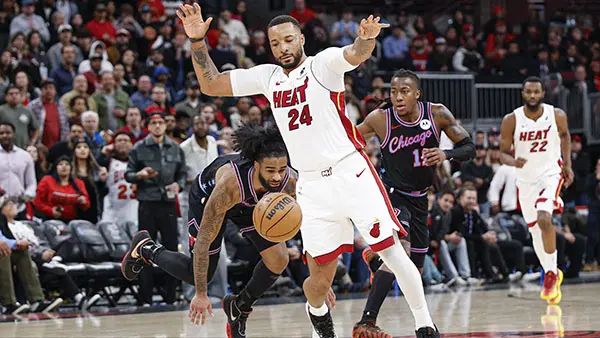
The Heat head to TD Garden without two key rotation guards to face a Celtics squad on a four-game tear. Our preview analyzes the efficiency gap and provides an ATS pick based on Miami’s significant road struggles and injury report.
The Setup: Heat at Celtics
Boston is laying 6.5 at home against a Miami squad that just got torched for 127 by Atlanta and is now traveling without two rotation pieces. The Celtics are riding four straight wins, just put up 114 on Houston with Derrick White going nuclear for 28, and they’re catching the Heat in a brutal spot. Miami sits 11-15 on the road, Boston is 16-8 at TD Garden, and the plus/minus differential tells you everything—Boston’s +7.3 net margin dwarfs Miami’s +1.9. The line opened at 6.5, and that number feels light when you consider the personnel Miami is missing and the efficiency gap between these rosters.
The Celtics are the better shooting team from every level—46.9% from the field versus Miami’s 46.4%, 36.7% from three against 36.1%—and they protect the ball better, committing just 12 turnovers per game compared to Miami’s 14.3. That’s an extra possession or two every night, and in a game where pace matters, those margins compound quickly. Miami averages more points per game at 119.9, but that scoring edge evaporates when you factor in who’s available and where this game is being played.
Game Info & Betting Lines
Miami Heat (27-25, 11-15 road) at Boston Celtics (33-18, 16-8 home)
Date: Friday, February 6, 2026
Time: 7:30 ET
Location: TD Garden
TV: NBC Sports BO (Home), NBA League Pass, FanDuel SN Sun (Away)
Spread: Celtics -6.5 (-110)
Total: 230.5
Moneyline: Celtics -256 | Heat +204
Why This Line Exists
Six and a half points reflects Boston’s home strength, Miami’s road struggles, and the injury situation that’s gutted the Heat’s backcourt depth. Tyler Herro is out and didn’t travel with the team on this road trip, which removes 21.9 points per game and Miami’s second-most efficient scorer at 49.7% from the field. Terry Rozier is also out, dealing with a situation that has no clear timetable for return. That’s two rotation guards gone, and while Jaime Jaquez Jr. has been solid at 15.5 per game, asking him and Pelle Larsson to absorb that usage against a Celtics defense that forces just 12 turnovers per game is a tall order.
Boston’s +7.3 plus/minus tells you they’re consistently outscoring opponents by a touchdown per 100 possessions, while Miami’s +1.9 suggests they’re treading water even when healthy. The Celtics just beat Houston by 21 despite missing Jaylen Brown, who’s averaging 29.5 per game this season. Derrick White stepped up with six triples and 28 points, proving this roster has multiple scoring options when someone goes down. Miami doesn’t have that same depth right now—Norman Powell is carrying 23.0 per game, but he’s getting fewer clean looks without Herro spacing the floor.
The total sits at 230.5 because both teams can score—Miami averages 119.9, Boston 115.9—but the shooting efficiency gap and Miami’s depleted backcourt suggest the Heat will struggle to keep pace. Boston shoots 36.7% from three as a team, and with Miami missing perimeter defenders, guys like White and Payton Pritchard can get clean looks in transition. That’s where this number makes sense: the market expects Boston to score, but Miami’s ceiling is capped without their second and third ball-handlers.
Miami Heat Breakdown: What You Need to Know
Norman Powell is the engine right now, averaging 23.0 points on 47.2% shooting and 39.2% from deep. He’s Miami’s most reliable perimeter threat with Herro out, but he’s also seeing more defensive attention without a secondary creator to pull help. Bam Adebayo gives you 18.1 and 9.9 boards, but his 44.4% shooting efficiency drops when he’s forced into more post touches instead of operating off movement. Andrew Wiggins adds 15.6 per game at 46.8% from the field, but his impact is inconsistent on the road—Miami’s 11-15 away record reflects their inability to maintain offensive rhythm in hostile environments.
Jaime Jaquez Jr. has been productive at 15.5 points and 4.7 assists, shooting 51.9% from the field, but his 28.7% three-point percentage means defenses can sag off him and load up on Powell and Adebayo. That’s a problem against Boston’s defensive scheme, which forces you to beat them from the perimeter. Miami averages 4.7 more assists per game than Boston at 28.7, but that ball movement requires multiple playmakers—something they don’t have right now.
The Heat commit 14.3 turnovers per game, and Boston’s 7.7 steals plus 5.2 blocks per game suggest they’ll force Miami into uncomfortable possessions. Miami’s 11.8 offensive rebounds per game could create second chances, but Boston grabs 12.8 offensive boards themselves, so that edge disappears in the paint.
Boston Celtics Breakdown: The Other Side
Jaylen Brown is out, but Derrick White just proved he can carry the scoring load with 28 points on six threes against Houston. White averages 17.3 per game with 5.6 assists, and his 1.2 steals and 1.4 blocks per game make him a two-way problem. Payton Pritchard gives you 17.1 points and 5.3 assists off the bench, shooting 46.0% from the field and 35.4% from deep. That’s secondary creation Miami can’t match right now.
Nikola Vucevic anchors the paint at 16.9 points and 9.0 rebounds per game, shooting 50.5% from the field and 37.6% from three. That floor-spacing big forces Adebayo out of the paint, and Miami doesn’t have the perimeter defenders to rotate effectively when Vucevic kicks out to shooters. Neemias Queta adds 10.1 and 8.3 boards on 63.8% shooting, giving Boston a second rim-running option when Vucevic needs a breather.
Boston’s 46.9% field goal percentage and 36.7% three-point shooting reflect a balanced offense that doesn’t rely on one guy to create everything. They commit just 12 turnovers per game, which means Miami’s 9.1 steals and 4.2 blocks per game won’t generate the transition opportunities they need to keep pace. The Celtics’ 16-8 home record and +7.3 plus/minus tell you they’re comfortable grinding out wins at TD Garden, and their four-game winning streak suggests they’ve found their rhythm even without Brown.
The Matchup: Where This Game Gets Decided
Miami’s 119.9 points per game looks impressive until you realize it’s propped up by home performances where they’re 16-10. On the road, they’re 11-15, and the efficiency drops when they can’t control pace and tempo. Boston’s 115.9 per game is more sustainable because it’s built on better shooting percentages and fewer turnovers. The Celtics shoot 46.9% overall and 36.7% from three, while Miami checks in at 46.4% and 36.1%. Those gaps widen when Miami loses two backcourt pieces who combine for 40-plus minutes of creation.
Boston forces just 12 turnovers per game, which means Miami can’t rely on transition points to bridge the efficiency gap. The Heat average 14.3 turnovers themselves, and against a Celtics team that generates 7.7 steals and 5.2 blocks per game, those extra possessions turn into Boston runouts. Miami’s 11.8 offensive rebounds per game could help, but Boston grabs 12.8 offensive boards themselves and converts at a higher clip.
The rebounding battle is essentially even—Miami averages 46.6 boards to Boston’s 45.3—but the Celtics’ 32.5 defensive rebounds per game compared to Miami’s 34.8 suggests Boston is better at ending possessions and pushing pace. Miami’s 28.7 assists per game lead Boston’s 24.0, but that assist edge requires multiple ball-handlers who can break down defenses. Without Herro and Rozier, Powell and Jaquez are carrying too much creation responsibility against a disciplined Celtics defense.
The total of 230.5 assumes both teams push tempo, but Miami’s depleted backcourt limits their ability to generate clean looks in transition. Boston’s 115.9 per game is achievable because they’ll get open threes off Miami’s scrambling rotations. Miami’s 119.9 per game is harder to reach without Herro’s 49.7% shooting efficiency and Rozier’s secondary playmaking. The math favors Boston covering and the game staying under.
Bash’s Best Bet & The Play
Boston -6.5 is the play. Miami is missing two rotation guards, traveling on the road where they’re 11-15, and facing a Celtics team that just beat Houston by 21 without Jaylen Brown. The efficiency gap is real—Boston shoots better from every level, commits fewer turnovers, and has the depth to absorb injuries. Miami’s 119.9 points per game is misleading when you factor in their road struggles and the personnel losses. Powell and Adebayo can’t carry the offensive load against a team that’s +7.3 in plus/minus and 16-8 at home.
The risk is Boston coming out flat after four straight wins, but their shooting efficiency and Miami’s backcourt depletion suggest the Celtics control this game from the opening tip. White just dropped 28 on Houston, Pritchard gives you 17 per game off the bench, and Vucevic’s floor-spacing forces Adebayo into uncomfortable rotations. Miami doesn’t have the depth to keep pace, and six and a half points feels conservative given the matchup dynamics.
BASH’S BEST BET: Celtics -6.5 for 2 units.
Boston covers at home, and Miami’s shorthanded roster can’t bridge the efficiency gap. Lay the number with confidence.