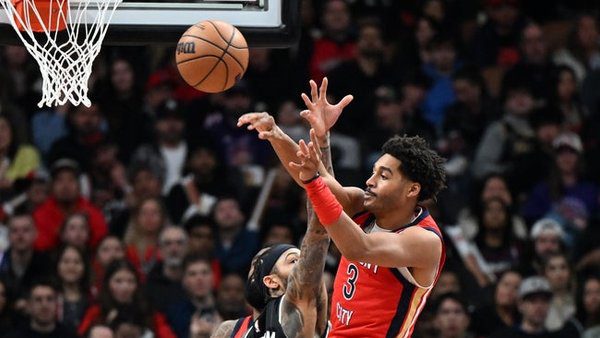
Bash examines a pace differential and offensive matchup that creates separation between the market’s total and what the floor suggests—one side of this number carries real value in a game that may not reach the scoring environment the books are pricing.
The Setup: Heat at Raptors
Toronto sits as a 1-point home favorite against Miami on Tuesday night, with the total posted at 239.5. That number catches my attention immediately—not because it’s outrageous, but because the projection sits a full touchdown underneath it. When you’ve got a five-possession pace gap between these two teams and Miami’s uptempo style running into Toronto’s methodical approach, the expected game shape doesn’t support a shootout. The Raptors grind at 99.3 possessions per game, fourth-slowest in the league. Miami pushes at 104.4. The blended pace projects around 102 possessions, which is elevated for Toronto but still well below what Miami prefers. That creates a real tension in how this game plays out, and my model projects a total around 232—more than a touchdown shy of where this line sits.
The spread feels about right. Toronto holds a microscopic net rating edge of 0.1 per 100 possessions, essentially a coin flip in efficiency terms. The Raptors are 21-17 at home, Miami 16-22 on the road. This is a tight matchup between two teams fighting for playoff positioning, and the market has it priced correctly as a toss-up. But that total? That’s where the value lives.
Game Info & Betting Lines
Game Time: April 7, 2026, 7:30 ET
Venue: Scotiabank Arena
TV: Home: TSN | Away: FanDuel SN Sun, NBA League Pass
Current Betting Lines (MyBookie.ag):
- Spread: Toronto Raptors -1.0 (-110)
- Moneyline: Toronto Raptors -116 | Miami Heat -105
- Total: 239.5 (Over -110 / Under -110)
Why This Line Exists
The books are pricing Miami’s offensive firepower and recent scoring explosion. The Heat just dropped 152 on Washington, their third 150-point game in franchise history this season. Jaime Jaquez Jr. went for 32, Kel’el Ware posted 24 and 19 boards with seven blocks, and even with Bam Adebayo drawing triple teams after his 83-point nuclear game earlier this year, Miami still torched the Wizards. That kind of offensive performance sticks in the market’s mind, and it pushes totals higher than they probably should go.
Toronto’s coming off a loss in Boston, 115-101, where the Celtics controlled the game despite starting cold from three. The Raptors have been solid at home but not dominant, and they’re dealing with some frontcourt uncertainty. Sandro Mamukelashvili and Collin Murray-Boyles are both questionable, which could thin out their rotation depth in the paint. Immanuel Quickley is also questionable after missing eight straight with plantar fasciitis, though his return would stabilize their backcourt.
The market sees two teams hovering around 115 offensive rating, both capable of scoring, and sets a total that reflects Miami’s recent explosion. But it’s not accounting for the pace dynamic properly. Toronto doesn’t want to run with Miami. They can’t. Their identity is built on half-court execution and limiting possessions. When these two styles collide, something has to give, and it’s usually the total that suffers.
Heat Breakdown
Miami’s offensive profile is legit. They rank 115.4 in offensive rating with a 57.7 true shooting percentage, and they move the ball well at 66.0 assist percentage. Norman Powell and Tyler Herro are both probable after missing time—Powell with an illness, Herro after sitting out Saturday. Getting both back gives Miami their full complement of perimeter scoring, which matters against a Raptors defense that can be exploited on the wings.
The Heat have three guys averaging over 20 points per game: Powell at 22.1, Herro at 21.4, and Adebayo at 20.2. Andrew Wiggins adds 15.6, and Jaquez Jr. chips in 15.2. That’s a deep scoring rotation, and when they’re clicking, they can put up points in bunches. The problem is pace. Miami wants to push, but Toronto won’t let them. The Raptors control tempo better than almost anyone, and that’s going to frustrate Miami’s transition game.
Defensively, Miami sits at 113.4 defensive rating, middle of the pack. They’re not stopping anyone consistently, which is why their net rating is only +2.1. Nikola Jovic is out with a sprained ankle, which removes some frontcourt depth, but the Heat’s defensive issues run deeper than one rotation piece.
Raptors Breakdown
Toronto’s built differently. They grind possessions, execute in the half-court, and rely on Brandon Ingram, RJ Barrett, and Scottie Barnes to create offense. Ingram leads at 21.3 points per game, Barrett adds 19.1, and Barnes contributes 18.1 with elite playmaking at 5.9 assists per game. Quickley’s return would give them another ball-handler and shooter, but even without him, they’ve managed to stay afloat.
The Raptors shoot 48.0 percent from the field and 54.4 effective field goal percentage, both slightly better than Miami. Their offensive rating of 114.5 is solid, and they protect the ball reasonably well at 12.2 percent turnover rate. But the key is pace. At 99.3 possessions per game, they’re built to control the game’s rhythm and keep it in the half-court. That’s their edge here.
Defensively, Toronto checks in at 112.3 defensive rating, slightly better than Miami. They block shots at a higher rate (4.9 per game versus Miami’s 4.3) and generate steals at the same clip. The frontcourt question marks with Mamukelashvili and Murray-Boyles both questionable could hurt their interior defense, but the Raptors have enough depth to manage.
The Matchup
This game comes down to pace control, and Toronto holds all the cards. Miami’s offensive rating advantage when matched against Toronto’s defense creates a +3.1 per 100 possessions edge for the Heat, which is the largest mismatch in this game. That suggests Miami should score effectively when they get into their sets. But the issue is volume. If Toronto keeps this game in the low-100s possession-wise, Miami doesn’t get enough opportunities to exploit that edge.
The blended pace projection sits at 101.9 possessions, which is up-tempo for Toronto but still well below Miami’s preference. That’s the sweet spot for the Raptors—fast enough to keep Miami from getting completely frustrated, but slow enough to limit total scoring opportunities. When you project both teams around 116 points in a 102-possession game, you’re looking at a total in the low 230s, not pushing 240.
Clutch performance slightly favors Toronto. The Raptors are 21-14 in clutch situations with a 60.0 percent win rate, while Miami sits at 17-16 with a 51.5 percent win rate. That’s not a massive gap, but it suggests Toronto has been better in tight games this season. Given the spread is only 1 point, this could easily come down to the final possessions, and Toronto’s track record there gives them a slight edge.
Bash’s Best Bet & The Play
I’m on the under 239.5. The pace mismatch is too significant to ignore, and the projection sits more than a touchdown below the posted number. Toronto’s going to slow this game down, limit possessions, and force Miami to execute in the half-court. Even if both teams score efficiently, there simply aren’t enough possessions in a 102-pace game to push this total over 240. Miami’s recent offensive explosion against Washington is baked into this number, but that was against the worst defense in the league in a game that hit 150. This is a different matchup entirely.
The risk is simple: if Toronto’s frontcourt injuries force them into smaller lineups and Miami gets out in transition, the pace could tick up enough to make this uncomfortable. But I trust Toronto’s identity. They’ve played this way all season, and they’re not suddenly going to turn into a run-and-gun team because Miami wants to push. Lay the under and trust the pace dynamic to do the work.