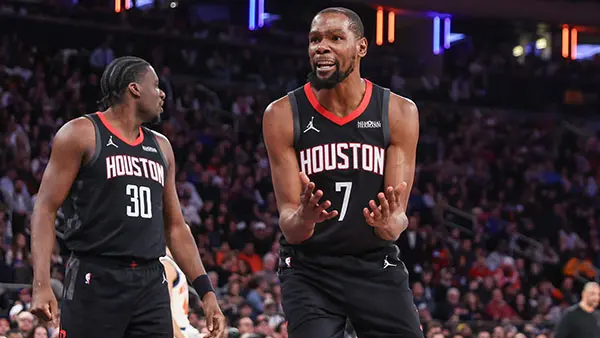
Houston enters Monday as a significant 13.5-point favorite, but a deep dive into the possession math suggests the market is pricing this game on season-long net ratings rather than the current deliberate pace. Taking Utah as our ATS pick aligns with a projected 8.1-point margin, creating nearly a six-point cushion of value against a Rockets team that often struggles to pull away in half-court environments.
Houston is laying 13.5 points at home against a Utah squad that’s 7-21 on the road and missing key rotation pieces. On the surface, this looks like a mismatch the Rockets should dominate. But once you run the efficiency math, the possessions blend, and the actual scoring projections, this line doesn’t add up. The projection sits at Rockets by 8.1 points, creating a 5.4-point edge toward Utah covering. The market’s disrespecting how competitive Utah can be in a slower-paced environment, even undermanned.
Houston’s +12.3 net rating advantage per 100 possessions is real—they’re the far superior team. But the pace blend of 99.8 possessions limits how many times the Rockets can exploit that edge. Utah plays at 103.1 pace, Houston at 96.5, and the deliberate tempo keeps this game within reach longer than the spread suggests. I’m taking the points all day long with Utah here.
Game Info & Betting Lines
Utah Jazz (18-39) at Houston Rockets (34-21)
When: Monday, February 23, 2026, 9:30 ET
Where: Toyota Center
Watch: Peacock
Betting Lines (Bovada):
Spread: Houston Rockets -13.5 (-105) | Utah Jazz +13.5 (-115)
Total: 227.0 (O/U -110)
Moneyline: Rockets -850 | Jazz +550
Why This Line Exists
The market sees Houston’s 34-21 record and 18-7 home mark, then looks at Utah’s 7-21 road record and missing pieces, and assumes blowout territory. That +12.3 net rating gap per 100 possessions tells you Houston is legitimately better—they score more efficiently (116.8 offensive rating vs. 113.4) and defend far better (112.0 defensive rating vs. 120.8). The Rockets also dominate the glass with a +9.3 offensive rebounding edge, creating extra possessions that should compound their advantage.
But here’s where the possessions math tells a different story. At 99.8 expected possessions, this is a deliberate, half-court game. Utah’s faster tempo (103.1) gets dragged down by Houston’s methodical approach (96.5), limiting the total number of scoring opportunities. The projection lands at Rockets 118.6, Jazz 112.5—a 6.1-point margin before home court. Add the standard 2-point home advantage, and you get 8.1 points. That’s a full 5.4 points shy of the 13.5-point spread.
The Rockets just blew an 18-point fourth-quarter lead in New York on Saturday, losing 108-106 to the Knicks. Kevin Durant scored 30, but Houston went cold down the stretch and couldn’t close. That loss snapped a five-game win streak and exposed some late-game execution issues. Utah, meanwhile, lost 123-114 in Memphis on Friday despite strong scoring from Isaiah Collier (24 points), Kyle Filipowski (20), and Ace Bailey (20). The Jazz trailed by 14 but stayed competitive offensively—they just can’t stop anyone with a 120.8 defensive rating.
Utah Jazz Breakdown: What You Need to Know
Utah’s roster is decimated. Walker Kessler is out for the season, Jaren Jackson Jr. is out for the season, and Jusuf Nurkic remains sidelined. Keyonte George is questionable after missing seven of the past eight games with an ankle injury, though he’s received the questionable tag for the first time since February 7. Lauri Markkanen is probable after missing two games with an illness and should return to anchor the offense with his 26.7 points per game on 47.8% shooting.
The Jazz offense isn’t the problem—they score 118.2 points per game with a 113.4 offensive rating and shoot 58.1% true shooting. Markkanen and George (23.8 PPG, 6.5 APG when healthy) provide legitimate scoring punch. The issue is defense: that 120.8 defensive rating ranks near the bottom of the league. They can’t protect the rim without Kessler, and their perimeter rotations leak open looks.
Utah’s clutch stats are surprisingly solid—48% win rate in close games with a +1.0 clutch plus/minus. They don’t fold late despite their record. On the road, though, they’re 7-21 and struggle to string together stops when games tighten up away from home.
Houston Rockets Breakdown: The Other Side
Houston’s strength is their balance. Kevin Durant leads at 26.1 points per game on elite 50.6/40.4 shooting splits, while Alperen Sengun (20.4 PPG, 9.1 RPG, 6.3 APG) orchestrates the offense from the post. Amen Thompson adds 17.4 points with 7.6 rebounds and 5.4 assists, giving them multiple playmakers. The Rockets score 114.3 per game with a 116.8 offensive rating, and their 112.0 defensive rating ranks among the league’s best.
That +9.3 offensive rebounding edge over Utah is massive. Houston grabs 15.6 offensive boards per game compared to Utah’s 11.8, creating second-chance points that extend possessions and wear down opponents. They also block 5.8 shots per game, deterring rim attacks.
The concern is late-game execution. Houston’s 46.7% clutch win rate with a -0.5 clutch plus/minus shows they struggle to close tight games. They shoot just 29.8% from three in clutch situations, and Saturday’s collapse in New York highlighted their tendency to go stagnant offensively when the game slows down. Steven Adams is out for the season, and Jae’Sean Tate is out with a knee sprain, thinning their depth slightly.
The Matchup: Where This Game Gets Decided
This is exactly the spot where Houston’s dominance gets overstated. The efficiency gap is too wide to ignore here—Houston’s +12.3 net rating advantage means they’re legitimately better. But over 99.8 possessions, that gap translates to roughly 12 extra points in a vacuum. Factor in Utah’s ability to score (113.4 offensive rating) against Houston’s 112.0 defensive rating, and the Jazz can generate 1.4 points per 100 possessions of positive mismatch value on offense.
Houston’s offense against Utah’s defense creates a -4.0 mismatch favoring Utah—meaning the Rockets’ 116.8 offensive rating faces Utah’s 120.8 defensive rating, which actually slows Houston down relative to their season average. The Rockets will still score, but they won’t blow the doors off a Jazz defense that allows high-volume scoring.
The pace blend changes everything in this matchup. At 99.8 possessions, this is a grind-it-out game where each possession matters. Houston’s +9.3 offensive rebounding edge gives them extra chances, but Utah’s true shooting percentage of 58.1% (compared to Houston’s 56.9%) means the Jazz convert efficiently when they do get clean looks. The turnover rates are nearly identical—13.6% for Utah, 13.3% for Houston—so neither team gains an edge through ball security.
The writing’s on the wall with this matchup: Houston wins, but the margin stays single digits. The Rockets’ clutch struggles (14-16 record in close games) mean they can’t pull away late, and Utah’s clutch competitiveness (12-13 record) keeps them within striking distance even on the road.
Bash’s Best Bet & The Play
The projection has this at Rockets by 8.1, and the market is asking you to lay 13.5. That’s a 5.4-point gap, and I’ve seen this movie before—Houston dominates the efficiency metrics but can’t cover inflated spreads when the pace slows down and the opponent stays competitive offensively. Utah’s missing key pieces, but Markkanen’s return gives them enough scoring to stay within range, and Houston’s recent collapse in New York shows they’re vulnerable to letting leads slip.
The main risk is Utah’s defense—if Houston’s second-chance points pile up and they build a 20-point lead by halftime, the Jazz don’t have the defensive firepower to claw back. But at 99.8 possessions and with Utah’s offensive efficiency, this number points to overpriced. The model projects 8.1, and I trust that math over the market’s assumption of a blowout.
BASH’S BEST BET: Utah Jazz +13.5 for 2 units.
This line doesn’t add up once you run the efficiency math and account for pace. Take the points and ride with the Jazz to keep it competitive in a slower, half-court game.