Considering the Wizards’ league-worst offensive rating and Utah’s superior ball movement, the road team serves as a high-value ATS pick in a matchup the metrics say is a toss-up.
The Washington Wizards are laying 2 points at home Thursday night against a Utah Jazz squad that’s lost seven straight and looks completely cooked. Both teams are deep in lottery mode—Utah sits 18-44, Washington 16-45—but the projection here tells a different story than the records suggest. the projection has this as a virtual coin flip, with Washington winning by just 0.3 points once you account for home court. That’s a 1.7-point edge against a spread asking the Wizards to win by two.
The efficiency gap is too wide to ignore here. Utah’s net rating of -7.5 per 100 possessions actually beats Washington’s -10.8 mark by 3.3 points. That’s a medium-sized gap that matters over 102.5 possessions—the pace blend for this matchup. Washington’s offensive rating of 109.4 ranks among the league’s worst, and when you match that against Utah’s 120.6 defensive rating, you get a -11.2 mismatch. The Jazz offense versus Washington’s 120.2 defense produces a -7.1 mark. Both teams struggle mightily on both ends, but Utah’s been the slightly less terrible squad when you run the possessions math.
The market’s disrespecting Utah here. I’m taking the points all day long.
Game Info & Betting Lines
Utah Jazz at Washington Wizards
Date: Thursday, March 5, 2026
Time: 7:00 PM ET
Venue: Capital One Arena
TV: Home: MNMT | Away: KJZZ-TV, Jazz+, NBA League Pass
Current Odds (MyBookie.ag):
Spread: Washington Wizards -2.0 (-110) | Utah Jazz +2.0 (-110)
Total: 243.0 (Over -110 | Under -110)
Moneyline: Washington -128 | Utah +104
Why This Line Exists
Washington’s getting 2 points of respect purely for being at home and having slightly better recent optics. The Wizards went 11-21 at Capital One Arena this season compared to Utah’s 7-23 road mark, and books know casual bettors see those records and lean home. But this line doesn’t add up once you run the efficiency math.
Utah posts a 113.1 offensive rating compared to Washington’s 109.4 mark—that’s a 3.7-point advantage in scoring efficiency per 100 possessions. Washington’s defense allows 120.2 points per 100, barely better than Utah’s 120.6 mark. The net rating differential of -3.3 in Utah’s favor drives the projected margin down to essentially a pick’em. Over 102.5 expected possessions, that efficiency gap compounds into real scoring separation.
The pace blend sits right around both teams’ season averages—Utah runs 102.9 possessions per game, Washington 102.2. Neither squad pushes tempo aggressively, but 102.5 possessions still creates enough offensive opportunities for efficiency advantages to manifest. True shooting percentage favors Utah by 1.6 points (57.8% vs 56.2%), and their effective field goal mark is 0.6 points better. Those shooting gaps are small but directionally consistent with Utah’s offensive edge.
The total of 243.0 reflects the market expecting a high-scoring mess between two defensively challenged teams. The projection lands at 237.5—a 5.5-point edge toward the Under. That’s strong value, and it makes sense when you consider both offenses rank bottom-five in the league. this number points to Over to casual bettors who see bad defenses, but the possessions math tells a different story.
Utah Jazz Breakdown: What You Need to Know
The Jazz are completely decimated by injuries. Walker Kessler, Jaren Jackson Jr., Jusuf Nurkic, and Vince Williams Jr. are all done for the season. Lauri Markkanen—their leading scorer at 26.7 points per game—is out for at least two weeks with an injury suffered at Wednesday’s practice. That’s five rotation players unavailable, including their entire frontcourt depth.
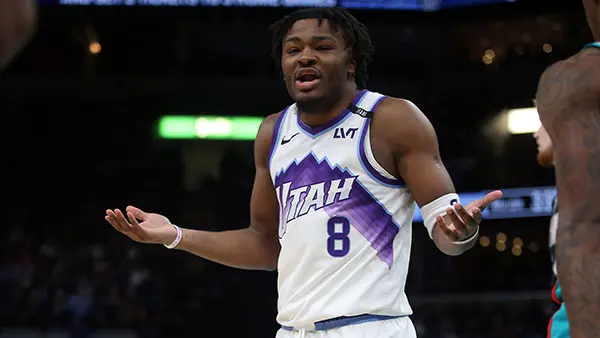
Keyonte George carried the load in Wednesday’s loss to Philadelphia, dropping 30 points in the 106-102 defeat. George averages 24.0 points and 6.3 assists per game this season on 46.0% shooting and 37.6% from three. He’s the primary offensive engine now, and his usage will spike even higher without Markkanen. Kyle Filipowski will handle starting center duties and should see expanded opportunities in the paint.
Despite the roster carnage, Utah’s offensive efficiency remains respectable at 113.1. They shoot 46.6% from the field and 34.6% from three, with a 70.2% assist rate that indicates solid ball movement. Their true shooting of 57.8% ranks in the top half of the league. The problem is defense—allowing 120.6 points per 100 possessions puts them 28th in the NBA. They can’t get stops, which is why they’ve lost seven straight.
Utah’s clutch stats show a 44.4% win rate in close games with a +0.9 net rating in crunch time. They’re not completely folding down the stretch, which matters in a game projected this tight.
Washington Wizards Breakdown: The Other Side
Washington’s injury report is equally catastrophic. Anthony Davis remains out indefinitely with a foot injury and likely won’t return this season. Alexandre Sarr is week-to-week with a hamstring strain. KyShawn George is out until late March at the earliest. Cam Whitmore, D’Angelo Russell, Tristan Vukcevic, and Jamir Watkins are also unavailable. The Wizards dressed nine healthy players in Tuesday’s 126-109 loss to Orlando.
Trae Young leads the active roster at 19.3 points and 8.9 assists per game, though his shooting has been rough—41.5% from the field and just 30.5% from three. Tre Johnson provides secondary scoring at 12.4 points per game, while rookie Juju Reese made his second career start Tuesday and posted nine points with eight rebounds in 32 minutes.
Washington’s offensive rating of 109.4 ranks dead last among playoff-hopeful teams and 27th overall. They shoot 45.9% from the field and 35.4% from three, but their 56.2% true shooting percentage indicates poor shot selection and free throw struggles (76.9%). Their assist rate of 60.4% is significantly worse than Utah’s 70.2% mark, suggesting more isolation-heavy offense that produces lower-quality looks.
The Wizards defense allows 120.2 points per 100 possessions—essentially identical to Utah’s 120.6 mark. They’ve lost six straight games and went 5-24 on the road this season. Their clutch record of 54.5% looks solid, but that’s over just 22 games—a small sample that doesn’t inspire confidence given their overall profile.
The Matchup: Where This Game Gets Decided
This game gets decided by which undermanned roster executes better over 102.5 possessions. The writing’s on the wall with this matchup—both teams are tanking, both rosters are shredded, and neither has defensive answers. But Utah’s offensive efficiency advantage of 3.7 points per 100 possessions is real and sustainable even without Markkanen.
When Utah’s 113.1 offensive rating faces Washington’s 120.2 defensive rating, you get a -7.1 offensive/defensive mismatch. That means Utah should score roughly 7 points below their typical output per 100 possessions in this matchup. When Washington’s 109.4 offense meets Utah’s 120.6 defense, the mismatch is -11.2—Washington projects to score 11 points below their norm. Over 102.5 possessions, that 4-point efficiency swing translates to real margin.
Utah’s 1.6-point true shooting advantage might seem small, but it compounds over volume. At 102.5 possessions, that’s roughly 1.6 additional points of scoring efficiency. Their offensive rebounding edge of 1.4 percentage points (26.2% vs 24.7%) creates extra possessions that favor the better offensive team—which is Utah.
The turnover rates are essentially identical at 13.4% for both squads, so ball security won’t be a differentiator. This comes down to which offense can generate better looks against porous defenses. Utah’s 70.2% assist rate versus Washington’s 60.4% mark suggests the Jazz will create higher-quality shots through better ball movement, even with their depleted roster.
I’ve seen this movie before—two lottery teams, market assumes home court matters more than it does, and the slightly less terrible road team covers because efficiency edges persist regardless of motivation. Utah’s been the better team by the numbers all season, and nothing about this spot changes that reality.
Bash’s Best Bet & The Play
The projection shows Washington winning by 0.3 points. The market asks them to win by 2. That’s a 1.7-point edge on Utah +2.0, and it’s exactly the spot where Washington burns you. The Wizards are 11-21 at home for a reason—they’re not good, and home court doesn’t magically fix a 109.4 offensive rating.
Utah’s net rating advantage of 3.3 points per 100 possessions is a medium-sized edge that matters over 102.5 possessions. Their offensive efficiency is legitimately better, their ball movement is superior, and their shooting metrics are cleaner. Yes, they’re without Markkanen and half their roster, but Washington’s equally decimated and significantly worse offensively.
The risk here is simple: both teams are tanking, effort levels are unpredictable, and roster chaos can produce random variance. But when you’re getting 2 points with the team that projects as a virtual pick’em, you take it. The clutch data shows Utah at 44.4% in close games versus Washington’s 54.5%, but that’s over a small sample and doesn’t outweigh the season-long efficiency edge.
BASH’S BEST BET: Utah Jazz +2.0 for 2 units.
This line doesn’t respect Utah’s offensive advantage, and Washington’s home court hasn’t been worth much all season. I’m taking the points with the better offensive team in a game that projects dead even. The market’s giving us value on the wrong side.