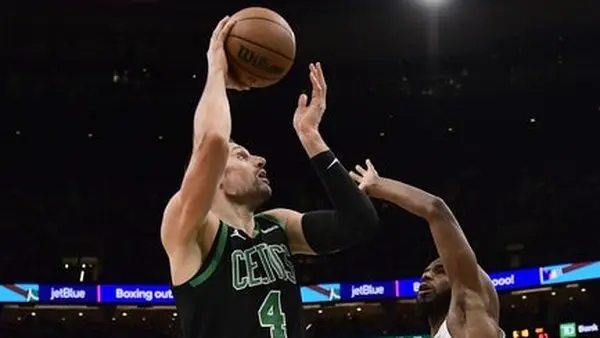
The New York Knicks head to Boston looking to rebound from a deflating loss in Detroit and settle a dead-heat race for the East’s second seed. Our analytical preview breaks down the efficiency splits and provides a sharp ATS pick based on the questionable status of Karl-Anthony Towns and OG Anunoby.
The Setup: Knicks at Celtics
Boston lays 4 points at home against a New York squad that just watched an eight-game winning streak evaporate in Detroit. The Knicks got blown out 118-80 on Friday, and now they’re walking into TD Garden on Sunday with Karl-Anthony Towns and OG Anunoby both questionable. The Celtics are coming off a 22-point comeback win over Miami where Jaylen Brown dropped 29 and Payton Pritchard added 24. This line opened at Celtics -4, and the total sits at 214.5. The market is telling you Boston should win by a field goal and change, but the injury uncertainty makes this number more volatile than it looks. New York averages 1.9 more points per game than Boston this season—117.5 to 115.6—but that offensive edge disappears if Towns can’t play through the right eye laceration he suffered Wednesday.
Game Info & Betting Lines
Matchup: New York Knicks at Boston Celtics
Date: Sunday, February 8, 2026
Time: 12:30 ET
Venue: TD Garden
TV: ABC
Current Betting Lines (MyBookie.ag):
- Spread: Celtics -4.0 (-110) | Knicks +4.0 (-110)
- Moneyline: Celtics -172 | Knicks +140
- Total: 214.5 (Over/Under -110)
Why This Line Exists
Four points at home for a Celtics team with a +7.2 plus/minus against a Knicks squad sitting at +5.2 makes sense on paper. Boston is 17-8 at TD Garden, while New York is just 11-13 on the road. The Celtics commit 1.6 fewer turnovers per game—12.1 compared to 13.7—and that ball security matters when you’re trying to cover a short number. The total at 214.5 reflects two teams that both push pace and score efficiently, but the market is accounting for the defensive adjustments that typically show up in conference rivalry games. New York shoots better across the board—47.0% from the field and 37.8% from three compared to Boston’s 46.8% and 36.5%—but the Celtics have the better defensive activity with 13 combined steals and blocks per game versus New York’s 12.1. The four-point spread exists because Boston has home court, the better net margin, and fewer question marks heading into Sunday.
The injury situation complicates everything. Towns is questionable with a right eye laceration, and he’s averaging 19.9 points and 11.9 rebounds per game. If he sits, Mitchell Robinson would likely start, and Ariel Hukporti would see increased minutes. OG Anunoby is also questionable with right toe soreness after missing Friday’s loss. Anunoby gives you 16.6 points and 5.5 rebounds, plus 1.7 steals per game—his absence would shift Mohamed Diawara into the starting lineup again. Miles McBride is already out with a sports hernia, removing 12.9 points and 42.0% three-point shooting from the rotation. That’s three rotation pieces either out or uncertain, and the market hasn’t moved this line aggressively because we won’t know the full picture until closer to tip.
Knicks Breakdown: What You Need to Know
New York’s offense runs through Jalen Brunson, who’s averaging 27.1 points and 6.1 assists while shooting 46.7% from the field. He’s the engine, and when he’s aggressive, the Knicks generate 26.9 assists per game—three more than Boston. Mikal Bridges has been efficient at 50.0% from the field and 39.0% from three, giving you 15.7 points per game as a secondary creator. The problem is depth. McBride’s absence removes a reliable shooter who was hitting 42.0% from deep, and if Towns and Anunoby both sit, you’re asking Brunson to carry too much of the offensive load against a Celtics defense that forces 12.1 turnovers per game.
The Knicks rebound well—46.3 boards per game with 13.4 offensive rebounds—but that advantage shrinks when you lose Towns’ 11.9 rebounds. Robinson can crash the glass, but he doesn’t give you the same floor spacing or pick-and-pop threat. New York’s 11-13 road record tells you they struggle away from Madison Square Garden, and Friday’s 38-point loss in Detroit showed what happens when the offense stalls. They shot poorly, turned the ball over, and couldn’t generate second-chance opportunities. If they show up flat again on Sunday, four points is too many to expect them to cover.
Celtics Breakdown: The Other Side
Jaylen Brown is the focal point, averaging 29.5 points, 7.0 rebounds, and 4.7 assists while shooting 48.5% from the field. He’s been aggressive all season, and Friday’s 29-point performance in the comeback win over Miami showed he’s locked in. Derrick White gives you 17.4 points and 5.5 assists with 1.2 steals and 1.4 blocks per game—his two-way impact matters when you’re defending a guard-heavy Knicks lineup. Payton Pritchard is averaging 17.3 points off the bench and shooting 46.2% from the field, providing instant offense in the second unit. Nikola Vucevic adds 16.8 points and 9.0 rebounds while shooting 50.4% from the field, giving Boston a legitimate interior presence.
The Celtics’ 17-8 home record is built on efficiency and execution. They turn the ball over just 12.1 times per game, and that discipline allows them to maximize possessions. Their 7.7 steals and 5.3 blocks per game create transition opportunities, and when they’re clicking, they can push tempo and punish teams that don’t get back on defense. Sam Hauser is questionable with lower-back spasms, but his absence doesn’t crater the rotation the way losing Towns or Anunoby would for New York. Boston has the depth to absorb one injury—Hugo Gonzalez, Baylor Scheierman, and Jordan Walsh can all fill minutes if needed.
The Matchup: Where This Game Gets Decided
This comes down to whether New York can keep the game in the halfcourt and limit Boston’s transition opportunities. The Knicks average 26.9 assists per game, which means they’re moving the ball and generating open looks when the offense is flowing. But they also turn it over 13.7 times per game, and every extra possession for Boston is a chance for Brown, White, or Pritchard to push in transition. The Celtics’ 7.7 steals per game create those opportunities, and if New York is careless with the ball, this game gets away from them quickly.
The rebounding battle matters. New York averages 46.3 rebounds per game with 13.4 offensive boards, while Boston sits at 45.4 total rebounds with 12.8 on the offensive glass. If Towns plays, the Knicks have an edge on the boards. If he sits, Robinson has to crash hard to make up for the lost production, and that’s not guaranteed. Boston’s defensive activity—13 combined steals and blocks per game—gives them multiple ways to disrupt New York’s rhythm. The Knicks shoot better from the field and from three, but those percentages drop when they’re forced into contested shots.
The total at 214.5 assumes both offenses execute. New York averages 117.5 points per game, Boston averages 115.6, and that gets you to 233 combined points. But the market is shaving 18 points off that expectation because conference games typically play tighter, and the injury uncertainty lowers the floor for New York’s offense. If Towns and Anunoby both play, the over has value. If one or both sit, the under becomes the sharper side because Brunson can’t carry the entire offensive load for 48 minutes.
Bash’s Best Bet & The Play
I’m waiting on injury news before committing, but if Towns and Anunoby both sit, I’m on Celtics -4. Boston has the better home record, the better plus/minus, and the depth to absorb Hauser’s absence if he can’t go. New York’s 11-13 road record and Friday’s blowout loss in Detroit tell you they’re vulnerable away from home, and asking Brunson to carry a depleted roster against a Celtics team that’s clicking is too much. If both Towns and Anunoby play, I’m leaning Knicks +4 because the talent gap narrows and four points is enough cushion to absorb a close loss. The main risk is New York’s road inconsistency—they’ve struggled to cover away from MSG all season, and one bad quarter can blow this game open.
BASH’S BEST BET: Celtics -4 for 2 units (if Towns and Anunoby both sit). If both play, Knicks +4 for 1 unit.
This is a situational play that hinges on roster availability. Check the injury report before tip, and adjust accordingly. Boston at full strength against a depleted Knicks squad should cover four at home. But if New York is healthy, the talent level evens out, and four points is too many to lay.